 கோசாலை / நன்கொடை

Opal Gemstone and Fire Opal: Shukra Upratna for Heera, Who Wears It, Ratti and Care
வெளியிடப்பட்டது · புதுப்பிக்கப்பட்டது
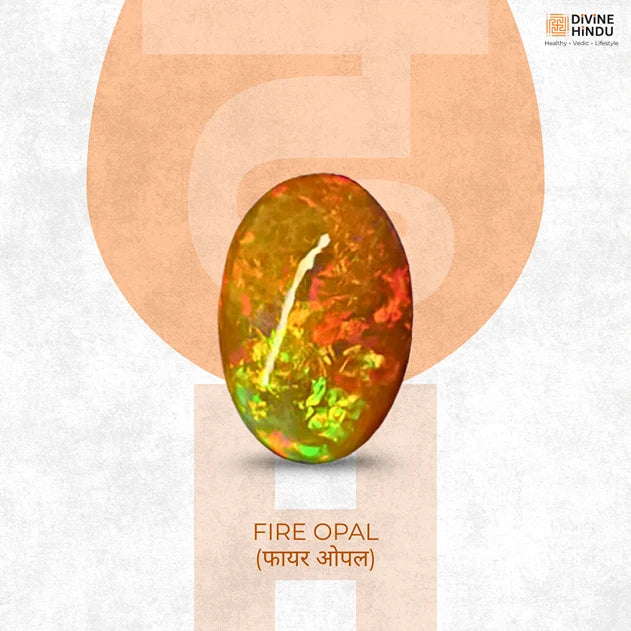
Opal is a natural gemstone of hydrated silica, known for its flashing play-of-colour. Fire opal is the variety with a yellow, orange or red body colour. In jyotish practice today, opal is commonly given as an upratna (substitute) for Heera (diamond) and is associated with Shukra (Venus). Astrologers advise it only after a chart reading.
The Divine Hindu App is here.
Chat with astrologers, generate your Kundli, book temple Puja and Chadhava, and check today's Panchang — all in one app.
Opal gemstone at a glance
| Detail | Opal |
|---|---|
| Material | Hydrated silica, SiO₂·nH₂O |
| Water | About 3–21%; gem opal often 6–10% |
| Hardness | About 5.5–6.5 Mohs (GIA: 5–6.5) |
| Types | Precious, common, fire opal |
| Graha (tradition) | Shukra (Venus) |
| Role (tradition) | Upratna for Heera |
The name is often traced to the Sanskrit upala, "precious stone", though its origin is uncertain.
Precious opal, fire opal and play-of-colour
Opal forms when silica-rich water fills cracks and cavities in rock, then slowly dries. Gem opal is largely amorphous, not crystalline, and holds water within its structure.
In precious opal, tiny silica spheres sit in an orderly grid. Light diffracts between them and splits into rainbow flashes, called play-of-colour. Common opal lacks this order and shows no play-of-colour.
Fire opal is transparent to translucent, with a yellow, orange or red body colour. The "fire" refers to this body colour, not to flashes. Many fire opals show no play-of-colour at all. The trade also calls it Mexican opal, and Querétaro in Mexico is known for it. GIA notes that about 90% of the world's opal comes from Australia; Ethiopia and Brazil are other important sources.
Treatments, doublets and triplets
Not every opal is a solid, untreated stone. None of these forms is wrong in itself, but each should be disclosed.
- Impregnation: oil, wax, resin or plastic improves the look or hides fine cracks.
- Smoke or sugar-acid treatment: carbon is deposited in porous opal to darken its body colour.
- Doublet: a thin slice of opal glued to a dark backing.
- Triplet: a doublet sealed under a clear quartz or glass dome.
- Synthetic opal: grown in a laboratory, not formed in the earth.
- Imitation: glass or plastic made to look like opal.
Opal in Vedic tradition: Shukra and Heera
Opal is not one of the nine navaratna. In jyotish practice today it is commonly given as an upratna for Heera, the diamond of Shukra (Venus). Zircon and white sapphire are the other substitutes often named. Our upratna guide and Heera (diamond) guide explain the pairing.
Lists of substitutes differ between texts, regions and astrologers, so treat the pairing as tradition, not a fixed rule.
Who traditionally considers opal (opal kaun pehne)
In tradition, an astrologer may suggest opal after a chart reading in these cases:
- Vrishabha (Taurus) or Tula (Libra) lagna or rashi, the two signs Shukra rules.
- A running Shukra mahadasha or antardasha, where Shukra is well placed.
- Makara or Kumbha lagna, where many astrologers treat Shukra as a yogakaraka.
- When Heera is advised but a natural diamond of the advised size is not practical.
As with Heera, opal is worn only if Shukra is favourable in your chart. For your sign's year ahead, see Vrishabha Rashi 2027 and Tula Rashi 2027.
How opal is traditionally worn
These customs are cited often, but families and astrologers differ. Follow the instructions given with your chart.
- Metal: silver is common; some use white gold or platinum.
- Finger: the middle or little finger is named often; some families use the ring finger.
- Day: Friday morning, often in Shukla Paksha.
- Mantra: "Om Shum Shukraya Namah" or the beej mantra "Om Draam Dreem Draum Sah Shukraya Namah", usually 108 times.
- Purification: a brief dip in raw milk or Ganga jal, then a rinse. Keep it short, as opal can be porous and doublets use glue.
See which finger to wear which gemstone for the customs of all nine grahas.
Opal weight in ratti and carat
Astrologers usually give weight in ratti, while a lab report gives carats. A carat is exactly 200 mg, but the ratti has no single fixed value. Sellers commonly use 180 mg or 182.25 mg. Our ratti to carat guide explains why.
| Ratti | Approx. carat (180–182.25 mg ratti) |
|---|---|
| 4 | 3.60–3.65 |
| 5 | 4.50–4.56 |
| 6 | 5.40–5.47 |
| 7 | 6.30–6.38 |
| 8 | 7.20–7.29 |
| 9 | 8.10–8.20 |
| 10 | 9.00–9.11 |
These are conversions only, not a store standard. Ask for the stone's actual weight in carats. In tradition, an upratna is often worn heavier than the primary stone, and the astrologer sets the weight.
Caring for opal
- Opal is softer than many gems. Diamond, sapphire, ruby and emerald can scratch it, so store it alone in a soft pouch.
- Keep it away from high heat, strong sunlight, sudden temperature changes and household chemicals. Moisture loss can cause crazing, a web of fine cracks.
- Clean it with warm, soapy water and a soft cloth. Avoid ultrasonic and steam cleaners, and do not soak a doublet or triplet.
How to check what you are buying
A report from a gemmological laboratory describes one stone. It typically states:
- Identification: natural opal, synthetic opal or an imitation.
- Whether the stone is assembled, as a doublet or triplet.
- Any treatment detected, such as impregnation or smoke treatment.
- Weight in carats, dimensions in millimetres, and a report number to check with the lab.
A report describes the material; it does not promise any result. Read how to verify a gemstone lab report for the red flags to watch.
Opal at Divine Hindu
We stock a Natural Gemstone Fire Opal with warm orange, red and golden hues. It is sold loose by weight, in options from 4 to 10 ratti. The pendant, brooch or ring setting is arranged separately. Contact the team before ordering if you need the exact weight and dimensions.
Browse other natural stones in the Gemstones collection. If you are unsure whether opal suits your chart, the Gemstone Recommendation Report suggests a stone with its weight, metal, finger and day.
Frequently asked questions
Which planet is opal associated with?
In jyotish practice today, opal is associated with Shukra (Venus). It is commonly given as an upratna, or substitute, for Heera (diamond), alongside zircon and white sapphire. Lists of substitutes differ between texts, regions and astrologers, so follow your own astrologer's guidance.
Opal kaun pehne? Who traditionally wears opal?
In tradition, astrologers consider opal for Vrishabha or Tula lagna or rashi, during a Shukra mahadasha, and for some Makara or Kumbha lagnas. It is suggested only when Shukra is favourable in the chart. As with Heera, a chart reading comes first.
On which finger and day is opal worn?
Commonly cited customs are a silver setting worn on a Friday morning, often in Shukla Paksha. The middle or little finger is named often, and some families use the ring finger. Many chant Om Shum Shukraya Namah 108 times. Customs differ by family and astrologer.
Is fire opal the same as opal?
Fire opal is a variety of opal. It is transparent to translucent, with a yellow, orange or red body colour, and the word fire refers to that colour. Many fire opals show no play-of-colour, the rainbow flashes of precious opal. In tradition it is also given as a substitute for Heera.
How many ratti of opal should I wear?
There is no single figure; the astrologer sets the weight from your chart. In tradition, a substitute stone is often worn heavier than the primary stone. Because the ratti has more than one value in use, ask for the stone's actual weight in carats before you buy.
How can I tell if an opal is natural?
A report from a gemmological laboratory states whether a stone is natural opal, synthetic opal or an imitation. It also notes assembled stones, such as doublets and triplets, and any treatment it detects, such as impregnation. Check the report number with the issuing lab.
Explore natural stones in the Gemstones collection.
Gemstones are worn in faith and tradition; no outcome is promised. Please consult your astrologer before wearing one.


