 கோசாலை / நன்கொடை

Rudraksha for Sade Sati 2027: Rashi-Wise Guide to 7 Mukhi and 14 Mukhi for Every Shani Phase
வெளியிடப்பட்டது · புதுப்பிக்கப்பட்டது
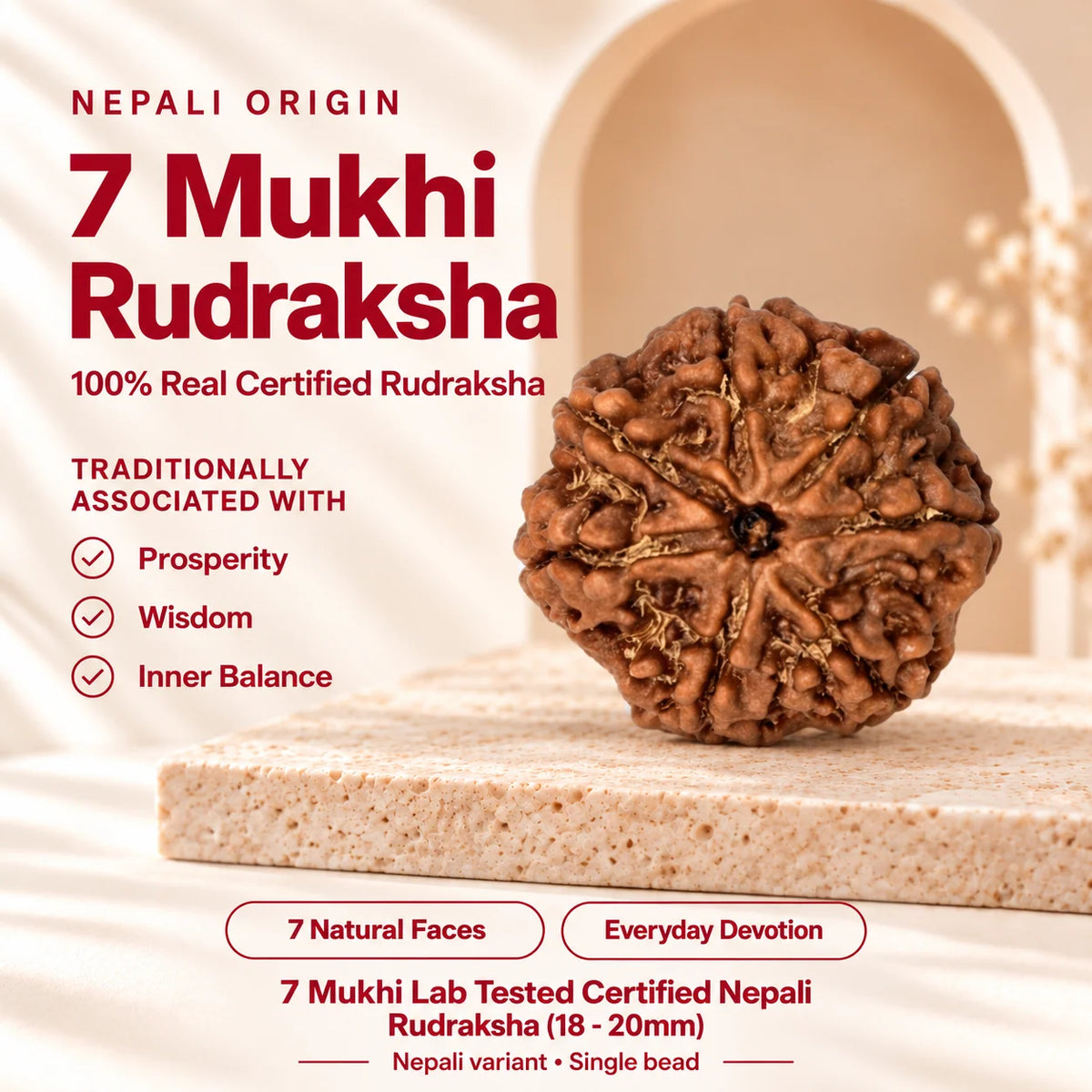
In 2027 Sade Sati touches Kumbha, Meena, Mesha and, from 3 Jun, Vrishabha, while Shani Dhaiya touches Simha, Dhanu, Kanya and Makara. The traditional Shani beads are the 7 mukhi (Mahalakshmi, Shani) worn through every phase and the 14 mukhi (Hanuman, Shani) added in the peak, both first worn on a Saturday with the Shani mantra.
The Divine Hindu App is here.
Chat with astrologers, generate your Kundli, book temple Puja and Chadhava, and check today's Panchang — all in one app.
Sade Sati and Shani Dhaiya in 2027: who is affected and when
Shani (Saturn) is in Meena (Pisces) from 1 Jan to 2 Jun 2027, enters Mesha (Aries), its debilitation sign, on 3 Jun, turns retrograde on 9 Aug, re-enters Meena on 20 Oct and turns direct on 24 Dec. It settles into Mesha on 23 Feb 2028. Because Sade Sati is counted from the Moon sign (chandra rashi), the short Mesha visit changes the map twice in one year. The full transit reading is in Shani Gochar 2027 and the phase-by-phase detail in Sade Sati and Shani Dhaiya 2027.
| Moon sign | 1 Jan – 2 Jun | 3 Jun – 20 Oct | 20 Oct – 31 Dec |
|---|---|---|---|
| Kumbha (Aquarius) | Sade Sati, final phase | Pause | Final phase returns (ends 23 Feb 2028) |
| Meena (Pisces) | Sade Sati, peak (Janma Shani) | Final phase | Peak again |
| Mesha (Aries) | Sade Sati, first phase | Peak (Janma Shani) | First phase again |
| Vrishabha (Taurus) | Not affected | Sade Sati begins (first phase) | Pause (resumes 23 Feb 2028) |
| Simha (Leo) | Ashtama Shani (Dhaiya) | Pause | Dhaiya returns |
| Kanya (Virgo) | Not affected | Ashtama Shani (Dhaiya) | Pause (resumes 2028) |
| Dhanu (Sagittarius) | Kantaka Shani (Dhaiya) | Pause | Dhaiya returns |
| Makara (Capricorn) | Not affected | Kantaka Shani (Dhaiya) | Pause (resumes 2028) |
| Mithuna, Karka, Tula, Vrischika | Not affected | Not affected | Not affected |
These are transit-based tendencies for the Moon sign; the personal chart (lagna, running dasha) decides how any phase is actually felt. If unsure of your rashi, see how to find your Moon sign.
Why 7 mukhi and 14 mukhi are the Shani beads
In the most widely followed deity and graha chart, the 7 mukhi Rudraksha is associated with Mahalakshmi and ruled by Shani, and the 14 mukhi, the Deva Mani, is associated with Hanuman and also placed under Shani. Traditions differ on a few beads; the full mapping is on the ruling planet and deity chart.
The 7 mukhi is worn for the whole length of a Shani transit; the 14 mukhi is the stronger addition reserved for the peak phase or a chart in which Shani is heavily placed, and Hanuman worship is itself a classical Shani upay. Background on each bead is in 7 mukhi Rudraksha and Shani and 14 mukhi Rudraksha.
Rashi-wise Rudraksha for Sade Sati and Dhaiya 2027
The combination column follows the pairings described in Rudraksha combination for Sade Sati.
| Rashi | 2027 phase | Primary bead | Addition | Combination | Day |
|---|---|---|---|---|---|
| Kumbha | Final phase till 2 Jun and from 20 Oct | 7 mukhi | 14 mukhi through the final phase | 7 and 14 mukhi together | Saturday |
| Meena | Peak till 2 Jun and from 20 Oct; final phase between | 7 mukhi | 14 mukhi in both peak windows | 7 and 14 mukhi; 5 mukhi for Guru, the rashi lord | Saturday |
| Mesha | First phase; peak 3 Jun – 20 Oct | 7 mukhi | 14 mukhi from 3 Jun | 7 and 14 mukhi; 3 mukhi for Mangal, the rashi lord | Saturday |
| Vrishabha | Begins 3 Jun, pauses 20 Oct | 7 mukhi | Usually none in the first phase | 7 mukhi alone, or with 6 mukhi for Shukra | Saturday |
| Simha | Ashtama Shani till 2 Jun and from 20 Oct | 7 mukhi | 14 mukhi if the chart calls for it | 7 mukhi with 1 or 12 mukhi for Surya | Saturday |
| Kanya | Ashtama Shani 3 Jun – 20 Oct | 7 mukhi | Usually none | 7 mukhi with 4 mukhi for Budh | Saturday |
| Dhanu | Kantaka Shani till 2 Jun and from 20 Oct | 7 mukhi | 14 mukhi if the chart calls for it | 7 mukhi with 5 mukhi for Guru | Saturday |
| Makara | Kantaka Shani 3 Jun – 20 Oct | 7 mukhi (also the rashi-lord bead) | 14 mukhi 3 Jun – 20 Oct | 7 and 14 mukhi; 8 mukhi for Rahu, which sits in Makara all year | Saturday |
A rashi-lord bead is strung with the Shani bead on the same thread. All twelve signs, including the four not under Shani this year, are in Rudraksha for 2027 by rashi.
The pause and the resume, explained plainly
The Mesha visit is only four and a half months long, so some signs get a pause rather than an ending. Kumbha's Sade Sati lifts on 3 Jun 2027, returns on 20 Oct when Shani slips back into Meena, and ends for good on 23 Feb 2028.
Vrishabha's Sade Sati begins on 3 Jun, pauses on 20 Oct and resumes on 23 Feb 2028 for the long run. Simha and Dhanu have the same pattern in Dhaiya: relief from 3 Jun, return from 20 Oct. Kanya and Makara enter Dhaiya only for the Mesha window and are clear again from 20 Oct until 2028.
The bead is therefore not removed on 3 Jun: a 7 mukhi worn for a Shani transit is kept through the pause, because the transit returns within months. The 14 mukhi, the peak-phase addition, follows the calendar more closely: Mesha adds it from 3 Jun, Meena wears it till 2 Jun and again from 20 Oct.
How to wear the Shani Rudraksha: Saturday procedure
By tradition the first wearing of a 7 or 14 mukhi falls on a Saturday, Shani's day. The bead is washed in clean water or raw milk and rinsed, placed before a Shiva or Shani image, and the Shani mantra, Om Sham Shanaishcharaya Namah, is recited 108 times before the bead is put on; the 7 mukhi has its own beej mantra as well, listed on the beej mantra chart.
It is worn on a black or red thread, or in a silver cap, close to the body. The mantra itself, with the Shani shanti and beej forms, is explained in Shani mantra for Sade Sati.
Shani Jayanti falls on 4 Jun 2027, the day after Shani enters Mesha, and is the traditional day of the year for Shani puja, tila daan and beginning a Shani upay; many devotees choose it, or the first Saturday after it, for the first wearing. Many also avoid a first wearing during the retrograde window of 9 Aug – 24 Dec, though a bead already on the body is not removed for it. Daily customs are in Rudraksha wearing rules for men and Rudraksha wearing rules for women.
What the Rudraksha is not
A Rudraksha is worn as a matter of faith and tradition; it does not replace a chart reading, and the Moon-sign table cannot see the lagna, the dasha or Shani's place in the birth chart. A Sade Sati report reads those together with the 2027 and 2028 dates.
The bead is also not a gemstone: neelam (blue sapphire) is Shani's stone, but it is worn only when Shani favours the lagna, confirmed by an astrologer, and a Sade Sati native with Shani ruling a difficult house is traditionally advised against it; see Neelam and Shani Gochar 2027. Rudraksha carries no such restriction.
Other Shani upay that sit alongside the bead
Tradition places the Rudraksha within a wider set of Saturday observances: Hanuman Chalisa and Shani Chalisa, mustard-oil lamp under a peepal tree, black sesame, black urad and iron daan, feeding crows and the Shani Kavach path. These are gathered in Shani Sade Sati remedies and Shani Kavach path. Sade Sati is often confused with Shani dosha in the birth chart; the difference is in Shani dosha vs Sade Sati.
Frequently Asked Questions
Which Rudraksha is worn for Sade Sati in 2027?
The 7 mukhi Rudraksha, associated with Mahalakshmi and Shani, is the traditional bead for every phase of Sade Sati and Dhaiya. The 14 mukhi, associated with Hanuman and Shani, is added in the peak phase.
Which rashis are under Sade Sati in 2027?
Kumbha (final phase), Meena (peak) and Mesha (first phase) from 1 Jan, with Vrishabha beginning on 3 Jun 2027. Simha, Dhanu, Kanya and Makara pass through Shani Dhaiya at different points of the year.
When does Sade Sati end for Kumbha rashi?
Kumbha's Sade Sati pauses on 3 Jun 2027 when Shani enters Mesha, returns on 20 Oct 2027 when Shani re-enters Meena, and ends for good on 23 Feb 2028.
Should the 7 mukhi be removed when Sade Sati pauses on 3 Jun?
By tradition, no. The transit returns on 20 Oct, so the bead is kept through the pause; it is the 14 mukhi, the peak-phase addition, that is timed to the calendar.
Can 7 mukhi and 14 mukhi be worn together?
Yes. In tradition they are strung on one thread as the standard Shani combination, and the rashi-lord bead, such as 5 mukhi for Meena or 3 mukhi for Mesha, can be added to the same thread.
On which day and with which mantra is the Shani Rudraksha worn?
Saturday, after washing the bead and reciting Om Sham Shanaishcharaya Namah 108 times. Shani Jayanti on 4 Jun 2027 is a traditional day to begin.
Is neelam a better Sade Sati remedy than Rudraksha?
Not for most people. Neelam is worn only when Shani favours the lagna, confirmed by an astrologer, while Rudraksha carries no such restriction and is the first remedy tradition reaches for.
Get Your Shani Rudraksha for 2027
Lab-certified Nepali beads are in the Nepali Rudraksha collection; the Shani beads are the 7 Mukhi Rudraksha and the 14 Mukhi Rudraksha, with sizes and pendants in the 7 mukhi collection. If you would like the bead chosen against your own chart, the Rudraksha recommendation report reads the lagna, dasha and the 2027 Shani dates together.
This article describes traditional Vedic astrology and is intended for guidance and self-reflection only; it does not guarantee any outcome. Spiritual products are worn as a matter of faith and tradition and are not a medical treatment.


