 ಗೋಶಾಲೆ / ದೇಣಿಗೆ

Nepali Rudraksha Buying Guide 2027: How to Choose an Original Bead, Mukhi, Size and Certificate
ಪ್ರಕಟಿಸಲಾಗಿದೆ · ನವೀಕರಿಸಲಾಗಿದೆ
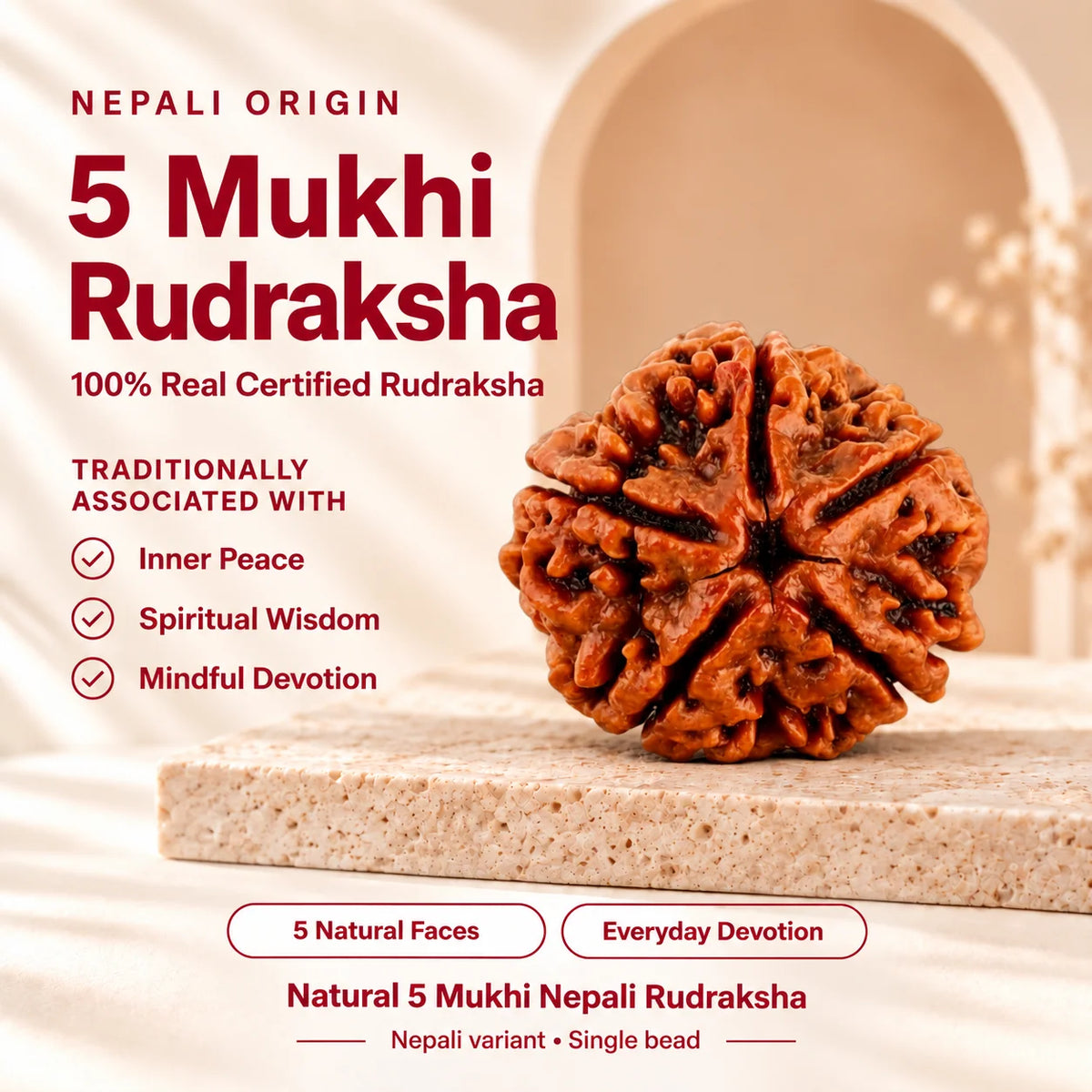
An original Nepali Rudraksha is a seed of Elaeocarpus ganitrus from Nepal's eastern hills, larger and more deeply lined than the Indonesian bead. Before buying online, check a lab certificate with an X-ray mukhi count, a natural untreated surface, the size in millimetres and lines running pole to pole. In 2027 the Shani and Guru transits guide the mukhi.
The Divine Hindu App is here.
Chat with astrologers, generate your Kundli, book temple Puja and Chadhava, and check today's Panchang — all in one app.
What makes a Rudraksha "Nepali"
Rudraksha is the dried seed of Elaeocarpus ganitrus, a broad-leaved tree that grows along the lower Himalaya. The beads sold as Nepali come from the eastern hills of Nepal, where the tree grows at altitude and the seed matures slowly.
That slow growth is the reason the Nepali bead is prized: it is larger, its surface is deeply carved by nature, and the mukhi (the lines that run from one pole of the seed to the other) are clear enough to count with the naked eye. A 5 mukhi Nepali bead commonly measures 14 to 30 mm across; the same mukhi from Indonesia is usually a fraction of that size, with faint lines and a smoother skin.
In tradition the bead is Shiva's own; the Puranic lists describe each mukhi as the face of a particular deity, and later tradition pairs each with a graha. The texts describe the mukhi, not the size; size is a matter of rarity and of how the bead will be worn.
Nepali vs Indonesian: the short comparison
Both beads are the same species and both are worn in tradition. The differences are physical, and they decide how the bead is used. The full comparison, with photographs, is in Nepali vs Indonesian Rudraksha: which is better; the summary is below.
| Feature | Nepali bead | Indonesian (Java) bead |
|---|---|---|
| Typical size (5 mukhi) | 14 to 30 mm | 6 to 12 mm |
| Mukhi lines | Deep, clear, countable by eye | Faint, often need magnification |
| Surface | Rough, pronounced natural ridges | Smooth, small ridges |
| Common use | Single-bead pendant, kavach, collector pieces | 108-bead japa mala, bracelets, pocket beads |
| Higher mukhi (8 to 14) | Rarer, each bead X-rayed | More available, smaller |
Which mukhi to choose: the most widely followed chart
Each mukhi is traditionally associated with a deity and a graha, and the mukhi is chosen from the graha a person wishes to honour or pacify. Traditions differ on a few entries, so the table below follows the chart most widely used in India and on this site; the full version with mantras is in the ruling planet and deity chart for 1 to 14 mukhi, and each mukhi has its own page in the Rudraksha mukhi guide 1 to 14.
| Mukhi | Deity (tradition) | Graha | Commonly chosen by |
|---|---|---|---|
| 1 | Shiva | Surya | Shiva devotees, seekers of detachment |
| 2 | Ardhanarishvara | Chandra | Couples, those seeking harmony at home |
| 3 | Agni | Mangal | Those with a Mangal-related reading |
| 4 | Brahma | Budh | Students, speakers, writers |
| 5 | Kalagni Rudra | Guru | Everyone; the first bead most people wear |
| 6 | Kartikeya | Shukra | Those seeking focus and will |
| 7 | Mahalakshmi | Shani | Sade Sati and Dhaiya natives |
Higher mukhi beads, 8 to 14, are rarer and are chosen on a specific reading more often than by habit.
| Mukhi | Deity (tradition) | Graha | Commonly chosen by |
|---|---|---|---|
| 8 | Ganesha | Rahu | Those with a Rahu-related reading |
| 9 | Durga | Ketu | Those with a Ketu-related reading |
| 10 | Vishnu | All grahas | General protection in tradition |
| 11 | Hanuman | Mangal and Shani (varies) | Devotees of Hanuman |
| 12 | Surya | Surya | Leaders, administrators |
| 13 | Kamadeva | Shukra | Artists, those seeking charm |
| 14 | Hanuman | Shani | Sade Sati natives; the rarest common bead |
What 2027 changes: Shani, Guru and Rahu-Ketu
The mukhi that people ask for in a given year follows the transits. Three movements matter in 2027. Shani (Saturn) enters Mesha (Aries) on 3 Jun, turns retrograde on 9 Aug and returns to Meena (Pisces) on 20 Oct, which starts Sade Sati for Vrishabha (Taurus), brings the peak to Mesha and pauses it for Kumbha (Aquarius); this is why the 7 mukhi and 14 mukhi are the beads of the year, and the rashi-wise reading is in Rudraksha for Sade Sati 2027.
Guru (Jupiter) is exalted in Karka (Cancer) from 25 Jan to 25 Jun, a window in which many people begin a 5 mukhi, Guru's bead. Rahu in Makara (Capricorn) and Ketu in Karka stay all year, which keeps the 8 mukhi and 9 mukhi in demand. The sign-by-sign table is in Rudraksha for 2027 by rashi.
| 2027 transit | Dates | Mukhi traditionally linked |
|---|---|---|
| Shani in Mesha (debilitated) | 3 Jun – 20 Oct (retrograde from 9 Aug) | 7 mukhi, 14 mukhi |
| Guru exalted in Karka | 25 Jan – 25 Jun (direct from 13 Apr) | 5 mukhi |
| Rahu in Makara, Ketu in Karka | All of 2027 (till 24 Jun 2028) | 8 mukhi, 9 mukhi |
| Mangal retrograde in Simha and Karka | 10 Jan – 1 Apr | 3 mukhi |
Before you buy: the checklist
A Nepali bead is bought on evidence, not on a photograph. Run through the points below before paying.
| Check | What to look for | Why it matters |
|---|---|---|
| Lab certificate | Issued by a laboratory, with an X-ray or CT image and a report number | The X-ray counts the internal seed chambers, which is the only reliable mukhi count |
| Natural, untreated | Certificate states no carving, filling, dye or polish | Carved or glued lines are the commonest fake |
| Size in mm | Stated as a measurement, not as "large" or "big" | Decides whether the bead suits a pendant, a mala or a shelf |
| Mukhi lines | Run unbroken from pole to pole, with a natural groove | Added lines stop short or sit on the surface |
| Surface | Rough, with no sanded or filled patches, no smell of resin | Natural seed has no coating |
| Capping and thread | Silver or gold cap; red or black thread; cap does not cover a line | A cap that hides a pole can hide a glued joint |
| Origin on the certificate | "Nepal" stated, not "Himalayan" | Vague wording often means an Indonesian bead |
Divine Hindu Rudraksha is lab-certified; the product page states the report that accompanies each bead. How to read that report line by line is in Rudraksha lab certificate and X-ray report explained.
Size: pendant, mala or collector
Size is the part of the purchase most buyers get wrong. A single-bead pendant for daily wear sits comfortably at 16 to 22 mm; above about 24 mm a bead is heavy on a thread and is usually set in a kavach or kept on the altar.
A 108-bead mala needs beads of one size, and the smaller the bead the shorter the mala; the full table is in Nepali Rudraksha size chart, and the mala-length arithmetic in Rudraksha bead size and mala length. Remember that in tradition a bigger bead is not a more powerful bead; it is a rarer one.
The 1 mukhi: an honest note
The round 1 mukhi from Nepal is extremely rare, and most beads sold as 1 mukhi are either the Indonesian half-moon (kaju-dana) form or a carved bead. The half-moon is a natural bead and is worn in tradition; the carved one is not a Rudraksha at all. If a seller shows a round Nepali 1 mukhi, ask for the X-ray and the laboratory's report number, and read 1 mukhi round Nepali vs Indonesian half-moon before deciding.
What drives the cost of a Nepali bead
Four things set the cost of a Nepali Rudraksha: the mukhi (higher mukhi are rarer in nature), the size, the clarity of the lines, and the certification. A 5 mukhi is the most common seed the tree produces; a 14 mukhi or a Gauri Shankar is found in a small fraction of a harvest. The explanation is in what drives the cost of a Rudraksha. Cost is not a measure of merit in tradition; the 5 mukhi is the bead most householders have always worn.
Wearing and energising, briefly
A new bead is traditionally washed in water or raw milk, placed before a Shiva image, and worn on a Monday after reciting Om Namah Shivaya and the beej mantra of that mukhi; the mantras are in the beej mantra chart for every mukhi. Daily customs (bathing, sleeping, food) are set out in Rudraksha wearing rules for men and Rudraksha wearing rules for women; they are matters of family custom and vary between regions.
Frequently Asked Questions
How do I know a Rudraksha is Nepali and not Indonesian?
By size, line depth and the certificate. A Nepali 5 mukhi is usually 14 to 30 mm with deep, countable lines; an Indonesian bead is smaller and smoother. The certificate should state Nepal as origin.
Which Rudraksha should a beginner buy?
The 5 mukhi, traditionally associated with Guru and Kalagni Rudra, is the bead most people wear first. It is the most available seed from the tree and is worn without any chart reading.
Which Rudraksha is in demand in 2027?
The 7 mukhi and 14 mukhi, traditionally associated with Shani, because Shani enters Mesha on 3 Jun 2027 and Sade Sati touches Kumbha, Meena, Mesha and Vrishabha during the year.
Is a bigger Rudraksha more powerful?
Not in tradition. The texts describe the mukhi, not the size. A bigger bead is rarer and is chosen for a kavach or for the altar; a smaller bead is chosen for a mala.
What should a Rudraksha lab certificate show?
Origin, mukhi count established by X-ray or CT of the internal seed chambers, a natural and untreated statement, weight, size in millimetres and a report number that can be checked with the issuing laboratory.
Can I buy a round 1 mukhi Nepali Rudraksha online?
Very rarely. Most 1 mukhi beads sold are the Indonesian half-moon form, which is natural and worn in tradition. Any round Nepali 1 mukhi should come with an X-ray and a report number.
Which day is a new Rudraksha worn?
Monday by most family customs, after washing the bead and reciting Om Namah Shivaya and the mukhi's beej mantra. Shravan and Maha Shivaratri (6 Mar 2027) are also chosen.
Choose Your Nepali Rudraksha for 2027
Begin with the 5 Mukhi Nepali Rudraksha, the Kantara natural 5 mukhi or the 5 mukhi Nepali mala, and browse every bead in the Nepali Rudraksha collection and the complete Rudraksha range. If you would rather have the mukhi chosen from your chart and the 2027 transits, the Rudraksha recommendation report names the bead, the day and the mantra.
This article describes traditional Vedic astrology and is intended for guidance and self-reflection only; it does not guarantee any outcome. Spiritual products are worn as a matter of faith and tradition and are not a medical treatment.


