 ಗೋಶಾಲೆ / ದೇಣಿಗೆ

Nepali Rudraksha Size Chart (mm): Which Size to Wear and Which to Keep as a Collector Bead
ಪ್ರಕಟಿಸಲಾಗಿದೆ · ನವೀಕರಿಸಲಾಗಿದೆ
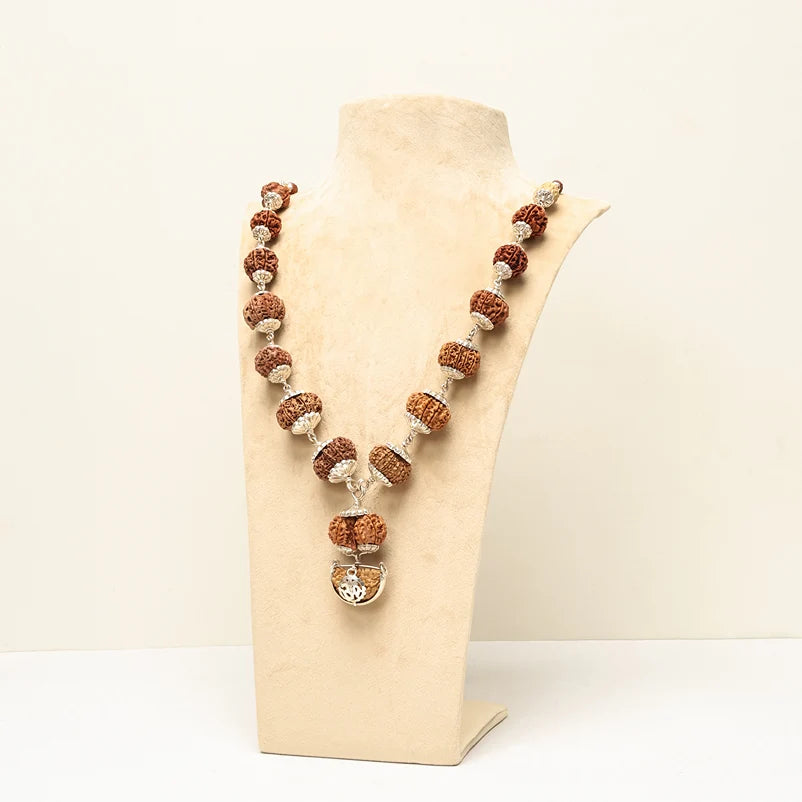
Nepali Rudraksha beads typically measure 14 to 30 mm across for a 5 mukhi, against 6 to 10 mm for an Indonesian bead. A daily-wear pendant sits at 16 to 22 mm, a Nepali kantha mala uses 14 to 20 mm beads, and 24 mm and above is collector or puja-room size. Bigger is not more powerful; it is rarer.
The Divine Hindu App is here.
Chat with astrologers, generate your Kundli, book temple Puja and Chadhava, and check today's Panchang — all in one app.
Nepali Rudraksha size chart by use (mm)
The ranges below are typical for natural Nepali beads of Elaeocarpus ganitrus from the eastern hills of Nepal; individual beads vary, and higher-mukhi beads run larger by nature because the seed has more chambers.
| Use | Typical Nepali size | Mukhi commonly chosen | Notes |
|---|---|---|---|
| Daily-wear pendant (single bead) | 16–22 mm | 5, 7, 8, 9, 14 mukhi | Silver cap or thread; comfortable under a shirt |
| Bracelet | 10–14 mm | Small 5 mukhi | Smaller Nepali beads are scarce; many bracelets use Indonesian beads |
| Japa mala, 108+1 beads | 6–10 mm (Indonesian) or 14–20 mm (Nepali) | 5 mukhi | Nepali 108-bead malas are long and heavy; see the length table below |
| Kantha or siddha mala (1 to 14 mukhi set) | 18–26 mm per bead | One bead of each mukhi | Worn on festival days or kept in the puja room by many families |
| Higher-mukhi wearing bead (8 to 14 mukhi) | 20–28 mm | 8, 9, 10, 11, 12, 13, 14 mukhi | Rarely found below 18 mm in Nepali origin |
| Collector or puja-room bead | 24–30 mm and above | Large 5 mukhi, rare mukhi, Gauri Shankar | Kept on the altar, carried for darshan, or worn on occasion |
The deity and graha of each bead, by the most widely followed chart, are in the Rudraksha mukhi guide 1 to 14.
How Rudraksha size is measured
Sellers and laboratories measure a bead with calipers across its widest point, at right angles to the hole. That figure is the diameter quoted on a listing and on a lab certificate. Hole-to-hole height is usually a little less, so a bead described as 22 mm may be about 20 mm tall; when comparing listings, check that both quote the same dimension. The lab certificate and X-ray report records diameter and weight in grams along with the mukhi count.
Why Nepali beads are larger than Indonesian beads
Both origins are Elaeocarpus ganitrus, but the trees of Nepal's eastern hills grow at altitude in a cooler, wetter climate, and the fruit matures slowly into a bigger seed with deeper, clearer mukhi lines. Indonesian (Java) trees produce a smaller seed, usually 6 to 12 mm, with finer, shallower lines.
Neither origin is treated as more sacred in scripture; tradition reads the mukhi count, not the country, as the bead's identity. The two origins are compared in Nepali vs Indonesian Rudraksha, and the practical checklist for choosing between them is in the Nepali Rudraksha buying guide 2027.
Bead count and mala length: how size changes the mala
A mala is described by its bead count, 27+1, 54+1 or 108+1, the extra bead being the sumeru (guru bead). Strung length depends almost entirely on bead size. The lengths below are approximate, measured as the loop before the tassel, allowing a little for knots.
| Bead count | Bead size | Approximate strung length | How it is usually worn or used |
|---|---|---|---|
| 27+1 | 8 mm | approximately 24–26 cm | Wrist mala, wrapped twice or thrice; short japa |
| 54+1 | 8 mm | approximately 47–50 cm | Short neck mala or japa mala |
| 108+1 | 6 mm | approximately 70–75 cm | Light japa mala; sits at the chest |
| 108+1 | 8 mm | approximately 92–98 cm | The standard japa and wearing mala |
| 108+1 | 10 mm | approximately 115–120 cm | Long wearing mala; often doubled |
| 108+1 | 16 mm Nepali | approximately 180–190 cm | Very long and heavy; usually worn doubled or kept for puja |
The detailed length arithmetic and regional kantha counts are worked through in Rudraksha bead size, mala length and bead count. For daily japa, 6 to 8 mm beads serve most people; for a Nepali mala worn on the body, 32+1 or 54+1 stays wearable. The 5 mukhi Nepali Rudraksha mala follows this principle.
Bigger is not more powerful; it is rarer
No classical text grades Rudraksha by millimetre. The classical texts describe the bead by its mukhi, its deity and its condition; the size remark commonly cited from the texts praises a bead the size of an amla without making the larger bead a stronger one. In tradition a sound 14 mm 5 mukhi and a sound 28 mm 5 mukhi are the same bead, with the same mantra and the same deity, Kalagni Rudra, by the most widely followed chart.
What changes with size is rarity. A tree gives the bulk of its harvest in the small and medium range; beads above 24 mm are a small fraction of a season, and beads above 28 mm with clean, unbroken lines are fewer still.
Cost follows that scarcity, so a large bead costs more than a small one of the same mukhi even when both are natural and certified. The other factors, line clarity, surface and origin, are set out in what drives the cost of a Rudraksha. Knowing this prevents two mistakes: paying for size you will not wear, and doubting a small bead that is sound.
Collector bead or wearing bead: how to decide
Ask three questions. First, where will the bead live. A bead worn under the shirt every day should be light enough to forget; at 16 to 22 mm a Nepali 5 mukhi weighs a few grams and sits comfortably on a thread or chain. Above 26 mm it is noticeable on the neck through a working day, and most buyers of that size keep it in the puja room or wear it on Mondays and festival days.
Second, who will wear it. Children and elderly family members are usually given smaller, lighter beads; the customs are in Rudraksha for children. Many women prefer 14 to 18 mm beads or a bracelet, though there is no rule; see Rudraksha wearing rules for women.
Third, single bead or mala. A single higher-mukhi bead is a pendant, and at 20 to 26 mm the mukhi lines are deep enough to read with the naked eye.
A mala of 5 mukhi beads is chosen by bead count and comfort rather than by the size of any one bead; the Kantara natural 5 mukhi Rudraksha and the 5 mukhi Rudraksha are the single-bead options, and the 1 to 14 mukhi Rudraksha mala is the set worn as a kantha. Pendants are in the Rudraksha necklace collection and wrist sizes in the Rudraksha bracelet collection.
Size and the lab certificate
Every Divine Hindu Rudraksha is lab-certified, and the certificate carries the diameter in millimetres and the weight in grams beside the mukhi count read from the X-ray. Check them with your own calipers and a kitchen scale on arrival. A fraction of a millimetre either way is normal, since beads are not perfect spheres; a difference of several millimetres means the bead and the certificate do not belong together.
A note on 1 mukhi sizes
A round 1 mukhi of Nepali origin is extremely rare; most 1 mukhi beads sold in India are the Indonesian half-moon or kaju-dana form, typically 15 to 25 mm along the curve, a natural bead of a different shape. A large, perfectly round bead with a single deep line at a modest cost is almost always carved. The comparison of forms, and how each is verified, is in 1 mukhi round Nepali vs Indonesian half-moon.
Frequently Asked Questions
What is the normal size of a Nepali Rudraksha?
A natural Nepali 5 mukhi usually measures 14 to 30 mm across its widest point. Beads of 16 to 22 mm are the common daily-wear size, 14 to 20 mm are used in kantha malas, and 24 mm and above are generally collector or puja-room beads.
Is a bigger Rudraksha more powerful?
Not in tradition. The texts identify a bead by its mukhi, deity and soundness, not by its millimetre size. Larger beads are rarer, which is why they cost more, but a sound small bead carries the same mantra and deity as a large one of the same mukhi.
Which size Rudraksha is best for daily wear?
Most people find a 16 to 22 mm Nepali bead, or a 6 to 10 mm Indonesian bead on a mala, comfortable for daily wear. Above 26 mm the bead is noticeable on the neck through a working day and is more often kept for puja or worn on special days.
How is Rudraksha size measured?
With calipers across the widest point of the bead at right angles to the hole, which gives the diameter quoted on listings and lab certificates. Hole-to-hole height is usually a little less, so check that any two listings quote the same dimension.
How long is a 108-bead Rudraksha mala?
It depends on bead size. In 8 mm beads a 108+1 mala is approximately 92 to 98 cm around before the tassel; in 6 mm beads about 70 to 75 cm; in 16 mm Nepali beads it is approximately 180 to 190 cm and is usually worn doubled or kept for puja.
Why are Nepali Rudraksha bigger than Indonesian ones?
Both are Elaeocarpus ganitrus, but the Nepali trees grow at altitude in the cooler, wetter eastern hills and the seed matures larger with deeper mukhi lines. Indonesian seeds are typically 6 to 12 mm with finer, shallower lines.
Does the lab certificate mention the size?
Yes. A Rudraksha lab certificate records the diameter in millimetres and the weight in grams beside the mukhi count confirmed by X-ray, so you can check the bead you received against the one described.
Choose the Right Size for Your Purpose
Browse the Nepali Rudraksha collection with the chart in hand, or let the Rudraksha recommendation report settle both the mukhi and the form, single bead or mala, from your birth chart. For a wearing bead that stays comfortable all day, the Kantara natural 5 mukhi Rudraksha of Nepali origin is the usual starting point; for a kantha, the 5 mukhi Nepali Rudraksha mala.
This article describes traditional Vedic astrology and is intended for guidance and self-reflection only; it does not guarantee any outcome. Spiritual products are worn as a matter of faith and tradition and are not a medical treatment.


