 Cow Shelter/Donation

Citrine: Natural vs Heat-Treated Amethyst, Properties & Care
September 03, 2026
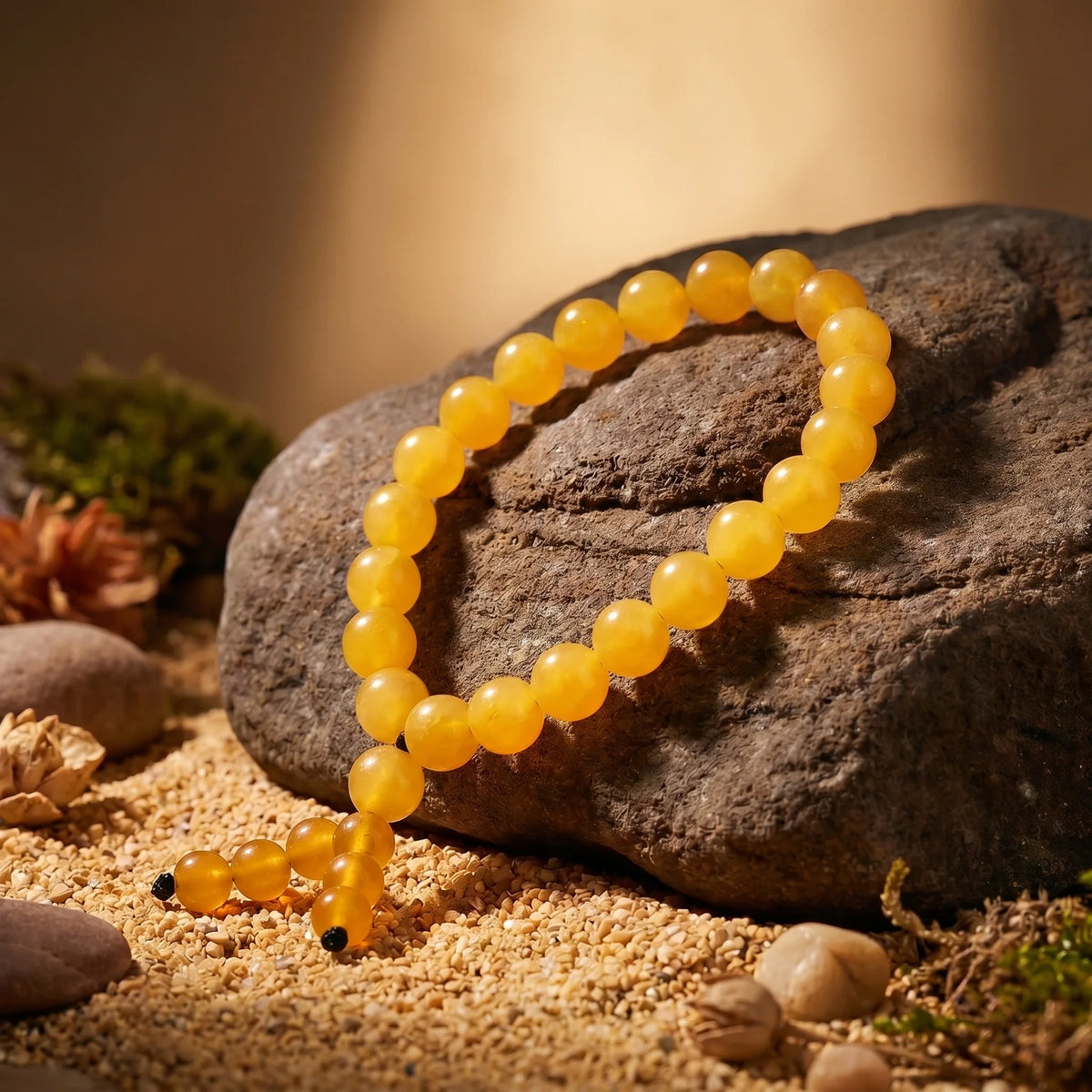
Citrine is the yellow-to-orange variety of quartz, coloured by traces of iron and rating 7 on the Mohs scale. The single most important thing to know before you buy any is this: natural citrine is genuinely uncommon, and the great majority of what is sold as citrine — in India and everywhere else — is amethyst that has been heated until the purple turns orange. That is not automatically fraud, and heated material is not worthless. But it should be disclosed, it changes what a fair price looks like, and once you know what to look for you can spot it in seconds. Citrine is water-safe but light-sensitive: prolonged sun will fade it.
What citrine actually is
Chemically it is silicon dioxide — quartz, the same mineral as clear quartz, rose quartz and amethyst. The yellow comes from traces of iron in the crystal structure. Colour runs from a pale lemon through honey and gold to a deep reddish-brown, and at 7 on the Mohs scale it is hard enough for a ring worn daily.
What makes it scarce is that the specific conditions needed to produce yellow iron colour centres in nature are less common than those that produce purple ones. Amethyst forms in enormous quantities. Natural citrine does not. Meanwhile the market wants citrine, and there is a straightforward way to bridge the gap.
The heat-treatment question
Heat amethyst to somewhere in the region of 470 to 560 degrees Celsius and the iron colour centres change state. The purple goes, and what is left is yellow, orange, or a reddish burnt-orange depending on the starting material and the temperature. Smoky quartz can be heated the same way to similar effect.

This has been done commercially for a very long time, and the overwhelming majority of citrine in the global market is produced this way. If you have ever seen those large, dramatic geodes with a grey rock exterior, a white or colourless base and vivid deep-orange points — the ones sold in every crystal shop in India — you have seen heat-treated amethyst. That form is an amethyst geode. Natural citrine does not generally occur as vivid orange cathedral geodes.
Is heated material fake? No. It is still quartz, and the colour is a permanent change to the stone itself rather than a dye sitting on the surface. It will not wash off or rub away. It is a treated natural stone, in the same category as heated ruby or sapphire, which the gem trade has accepted for centuries. What is not acceptable is selling it as untreated natural citrine at untreated prices without saying so.
How to tell them apart
| Check | Natural citrine | Heat-treated amethyst |
|---|---|---|
| Colour | Paler and smokier — lemon, straw, honey, gentle gold | More saturated — vivid orange, burnt orange, reddish-brown |
| Colour distribution | Fairly even and diffuse through the stone | Often concentrated at the crystal tip with a white or colourless base |
| Form it is sold in | Usually cut stones, small points, tumbles | Frequently large geodes, cathedrals and clusters |
| Base of a point or cluster | Colour carries reasonably far down | Sharp transition from orange tip to white base |
| Under magnification | Clean quartz features | Can show fine crazing or cloudiness from thermal stress |
| Availability and price | Uncommon; priced accordingly | Widely available, often at very low prices |
The base-of-the-point test is the fastest. Pick up any citrine cluster and look at where the crystals meet the matrix. If there is a clean line where deep orange becomes white, you are almost certainly holding heated amethyst, because that white zone is where the original amethyst was already pale.
The colour test is nearly as quick. Natural citrine tends toward the subtle end — people are often disappointed by how pale it is. If a stone is a vivid, almost artificial orange, that intensity usually came from a furnace.
Neither test is conclusive, and separating the two definitively is laboratory work — gemmologists look at dichroism and at the response to controlled conditions. At home, treat the two checks above as a strong indication, and beyond that rely on the seller telling you honestly.
The other substitutions
Two more things are sold as citrine and neither is quartz at all.
- Dyed or coated quartz. Clear quartz given a yellow coating or dye. It shows the usual dye tells — colour pooling in fractures, a darker ring around drill holes on beads, and an unnaturally uniform tone. Unlike heat treatment, this can wear off.
- Glass. Perfectly even colour, sometimes tiny round gas bubbles, mould seams on moulded pieces, and it warms up quickly in the hand where quartz stays cool for a moment. Glass sits at about 5.5 on the Mohs scale, so quartz will scratch it while it will not scratch quartz.
You will also see the trade term Madeira citrine for the deep reddish-brown material. That is a colour description, not an origin or a quality grade, and it is very often heated.
Care: the two rules that matter
Keep it out of direct sunlight. Citrine is light-sensitive. Prolonged exposure to strong sun will fade the colour, and it does not come back. This applies to natural and heat-treated material alike, and it catches out a lot of people who leave a piece on a windowsill to charge it. If you cleanse your stones in light, use moonlight — there is no fading risk and the tradition is just as well established.
Avoid sudden temperature changes. Heat-treated stones have already been through one thermal cycle and can carry internal stress from it. Steam cleaning, ultrasonic cleaners and hot water on a cold stone are all ways to turn an invisible internal fracture into a visible crack. Ultrasonic cleaners are best avoided entirely.
Beyond those two, citrine is easy. It is quartz — hard, stable and fully water-safe, quite unlike selenite, which dissolves. Lukewarm water, a drop of mild soap and a soft cloth is all it needs. Keep it away from bleach and solvents, put perfume on before jewellery rather than after, and store it in a pouch so harder materials do not scuff the polish.
Who traditionally wears it
In modern crystal practice citrine is customarily associated with confidence, optimism and enterprise, and it has picked up the nickname the merchant’s stone. Those are contemporary associations rather than scriptural ones, and they are matters of belief.
Within Vedic tradition the position is more specific. Yellow stones are customarily linked with Guru — Jupiter — and the principal jyotish gemstone for Guru is yellow sapphire, or pukhraj. Citrine, known in the trade as sunela, is recognised as an upratna: a secondary or substitute stone, traditionally worn where the principal stone is not appropriate or not available. That is a real and long-standing place in the tradition, and it is more honest than the claim that citrine is itself a primary jyotish stone.
It needs saying plainly, though: a gemstone prescription in Vedic tradition is made by a qualified astrologer from a complete birth chart — the ascendant, the planetary lords and their strengths, and the running dasha period. It is not derived from a sun sign, a moon sign or an internet chart. If you are buying citrine without a prescription, buy it because you like it, and treat the traditional associations as tradition. Citrine is not a treatment for any condition and it does not produce financial outcomes.
How to choose a piece
Decide first whether treatment matters to you. If you simply want a golden quartz you enjoy wearing, heated material is durable, attractive and inexpensive, and there is no reason to avoid it. If you specifically want untreated natural citrine, expect subtler colour, higher prices and less availability — and buy from someone who will state the treatment in writing.
Do not use price as reassurance in reverse. An expensive stone is not proof it is untreated. A very cheap vivid orange geode is, however, near-conclusive evidence that it is.
Check the drill holes on beads. Clean, centred, no darker halo. A dye halo means dye, which is a different and worse problem than heat.
Match the format to the use. A Natural Stone Bracelet for daily wear, a Stone Pendant if you would rather keep it clear of knocks, or a Crystal Tree or cluster for a room — placed away from a sunny window. If it is the wealth association you are drawn to, pyrite is the other stone in that territory and is a genuinely different mineral; see our Pyrite Collection.
Ask the question directly. “Is this heated?” is a fair question and a straight answer is a good sign. The full range sits in All Gemstones and Gemstone Jewellery.
Frequently asked questions
Is most citrine really heat-treated amethyst?
Yes. Natural citrine is genuinely uncommon, and the great majority of citrine in the global market is amethyst — or sometimes smoky quartz — heated to somewhere around 470 to 560 degrees Celsius, which converts the purple to yellow or orange. This has been standard commercial practice for a very long time.
Does heat treatment make citrine fake?
No. The stone is still quartz and the colour change is permanent, affecting the crystal itself rather than sitting on the surface as a dye would. Treated natural stones are an accepted category in the gem trade. What is not acceptable is selling heated material as untreated natural citrine without disclosure.
How can I tell heated amethyst from natural citrine?
Look at the base of a point or cluster: heat-treated amethyst typically shows a sharp transition from vivid orange tips to a white or colourless base, because that part of the original amethyst was already pale. Also judge the colour — natural citrine is usually paler and smokier, while heated material tends to a saturated orange or reddish-brown. Neither test is conclusive; a definitive answer needs a gemmological laboratory.
Do citrine geodes occur naturally?
Large vivid orange geodes and cathedrals are essentially always heat-treated amethyst geodes. Natural citrine does not generally occur in that form. If you are buying a big orange geode, buy it as what it is.
Does citrine fade in sunlight?
Yes. Citrine is light-sensitive and prolonged direct sun will fade the colour permanently, for natural and heat-treated material alike. Keep it off windowsills, and if you cleanse your stones in light, use moonlight instead.
Can citrine go in water?
Yes. It is quartz — hard, stable and entirely water-safe, unlike selenite, which dissolves. Lukewarm water with a soft cloth is fine. Avoid ultrasonic and steam cleaners, though, and avoid abrupt temperature changes, since heat-treated stones may carry internal stress.
Is citrine a substitute for yellow sapphire?
In Vedic tradition citrine, known as sunela, is recognised as an upratna — a secondary or substitute stone — for pukhraj, the yellow sapphire associated with Guru. That is a real place within the tradition. But which stone a person should wear, and whether a substitute is appropriate at all, is decided by a qualified astrologer from a full birth chart, not from a sun sign or a moon sign alone.


