 Cow Shelter/Donation

Hindu Wedding Gift Guide: Auspicious Gifts for the Couple and Their New Home
September 03, 2026
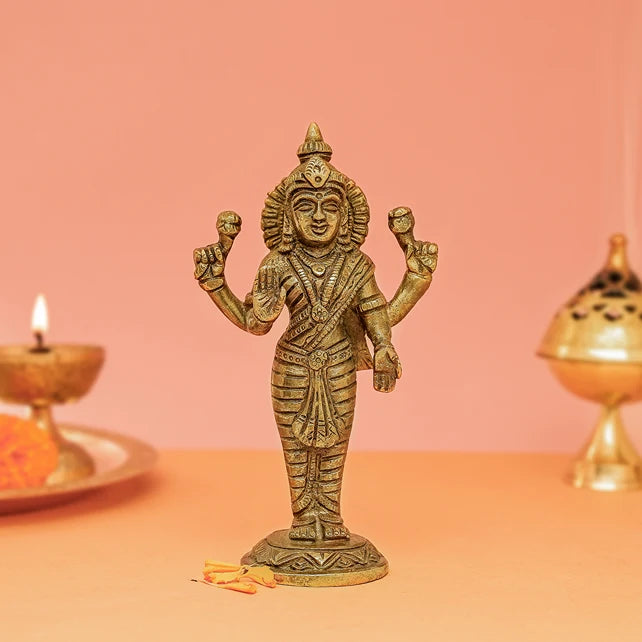
At most Hindu weddings the expected gift is two things, not one: an envelope, and an object. The envelope carries shagun, customarily an amount ending in one rupee. The object is traditionally something the couple will use as they set up a household, which is why silver, lamps, a Lakshmi murti and a puja thali set have remained the standard choices for generations. This guide covers what to give, why each item is considered auspicious, how to choose by your relationship to the couple, and what is customarily left out.
Two gifts, not one
Guests often agonise over choosing between cash and a present. In most Indian communities the answer historically has been both, in different proportions. Cash covers the practical reality of a wedding, is easy to give and is never wrong. The object is what the couple remembers and what stays in the house.
If your budget is modest, weight it toward the envelope and give one small, well chosen object. If your budget is generous, invert it: a substantial object with a token envelope reads as more considered than a thick envelope alone. Close family typically gives both properly. Colleagues and acquaintances usually give one.
Why silver is the default
Silver has been the conventional wedding gift across almost every Indian community for a very long time. Part of the reason is practical, in that it holds value and lasts, but the traditional reasoning runs differently: silver is associated in Vedic tradition with the moon and with coolness, and is customarily given at beginnings, which is why it appears at weddings, at namkarans and at Akshaya Tritiya alike.
What actually gets given is usually small: a coin, a pair of bowls, a glass, a small lamp, a Lakshmi charan set, or Lakshmi and Ganesha embossed coins. A single well made hallmarked silver article is a better gift than several unhallmarked ones, and hallmarking matters here for a plain commercial reason: it tells the couple what they actually have.
The couple's first mandir
Almost every newly married couple sets up a shrine of their own within the first year, and almost none of them plan for it. That gap makes mandir items unusually good wedding gifts, because they are needed, they are not duplicated by the ten other guests buying home decor, and they carry the right meaning for the occasion.

The conventional pieces are a Lakshmi murti, often given as a Lakshmi and Ganesha pair, a brass or silver lamp, and a puja thali set with its small accessories. Keep the murti modest in size; a new couple in a rented flat has less space than you imagine, and a large piece forces a decision they are not ready to make. If you would rather give one presented set than assemble pieces, curated spiritual combos solve the presentation problem in one step.
Choose by your relationship to the couple
| You are | What is customarily given | Typical form |
|---|---|---|
| Immediate family | Substantial silver or gold, a full mandir set, or household essentials | Given in person, often before the wedding day |
| Extended family | Silver article, brass lamp pair, Lakshmi and Ganesha murti | Object plus a shagun envelope |
| Close friends | A considered single piece, or a curated set for the new home | Object, sometimes pooled between friends |
| Colleagues | Envelope, or one mid range object | Usually one, not both |
| Attending as a group | One substantial piece rather than several small ones | Pooled, delivered to the home rather than the venue |
One logistical point worth more than it sounds: heavy or fragile gifts are better sent to the home than carried to the venue, where they have to survive a day of being moved between halls, cars and hotel rooms.
Wearables, and where care is needed
A rudraksha bead or a plain japa mala is a conventional and well received wedding gift, and neither is tied to an individual horoscope. Malas of tulsi, sandalwood and rudraksha are given routinely at auspicious occasions, and a japa mala suits a couple who already have some practice.
Gemstones are different, and this is where guests most often go wrong with good intentions. In Vedic tradition a gemstone is selected for a specific person on the basis of their birth chart, not chosen as a general present, so a rashi bracelet or a ratna given without knowing the recipient's rashi is customarily avoided. If you want to go down this route, ask first, or read our rashi bracelet guide to understand what the selection actually depends on. A gemstone is not a claim about outcomes and should not be presented as one.
Budget bands
There is no correct figure, and it varies by community, city and how close you are. As a working guide: under 999 covers a good brass diya, a small murti or an incense set as a token to accompany an envelope. The middle band, roughly 1,000 to 3,000, is where most guest gifting sits and where a lamp pair, a mid size murti or a thali set becomes possible. Above 3,000 is family and close friend territory, and covers hallmarked silver, larger brass pieces and multi item sets; browsing gifts above 3,000 is the quickest way to see what that band actually buys. Cash, wherever it sits, is customarily given as an amount ending in one.
What is customarily avoided
- Sharp objects. Knives, scissors and cutlery sets are traditionally left out of auspicious gifting in most communities.
- Black and white items. Black is customarily avoided in gifting, and white is associated with mourning in many Hindu communities, which makes white flowers and white clothing an awkward choice.
- Leather and footwear. Customarily avoided as gifts in Indian households generally.
- Handkerchiefs. A widely observed custom associates them with tears, so they are traditionally not gifted at a wedding.
- Empty vessels. Customarily filled with rice, sugar or a coin before being given.
- Round cash amounts. 500 or 1,000 is traditionally avoided in favour of 501 or 1,001.
- Anything chipped or repaired. Check the piece before it is wrapped, particularly if it has travelled.
Regional differences worth knowing
In much of North India the shagun envelope, or lifafa, is the centre of guest gifting and the amount ends in one. In Tamil and Telugu weddings, cash given by guests is often formally recorded, and thamboolam bags of betel leaves, areca nut and coconut go the other way as the family's return gift. Bengali families exchange tattwa trays between the two households, with the contents laid out and decorated to a set convention. Maharashtrian and Gujarati practice differs again. None of this changes what makes a good object gift, but it does change what the family will expect from you specifically, and asking someone from the household is never considered rude.
A note on tradition
The customs described here are widely followed across Indian communities and vary meaningfully between them. Nothing above should be read as a claim that a particular gift will bring the couple prosperity, harmony, health or any other outcome. These are conventions of respect and good wishes, observed differently in different families, and where a household's own practice differs from what is written here, that practice is the one to follow.
Frequently Asked Questions
What is the most traditional Hindu wedding gift?
Silver is the most widely given, and has been for generations. A hallmarked silver coin, a pair of small bowls, a lamp or a Lakshmi charan set is customarily given at weddings across most Indian communities. Cash in a shagun envelope, given as an amount ending in one, is equally traditional and equally welcome.
Why do shagun amounts end in one rupee?
The extra rupee is customarily added so that the amount does not end in a round figure, which in tradition is associated with completion and closure. An amount such as 501, 1,001 or 2,101 rupees is understood to represent something continuing rather than something finished. The custom is followed at weddings, at housewarmings and at most other auspicious occasions.
Is it appropriate to give a god idol as a wedding gift?
Yes, and it is common, particularly a Lakshmi murti or a Lakshmi and Ganesha pair for the couple's new mandir. Because a murti is traditionally installed and cared for rather than simply displayed, it suits couples who will keep a home shrine. If you are unsure, a lamp, a silver article or a thali set carries the same warmth without the assumption.
Can I gift a gemstone or rashi bracelet to a couple?
It is better to ask first. In Vedic tradition a gemstone is selected for a specific individual on the basis of their birth chart rather than chosen as a general present, so gifting one without knowing the person's rashi is customarily avoided. If you want to give something wearable, a rudraksha or a plain japa mala is the more conventional choice and is not tied to an individual chart.
What is customarily avoided as a wedding gift?
Sharp objects such as knives and scissors, black items, leather goods, footwear, handkerchiefs and anything broken or chipped are traditionally left out of wedding gifting. Empty vessels are customarily filled with rice, sugar or a coin before being given. These are widely followed customs rather than fixed rules, and many families do not observe all of them.
Should the gift be for the bride, the groom or the couple?
In current practice most wedding gifts are addressed to the couple jointly, particularly anything intended for their home. Individual gifting still happens within close family, where the two sides often exchange specific items according to their own community custom. If you are a guest rather than family, a joint gift is the simplest and safest choice.


