 Cow Shelter/Donation

How to Chant on a Mala: Japa Technique, Fingers, Sumeru & Counting
August 29, 2026
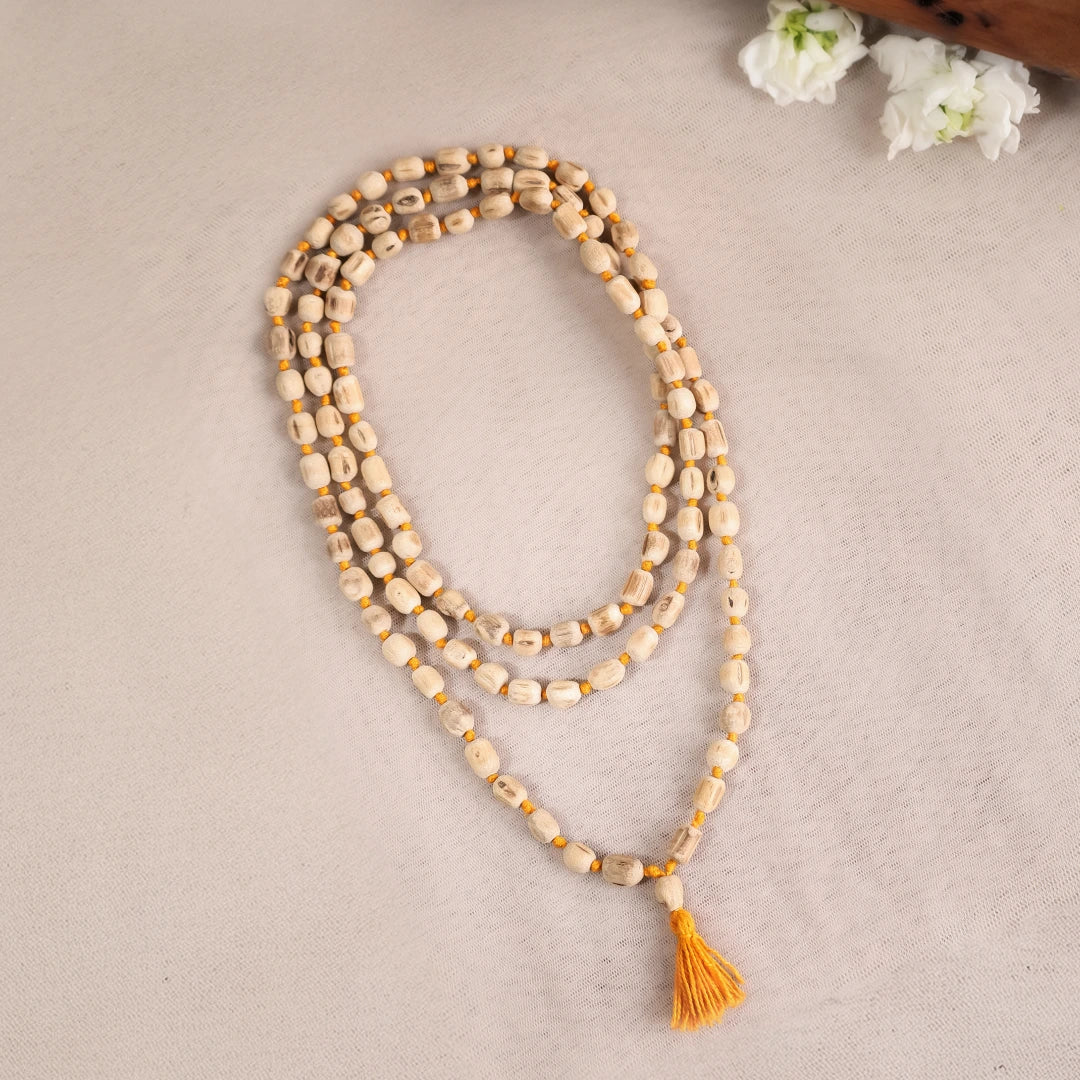
To chant on a mala, hold it in your right hand draped over the middle finger, and move each bead toward you with the thumb — one bead, one repetition of the mantra. The index finger is traditionally kept clear of the beads altogether. When you reach the sumeru, the larger bead where the loop closes, you do not chant on it and you do not pass over it: you turn the mala around and travel back the way you came. One hundred and eight repetitions makes one round. Everything else in this guide is detail on top of those four rules.
What japa actually is
Japa is the repetition of a mantra a fixed number of times. It is one of the oldest and most widely kept practices in Hindu tradition, and its appeal is that it requires almost nothing — no priest, no ceremony, no particular place. A mantra, a mala and a few quiet minutes.
Traditional texts describe three grades of repetition. Vaikhari is aloud, audible to anyone nearby. Upamshu is whispered — the lips move, the sound barely carries. Manasika is mental, with no movement at all. Most traditions rank these in ascending order, with mental japa considered the most refined, but beginners are almost always started on the audible or whispered form because the mind wanders less when the body is doing something.
There is no requirement to be initiated before beginning. Many mantras — Om Namah Shivaya, the Gayatri, the Mahamrityunjaya, the Hare Krishna mahamantra — are chanted openly by householders across India. Some tantric mantras are traditionally given by a guru; if you have received one that way, follow the instructions you were given over anything written here.
Which fingers hold the mala
This is the part most people get wrong, and it is worth getting right because it is easy.
| Finger | Role in japa |
|---|---|
| Thumb (angustha) | Does the work. Draws each bead toward you, one per repetition. |
| Middle finger (madhyama) | Carries the mala. The beads rest over it and it acts as the support. |
| Index finger (tarjani) | Traditionally kept away from the beads entirely. It is the finger of pointing and accusation and is associated with the ego, and in most lineages it is held out and clear. |
| Ring finger (anamika) | Used in some traditions in place of the middle finger, particularly in certain Devi and tantric practices. |
| Little finger | Not used. |
The right hand is conventionally used. The mala is held around the level of the heart — not up at the face, and not dropped into the lap below the navel. The beads should never touch the floor, which is the practical reason for keeping the hand raised.
Many practitioners chant with the mala inside a gomukhi, a small cloth bag with a hole for the hand. The stated reason is that japa is a private matter and the count is nobody else’s business. The practical effect is that it also keeps the mala clean and stops you looking at the beads, which helps concentration.
The sumeru, and why it is never crossed
A japa mala has 108 counting beads plus one larger bead that closes the loop, usually with a tassel or a knot hanging from it. That bead is the sumeru — also called the meru, the bindu, or the guru bead.
It is not one of the 108. You do not chant a repetition on it, and in the near-universal convention you do not pass your thumb over it to begin the next round. Instead, when your thumb arrives at the sumeru you have completed one round. Many practitioners touch it briefly to the forehead or to the eyes as a mark of respect. Then you rotate the mala in your hand and chant the next round travelling back in the opposite direction, so that the sumeru is always the turning point rather than a bead you step across.
The traditional explanation is that the sumeru represents the guru, or the summit of Mount Meru, and one does not climb over either. The functional explanation is just as good: the turn gives you a definite, tactile marker for the end of every round, which is exactly what you need when your attention is on the mantra rather than on counting.
Counting rounds beyond the first
One round is 108. Serious sankalpas — vows to complete a set number of repetitions — run into the tens of thousands, and you cannot hold that count in your head while chanting. The traditional solutions are all physical:
- A counter mala. A short strand, usually of ten or eleven beads, worn on the finger or kept beside you. Advance one bead per completed round.
- Counter beads on the mala itself. Some malas are made with two small side strands hanging from the sumeru — one counting units of rounds, the other counting tens.
- Moving a physical marker. A grain of rice, a small stone or a flower petal set aside per round. Simple, and very old.
- A written tally. Unromantic but effective for long sankalpas kept over weeks. Many households keep a japa diary.
Traditionally an extra few repetitions are added beyond the vowed number, on the reasoning that some will have been chanted inattentively. If you promised 108, chanting 112 is considered better form than stopping dead at 108 and worrying about the ones you lost.
Posture, seat and direction
Nothing here is difficult, and all of it is aimed at one thing: sitting still comfortably for long enough that the body stops interrupting.
- Sit on the floor if you can, in sukhasana, padmasana or vajrasana. If your knees will not allow it, a chair is entirely acceptable — discomfort is a bigger obstacle to japa than an unorthodox seat.
- Use an asan. A mat or folded cloth between you and the floor is customary. Wool, cotton or kusha grass are the traditional materials.
- Keep the spine upright and the shoulders loose. A collapsed spine makes the breath shallow and the mind drowsy.
- Face east or north. East at sunrise and north for sustained practice are the usual conventions.
- Bathe first and wear clean clothes. Standard for any devotional practice, and it also serves as a signal to yourself that the next half hour is different from the rest of the day.
When to chant
Brahma muhurta — roughly the hour and a half before sunrise — is the period traditionally regarded as the best for japa. The reasoning offered is that the mind is least cluttered before the day begins. The three sandhya junctions — sunrise, midday and sunset — are the other customary times, and the Gayatri in particular is traditionally chanted at these.
More useful than any of this is consistency. A tradition-approved hour you cannot keep is worth less than a fixed ten minutes you actually sit for every day. Choose a time you can defend against the rest of your life, and keep the same seat and the same mala for it.
Choosing a mala for your mantra
Different mantras are traditionally paired with different mala materials. These are customary associations, not rules with consequences attached.

| Mala | Traditionally used for |
|---|---|
| Rudraksha | Shiva mantras and general practice; the most widely used japa mala in India |
| Tulsi | Vishnu, Krishna and Rama mantras; central to Vaishnava practice |
| Chandan (sandalwood) | Devi mantras and practices oriented toward calm |
| Sphatik and gemstone | General japa; sphatik is commonly chosen for Devi and Lakshmi mantras |
| Karungali (ebony) | Widely used in Tamil practice, particularly in association with Shiva and Shani |
If you are buying your first mala, the practical advice is to pick one you will be comfortable holding for twenty minutes and then leave it alone. Our Authentic Japa Mala range is strung specifically for counting rather than for wear, which matters more than it sounds: a mala meant for the neck often has beads too closely spaced for the thumb to work cleanly.
Things that quietly go wrong
- Using the index finger. Nearly everyone does this instinctively on the first attempt. Rest the beads on the middle finger instead and hold the index clear.
- Crossing the sumeru. Turn the mala; do not step over it.
- Chanting faster than you can articulate. Japa is not a race to 108. If the syllables are blurring, slow down.
- Sharing the mala. A japa mala is traditionally personal and is not passed around or worn by others.
- Letting it touch the floor, or leaving it on a bed or a bathroom shelf. Keep it in a bag or in the mandir.
- Wearing a japa mala into the bathroom or to sleep. Most households remove it for both.
These are matters of traditional etiquette and respect. Breaking one does not invite a consequence; it simply falls outside how the practice is customarily kept.
Frequently asked questions
Which finger should not be used while chanting on a mala?
The index finger. In most traditions it is held clear of the beads entirely, as it is associated with pointing, accusation and the ego. The thumb moves the beads and the middle finger supports them.
Why should you not cross the sumeru?
The sumeru is the larger bead where the loop closes, and it is not one of the 108. It traditionally represents the guru, and the convention is that one does not climb over it. When your thumb reaches it, the round is complete: turn the mala and chant the next round back in the other direction.
Can japa be done in the left hand?
The right hand is the conventional one across most Hindu traditions. If the right hand is injured or unavailable, practice is not abandoned — but where there is a choice, the right is used.
How many rounds of japa should be done daily?
There is no fixed number for a householder. One round of 108 is a common daily minimum, and many practitioners keep a self-set sankalpa of a specific number of rounds over a specific period. Consistency is generally regarded as more valuable than volume.
What is the best time of day for japa?
Brahma muhurta, roughly the ninety minutes before sunrise, is the period traditionally considered most suitable, followed by the sandhya junctions at sunrise, midday and sunset. In practice a fixed time you can keep every day is worth more than an ideal time you cannot.
Should a japa mala be worn around the neck?
Practice varies. Some traditions keep the japa mala strictly for counting and store it in a cloth bag, using a separate mala for wear. Others wear the same one. What is generally agreed is that a mala used for japa is personal, is not lent out, and is removed before bathing and sleeping.
Does the mantra have to be chanted aloud?
No. Tradition recognises three forms — aloud, whispered, and purely mental — and ranks the mental form highest. Beginners are usually advised to start aloud or whispered, because the mind stays with the mantra more easily when the mouth is involved.


