 Cow Shelter/Donation

Puja Thali: What Goes On It, How to Arrange It & Brass Care
September 03, 2026
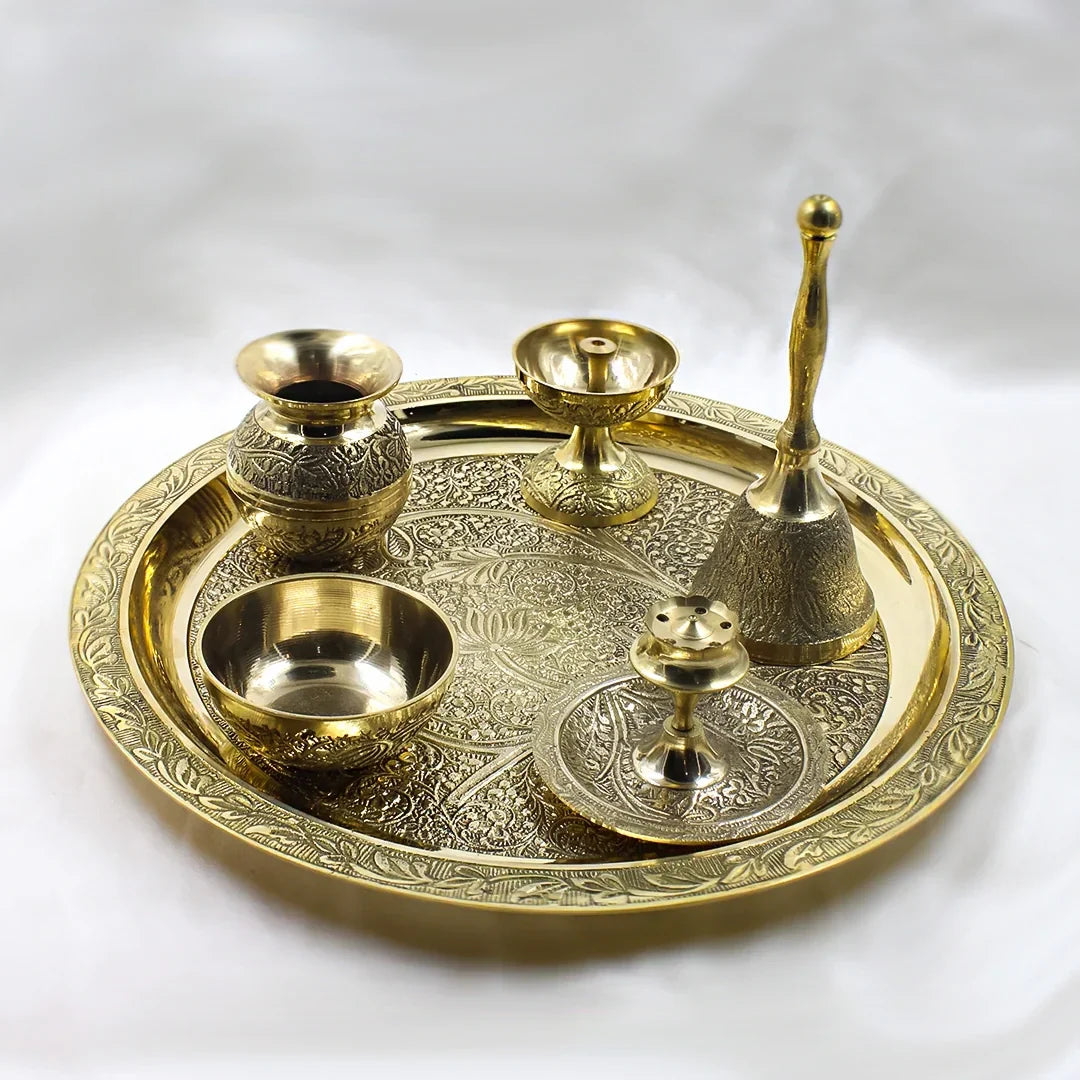
A puja thali is the plate that holds everything needed for worship, arranged so that each item can be picked up in sequence without hunting for it. The core set is a diya, agarbatti or dhoop, kumkum, haldi, chandan, akshat, flowers, water and naivedya, usually with a bell and camphor alongside. The arrangement follows one practical rule: the right hand makes the offerings, so the diya and water sit on the right and the bell on the left, where the left hand can ring it without crossing over. Everything else is regional and household custom.
The thali is a working tray, not a display
It is worth starting here, because it explains every arrangement decision that follows. During puja your attention is meant to be on the deity and on what you are saying, not on locating the haldi. The thali exists so that the sequence — water, tilak, akshat, flowers, incense, lamp, offering, arti — can run without breaking.
That is also why the traditional thali is a shallow round plate with a raised rim rather than a flat board. The rim contains spills, the round shape means nothing is out of reach, and the whole plate can be lifted and circled during arti. A puja thali and an arti thali are frequently the same object doing two jobs.
Household practice varies enormously, and there is no single correct list. What follows is the broad, widely kept pattern rather than a rule. If your family does it differently, your family is not wrong.
What goes on it
| Item | What it is | Its role |
|---|---|---|
| Diya | Ghee or oil lamp with a cotton wick | The lamp offering; lit first and usually kept burning throughout |
| Agarbatti or dhoop | Incense stick or cone | The fragrance offering |
| Kumkum | Red powder | Applied to the deity and used for tilak |
| Haldi | Turmeric powder | Offered and applied; central to many domestic rites |
| Chandan | Sandalwood paste | Applied to the deity and to the forehead |
| Akshat | Unbroken rice grains, often tinted with haldi | Offered by hand; the grains must be whole and unbroken |
| Pushp | Fresh flowers | Offered directly; garlands are draped |
| Jal | Water in a small lota or kalash, with a spoon | For achman, for offering, and for sprinkling |
| Naivedya | Fruit, sweets or cooked food | The food offering, distributed afterwards as prasad |
| Ghanti | Small hand bell | Rung during arti and at points through the puja |
| Kapoor | Camphor tablets, with a small holder | Burned for the concluding arti |
| Kalava or moli | Red and yellow sacred thread | Tied on the wrist; also used to bind the kalash |
| Supari and paan | Betel nut and betel leaf | Offered in many household and festival rites |
The small powders sit in katoris — little bowls — rather than loose, both to keep them separate and so they can be lifted. A five-katori thali is the most common configuration sold, and it covers kumkum, haldi, chandan, akshat and one spare. Our Pooja Thali range covers the standard configurations, and the consumables sit under Daily Essentials.
Laying it out
Sit facing the deity, ideally facing east or north. Then work outward from your hands.

- Diya on the right. The right hand performs the offerings and the arti, so the lamp goes where that hand naturally reaches. Place it toward the outer edge so a sleeve does not pass over the flame.
- Bell on the left. The left hand rings the bell while the right performs the arti. Putting the bell on the right means crossing your arms mid-ritual, which is exactly the sort of fumble the layout is meant to prevent.
- Water pot on the right, near the diya, with its spoon resting in or beside it.
- Katoris in an arc across the middle, in the order you will use them: chandan, kumkum, haldi, akshat. Keeping them in ritual sequence means you never have to look.
- Flowers and naivedya toward the front, closest to the deity, since they are what gets offered directly.
- Incense and camphor toward the back or the edge, clear of everything else — both produce ash, and camphor in particular flares.
During arti the thali is lifted and circled clockwise before the deity, traditionally in a set number of rotations, often beginning at the feet and rising. Keep the plate light enough to hold in one hand for a minute: an overloaded thali is the usual reason people struggle at this point.
Regional variations
The underlying logic holds across India. The contents shift considerably.
| Region | What is characteristic |
|---|---|
| North India | Roli and akshat for tilak; a kalash topped with mango leaves and a coconut; ghee diya; the multi-wick panchmukhi lamp for arti; brass or steel thalis |
| South India | Separate containers for kumkum, chandan and vibhuti (sacred ash); the tall standing kuthu vilakku lamp alongside the thali; camphor arti in a small deepa; jasmine and tulsi; banana leaf used for offerings |
| Bengal | The conch blown at key moments; dhunuchi burning resin dhuno rather than only agarbatti; strong emphasis on flowers and fruit naivedya; the thali prominent in Durga Puja |
| Maharashtra | Haldi-kunku offered between women as a social rite in its own right; durva grass and modak in Ganpati worship |
| Gujarat | The decorated arti thali central to Navratri; the perforated garbo lamp carried and circled during garba |
These are broad characterisations rather than boundaries — households migrate, marry across regions and keep composite traditions, and all of that is normal. If you are assembling a thali for a specific festival, follow whichever tradition your family keeps. Our Kalash & Pooja Accessories, Diyas & Lamps, Agarbatti & Incense and Shankh & Bells collections cover the components separately. For the wider home-temple checklist rather than the thali specifically, see our guide to daily pooja essentials.
Caring for a brass thali
Brass is an alloy of copper and zinc, and the copper in it oxidises on contact with air and moisture. A brass thali will darken. That is chemistry, not neglect.
The traditional cleaning methods work and are still the best. Tamarind pulp rubbed over the surface, or lemon with a little salt, or a paste of lemon juice and baking soda. The mild acid lifts the oxide layer. Wood ash and water is the oldest method of all and it still works. Rub with a soft cloth, rinse thoroughly, and then — the step people skip — dry it completely. Trapped moisture is what causes stubborn staining, so a thali put away damp will come out worse than it went in.
What to avoid:
- Steel wool and harsh scouring pads. They will take the tarnish off and the finish with it, leaving fine scratches that hold dirt and tarnish faster next time.
- Acids on lacquered brass. Many decorative brass items carry a clear lacquer to stop them tarnishing. Lemon and tamarind strip it, leaving a patchy surface that then tarnishes unevenly. If your thali stays bright with no effort, assume it is lacquered and clean it with a damp cloth only.
- The dishwasher. Detergent and sustained heat will discolour brass badly.
- Leaving acidic food sitting on it. Lemon, tamarind, curd and tomato all react with brass over time. This is why brass cooking and serving vessels are traditionally tinned inside with kalai. Clear the naivedya rather than leaving it overnight.
- Storing it damp or unwrapped. Dry fully, then wrap in cloth or paper for storage between festivals.
How often to clean is a matter of preference. Some households polish before every major puja; others let the thali darken to a deep patina and clean only at Diwali. Neither is incorrect. See Brass Collections for the wider range of brass ritual ware.
How to choose a thali
Size it to your mandir, not to the photograph. A large thali that will not sit flat in your temple space is a daily irritation. Measure the shelf first.
Count the katoris against what you actually use. Five is the common configuration and suits most households. If your family uses vibhuti as well as kumkum and chandan, you need more compartments than a standard set provides.
Check the weight before buying. You will be holding this in one hand, at arm’s length, during arti. A heavy decorative thali is impressive on a shelf and tiring in use.
Decide about lacquer. Unlacquered brass darkens and needs cleaning but develops the patina many people prefer. Lacquered brass stays bright with almost no work but cannot be polished with traditional methods and looks poor once the lacquer starts to fail. Steel is the low-maintenance alternative and is entirely acceptable, though brass and copper are the traditional metals.
Think about the idol it will serve. The thali sits in front of the deity, and a very ornate plate can compete with a simple murti. Our Sacred God Idols range is worth looking at alongside the thali rather than separately.
Frequently asked questions
What items go on a puja thali?
The common set is a diya, agarbatti or dhoop, kumkum, haldi, chandan, akshat, fresh flowers, water in a small lota with a spoon, and naivedya. A bell, camphor with a holder, kalava thread, and supari and paan are usually kept alongside. Household and regional practice varies and there is no single fixed list.
Which side should the diya and the bell go on?
The diya on the right and the bell on the left. The right hand performs the offerings and the arti, so the lamp needs to be within its reach, while the left hand rings the bell. Reversing them means crossing your arms during the arti, which is precisely what a good layout avoids.
Why must akshat rice be unbroken?
Akshat means unbroken, and the grains offered are traditionally required to be whole. Broken grains are customarily set aside. It is a matter of ritual propriety in the offering rather than a rule with a consequence attached.
How do I clean a brass puja thali?
Use a traditional mild acid: tamarind pulp, or lemon with a little salt, or a paste of lemon juice and baking soda. Rub with a soft cloth, rinse well and dry completely, since trapped moisture causes lasting staining. Avoid steel wool and harsh scouring pads, and do not put brass in a dishwasher.
Why has my brass thali gone dull even though I clean it?
Most likely it is lacquered. Decorative brass often carries a clear protective coating, and acidic cleaners strip it patchily, leaving areas that then tarnish unevenly. If it stays bright with no effort, treat it as lacquered and clean it with a damp cloth and nothing else.
Is a steel puja thali acceptable instead of brass?
Yes. Brass and copper are the traditional metals and many households prefer them, but steel is widely used, needs almost no maintenance and does not react with acidic offerings. There is no prohibition on it.
Can the same thali be used for puja and for arti?
Yes, and in most households it is. The same plate holds the offerings during the puja and is then lifted and circled for the arti. The only practical consideration is weight — a thali too heavy to hold comfortably in one hand for a minute is worth reconsidering.


