 Cow Shelter/Donation

Rose Quartz: Properties, Natural vs Dyed, Care & Who Wears It
September 01, 2026
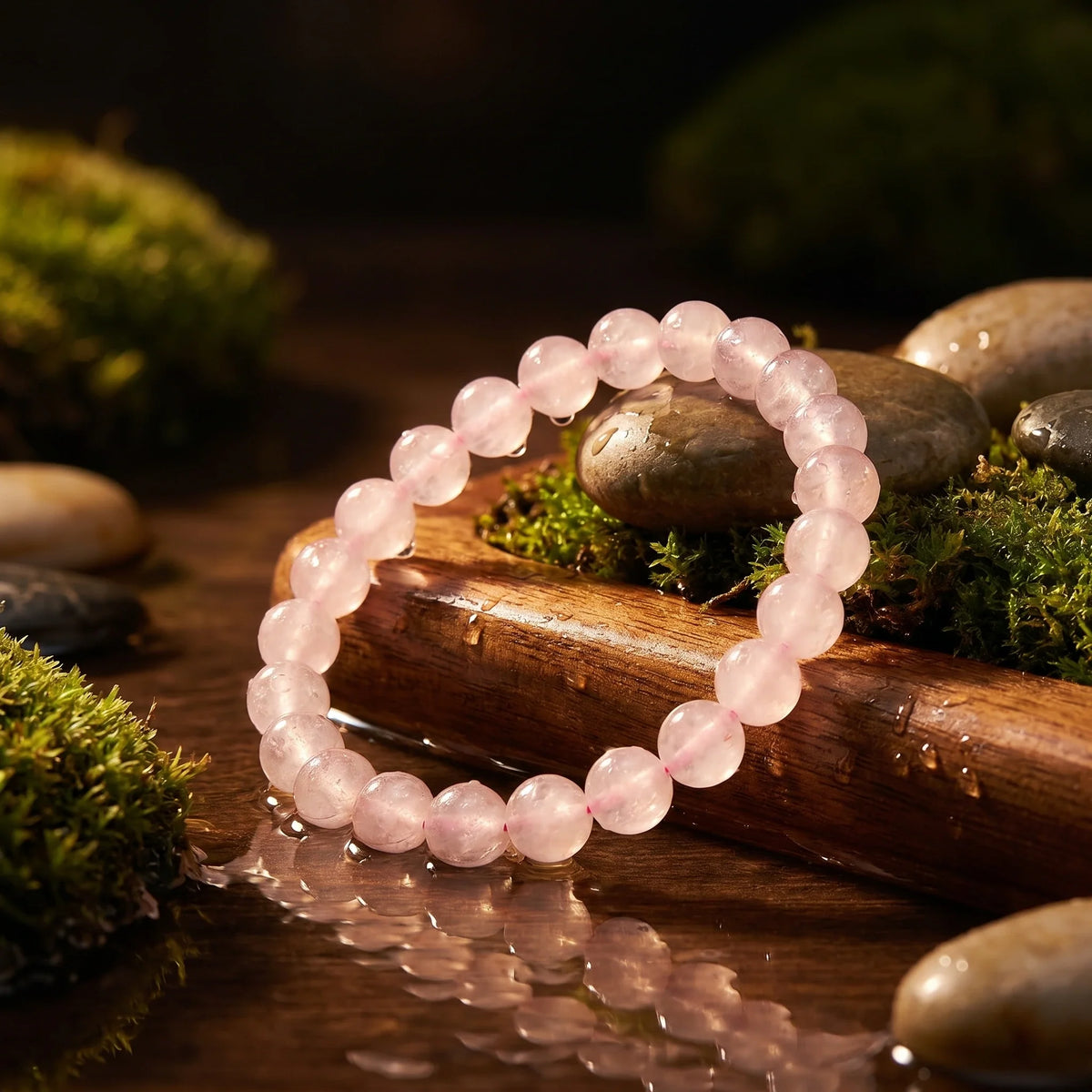
Rose quartz is a pink variety of quartz — the same mineral as clear quartz and amethyst, coloured by microscopic mineral inclusions rather than by a dye. It is almost never transparent: genuine rose quartz is translucent to milky, with a soft cloudiness running through it. It rates 7 on the Mohs scale, so it is hard enough for daily wear, and it is safe in water. Its one real vulnerability is light — prolonged direct sunlight will fade the pink. In Indian practice it is customarily associated with the heart and with Shukra (Venus), and it is worn as a bracelet, pendant or mala.
What rose quartz actually is
Chemically, rose quartz is silicon dioxide — SiO2 — exactly like clear quartz. What makes it pink is not an impurity dissolved through the crystal but a scatter of microscopic fibrous inclusions, understood to be a mineral related to dumortierite, distributed through the stone. This is the reason for a characteristic that confuses a lot of buyers: rose quartz is cloudy by nature. The same fibres that give it the colour also scatter the light passing through it.
That cloudiness is the single most useful thing to know before you buy. A bead that is water-clear and vividly, evenly pink is almost certainly not rose quartz. Nature does not generally produce that stone.
The fibres have one more consequence worth looking for. Hold a good piece under a single strong point of light — a torch, not a room lamp — and some specimens will show a faint six-rayed star floating in the stone. This is asterism, caused by light reflecting off the aligned inclusions, and it is a positive sign of natural material. Not every genuine piece shows it, but nothing dyed does.
At a glance
| Property | Rose quartz |
|---|---|
| Mineral | Quartz (silicon dioxide) |
| Hardness | 7 on the Mohs scale |
| Transparency | Translucent to milky; rarely close to transparent |
| Colour | Pale blush to deep dusty pink, usually uneven |
| Water safe? | Yes — unlike selenite, it does not dissolve or degrade |
| Light sensitive? | Yes — fades with prolonged direct sunlight |
| Traditionally linked to | The heart centre; Shukra (Venus) in Vedic association |
Natural, dyed or glass: how to tell them apart
Three things get sold as rose quartz. Genuine rose quartz. Pale or colourless quartz that has been dyed pink. And moulded glass. Each leaves different evidence.
| Check | Natural rose quartz | Dyed quartz | Glass |
|---|---|---|---|
| Colour distribution | Uneven, patchy, softer in some areas than others | Suspiciously uniform, or pooled in cracks and around drill holes | Perfectly even throughout |
| Clarity | Cloudy, milky, never glassy-clear | Often clearer than natural, with a flat look | Very clear, sometimes with tiny round gas bubbles |
| Internal features | Veils, fractures, faint banding, occasional asterism | Dye concentrated along internal fractures | Swirls and bubbles rather than mineral features |
| Hardness | Will scratch a glass surface | Will scratch glass — it is still quartz | Will not scratch glass; scratches easily itself |
| Temperature | Feels cool and stays cool for a moment in the hand | Same as natural | Warms up noticeably faster |
| Edges and holes | Drill holes clean, colour continuous through the hole | Darker ring of dye around the drill hole | Mould seams; conchoidal chipping at edges |
The drill-hole test is the quickest of these on a bracelet. Dye enters where the stone was cut and pools there, so a dyed bead very often shows a deeper pink halo around each hole. Natural colour carries straight through.
The hardness test separates glass from quartz definitively but tells you nothing about dye — dyed quartz is still quartz and will still scratch glass. Use both checks together, and be aware that no home test is conclusive. If certainty matters to you, buy from a seller who will describe the treatment honestly.
The sunlight problem
This is the care fact that matters most, and it is the one most often left out.
Rose quartz is photosensitive. Prolonged exposure to direct sunlight will lighten the pink, and the change is permanent — the colour does not come back. The mechanism relates to the same inclusions and trace elements that produce the colour in the first place. The effect is gradual rather than dramatic; you will not lose the colour in an afternoon. But a rose quartz cluster kept on a sunny windowsill for a year will be visibly paler than one kept on a shelf, and a bracelet worn daily in strong Indian sun will lose depth over time.
The practical implications are simple:
- Do not display rose quartz on a windowsill. This is the single most common way people fade their own stones — often while trying to charge them in sunlight.
- If you cleanse in light, use moonlight. The traditional moonlight practice carries no fading risk at all, which is convenient.
- Store it away from light. A cloth pouch or a closed box, not an open display in a bright room.
- Amethyst behaves the same way. If you keep both, the same rule applies to both.
Caring for rose quartz
Beyond the light issue, rose quartz is one of the easier stones to look after. At Mohs 7 it is harder than window glass and most household surfaces, and unlike selenite or malachite it is entirely water-safe.
- Cleaning: lukewarm water, a drop of mild soap if needed, and a soft cloth. Rinse and dry properly. Avoid hot water on a piece with visible fractures, since thermal shock can extend an existing crack.
- Avoid harsh chemicals. Bleach, drain cleaner and strong solvents have no business near jewellery. Remove bracelets before using them.
- Perfume and cosmetics. Put them on before your jewellery, not after. Residue dulls the surface polish over time.
- Ultrasonic cleaners: best avoided. Rose quartz very often has internal fractures, and ultrasonic vibration is exactly what turns a stable internal fracture into a break.
- Storage: separately, in a pouch. Not because it is fragile, but because harder materials — and other quartz — will scuff its polish if they rattle against it.
- Restringing: if your rose quartz is on an elastic bracelet, check the cord every few months. Elastic perishes long before the stones do.
If you keep a piece on a shelf rather than wearing it, our Crystal Tree range is designed for display — just place it somewhere that does not catch direct sun.
Who traditionally wears it
Rose quartz is traditionally associated with the heart centre, and in Vedic association it is customarily linked with Shukra — Venus — the planet connected with relationships, comfort and the arts. It is commonly chosen by people who want a stone connected with those themes: calm, affection, self-regard, easing of relationships within a household.

These are traditional associations and matters of belief. Rose quartz is not a treatment for anything, it does not resolve relationships, and it should not be used in place of medical or psychological care. It is also not a Vedic remedial gemstone in the formal sense: a jyotish prescription is made by a qualified astrologer from a complete birth chart, and it names specific stones under specific conditions. Rose quartz is generally worn as a personal choice rather than as a prescribed remedy — which, practically, makes it one of the easier stones to buy without a consultation.
How to choose a piece
Judge the colour on evenness, not intensity. A soft, slightly patchy blush is what natural material looks like. Deep uniform candy pink usually means dye.
Accept the cloudiness. Buyers often reject the milkiest beads in a strand as flawed. That milkiness is the mineral being itself.
Check the drill holes on a bracelet. Clean, centred, no dye halo, no chipping at the rim.
Match the format to the use. A Natural Stone Bracelet for daily wear, a Stone Pendant if you would rather keep it away from knocks and washing-up, a tumbled piece or cluster if you want it for a room, or a Crystal & Gemstone Mala if you want to use it for counting.
Ask what has been done to it. A seller who tells you a stone is dyed or heated is being useful. A seller who claims every stone is entirely untreated at an unusually low price is telling you something else. The wider range sits in All Gemstones.
Frequently asked questions
Does rose quartz fade in sunlight?
Yes. Rose quartz is photosensitive and prolonged direct sunlight will lighten the pink permanently. The change is gradual rather than sudden, but a piece kept on a sunny windowsill will visibly pale over months. Keep it out of direct sun and use moonlight rather than sunlight if you cleanse it in light.
Can rose quartz go in water?
Yes. Unlike selenite, which dissolves, rose quartz is quartz — hard, stable and entirely water-safe. Lukewarm water and a soft cloth are fine. Avoid very hot water on pieces with visible internal fractures, and avoid ultrasonic cleaners for the same reason.
Why is my rose quartz cloudy and not clear?
Because that is what rose quartz is. The pink comes from microscopic fibrous inclusions scattered through the stone, and those same inclusions scatter light, producing the characteristic milkiness. Genuine rose quartz is translucent rather than transparent, and a water-clear vivid pink bead is far more likely to be dyed quartz or glass.
How can I tell if rose quartz is dyed?
Look at the drill holes on a bead: dye pools where the stone was cut, so a dyed bead often shows a darker pink ring around each hole. Also check whether the colour is unnaturally uniform, whether it is concentrated along internal cracks, and whether the piece looks clearer than natural rose quartz should. No home test is conclusive, so buy from a seller who describes treatments openly.
What is the star effect some rose quartz shows?
It is called asterism — a faint six-rayed star that appears when light from a single point source reflects off the aligned fibrous inclusions inside the stone. Not all natural rose quartz shows it, but when it appears it is a good indication that the material is genuine, since dyed and glass imitations do not produce it.
Who should wear rose quartz?
Anyone who is drawn to it. It is traditionally associated with the heart centre and customarily linked with Shukra in Vedic association, and it is commonly chosen for themes of calm and affection. These are traditional beliefs rather than established effects, and rose quartz is not a substitute for medical or psychological care. It is also not usually a formally prescribed jyotish stone, which is why it is generally worn as a personal choice.
How hard is rose quartz, and will it scratch?
It rates 7 on the Mohs scale, which makes it harder than glass and durable enough for everyday wear. It will still take scuffs from harder materials and from other quartz pieces rattling against it, so store it separately in a pouch rather than loose in a jewellery box.


