 Cow Shelter/Donation

Shree Yantra: The Nine Triangles, Placement, Direction & Energisation
August 27, 2026
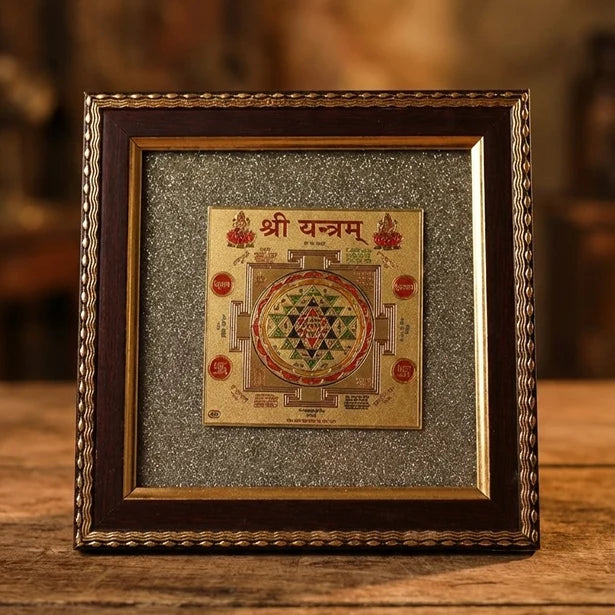
The Shree Yantra — also written Sri Yantra or Shri Chakra — is a geometric diagram built from nine interlocking triangles radiating outward from a single central point. In Vedic tradition it is regarded as the visual form of the Goddess Lalita Tripura Sundari, and it is considered among the most important of all yantras. It is traditionally kept in the north or north-east of a home, shop or office, raised off the floor on a clean surface, and is customarily energised with mantra before being placed. This guide covers what the diagram actually contains, how its nine layers are read, where it goes, which way it faces, how it is energised, and who traditionally keeps one.
What a yantra is, and what makes this one different
A yantra is a diagram — not a picture. Where an idol gives a deity a body you can look at, a yantra gives the same idea a structure you can trace. Every line, petal and gate has a name, and in Vedic tradition the diagram is treated as a map: you enter at the outer edge and move inward, layer by layer, toward the point at the centre.
The Shree Yantra is singled out from the other yantras for two reasons. First, its geometry is unusually difficult. Getting nine triangles to interlock so that every intersection is clean and every sub-triangle closes properly is a genuine drafting problem, and a badly drawn Shree Yantra is visibly wrong — lines miss, triangles collapse into slivers. Second, it belongs to the Sri Vidya stream of practice, which treats the diagram itself as the primary object of worship rather than as a support for something else.
Traditionally, the Shree Yantra is understood as a diagram of expansion — the bindu at the centre unfolding outward into the visible world, and the practitioner tracing the same path in reverse. That is the traditional reading; it is a devotional and philosophical framework, not a claim about outcomes.
The nine interlocking triangles
At the heart of the yantra sit nine triangles. Four point upward and five point downward. In traditional commentary the four upward triangles are called the Shiva trikonas and the five downward ones the Shakti trikonas, and the whole figure is read as the two principles interpenetrating rather than sitting side by side.
Because they overlap rather than nest, these nine triangles cut each other into 43 smaller triangles. Those 43, together with the surrounding lotus rings, circles and the outer square, are grouped into nine concentric enclosures known as the navavarana — literally the nine coverings. Each has a Sanskrit name, and in formal Sri Vidya worship each is addressed in turn.
The nine enclosures, outermost to innermost
| # | Enclosure (avarana) | What you see |
|---|---|---|
| 1 | Trailokya Mohana | The outer square, or bhupura — three concentric lines with four gates, one on each side |
| 2 | Sarvasha Paripuraka | A ring of sixteen lotus petals |
| 3 | Sarva Samkshobhana | A ring of eight lotus petals |
| 4 | Sarva Saubhagyadayaka | Fourteen triangles |
| 5 | Sarvartha Sadhaka | The outer set of ten triangles |
| 6 | Sarva Rakshakara | The inner set of ten triangles |
| 7 | Sarva Rogahara | Eight triangles |
| 8 | Sarva Siddhiprada | The single primary triangle |
| 9 | Sarvanandamaya | The bindu — the central point |
You do not need to memorise this to keep a yantra at home. But it is worth knowing, because it is the fastest way to check whether the piece you are buying was drawn properly: count the petals. Sixteen outside, eight inside. If a maker has given you twelve and six because it looked neater, the drafting is decorative rather than traditional.
Flat plate, three-dimensional Meru, or pendant?
The same geometry is sold in three quite different physical forms, and they suit different situations.
| Form | What it is | Traditionally suited to |
|---|---|---|
| Flat plate or engraved yantra | The diagram engraved on a sheet of copper, brass or another metal, sometimes framed | A home mandir, a shop counter, a locker or cash box — anywhere it can lie flat or stand upright against a wall |
| Meru or three-dimensional yantra | The same nine enclosures built up as a stepped pyramid, rising to a point at the bindu | A dedicated altar or puja room where it can be the focal object and is not moved about |
| Pendant, ring or carved bead | The diagram cut into wood, stone or metal and worn on the body | People who want to carry the symbol rather than install it |
The flat plate is the most common and the easiest to place. The Meru form is the most demanding — it needs a permanent, undisturbed spot. If you are drawn to the carved-in-wood versions, our Karungali Yantra range cuts the geometry into government-lab-certified Karungali (ebony) rather than metal.
Where to place a Shree Yantra, and which way it faces
Placement customs vary between households and lineages, but the widely followed conventions are consistent enough to state plainly.
- Direction of the room or wall: the north or north-east — the Ishaan corner — is traditionally preferred. In a shop or office, the north wall behind the seat or near the cash counter is the customary spot.
- Which way it faces: the yantra is set so that it faces the worshipper. If it is mounted on a wall, the wall is usually the south or west one, so that the diagram itself looks north or east.
- Height: never on the bare floor. It is customarily raised on a chowki, a shelf or inside the mandir, on a clean cloth — red, yellow or white are the usual choices.
- What it should not sit near: bathrooms, under a staircase, in a store room, or directly under a beam are all traditionally avoided, as with any object of worship.
- Keeping it clean: it is customarily dusted regularly. A metal yantra that has darkened is usually cleaned gently rather than left tarnished.
If you are setting up the space around it, our Pooja Thali and Diyas & Lamps collections cover the everyday items that usually sit alongside a yantra in a home mandir.
How a Shree Yantra is traditionally energised
In Hindu practice an object of worship is generally installed rather than simply placed. The formal rite is prana pratishtha, and when it is done in full it is performed by a qualified priest with the complete sequence of mantras. Many households have a new yantra energised this way once, at the start.
The simplified home procedure that is commonly followed looks like this:
- Bathe and put on clean clothes. Clean the spot where the yantra will sit and lay a fresh cloth.
- Wipe the yantra clean. A metal yantra is customarily washed with clean water, and in some households with panchamrit, then dried completely before it is set down. Wooden and stone yantras are wiped dry rather than washed.
- Place it on the cloth, facing you. Light a diya and incense.
- Offer kumkum, haldi, akshat (unbroken rice) and flowers, traditionally touching the four gates first and then the centre.
- Chant your chosen mantra. The seed syllable associated with this yantra is Shreem, and the Mahalakshmi mantra is commonly used alongside it. A count of 108 — one full mala — is the usual minimum.
- Conclude with a short arti and let the diya burn out safely.
Friday is traditionally favoured for Lakshmi-related worship, and many families choose a festival day such as Diwali or Akshaya Tritiya for the initial installation. We would not advise fixing a specific muhurat from a blog post — if the timing matters to you, ask a priest or astrologer who can work it out for your household.
A necessary note: everything described here is traditional practice and belief. Keeping a Shree Yantra is not a financial strategy, and nothing on this page should be read as financial advice or as a promise of any material result.
Who traditionally keeps one
There is no restriction of caste, gender or age on keeping a Shree Yantra in the home, and it is found in ordinary household mandirs across India. In practice, four groups tend to seek one out:
- Households setting up or refreshing a mandir, who want a central object for the altar alongside their idols.
- Shopkeepers and business owners, who traditionally keep one near the cash counter or in the locker — a custom that sits alongside the older practice of keeping a Kuber Yantra there.
- People with a regular japa practice, who use the yantra as the focal object while chanting.
- Students of Sri Vidya, for whom the navavarana structure is the actual framework of their worship rather than a decorative feature.
If you are drawn to the wealth-tradition side of this specifically, the pieces in Dhan Varsha and the Pyramid range sit in the same customary territory.
How to choose one
Four things separate a well-made yantra from a decorative one.
Count the petals. Sixteen in the outer lotus ring, eight in the inner. This is the single quickest check, and a surprising number of mass-produced plates get it wrong.
Look at the intersections. On a correctly drawn Shree Yantra the nine triangles meet at clean shared points. On a poor one you will see near-misses — two lines crossing where three should meet — and slivers where a triangle has been squeezed out of shape. Hold the plate at an angle to the light and the errors become obvious.
Decide the material honestly. Copper and brass are the traditional metals and both darken over time, which means committing to occasional cleaning; see our Brass Collections if you want the metal route. Karungali and stone need no polishing but cannot be washed the same way.
Match the form to the space you actually have. A Meru needs a permanent home. If your mandir is a shelf that gets moved for cleaning, a flat plate is the more practical choice — and there is no traditional hierarchy that makes the flat form lesser.
Frequently asked questions
How many triangles does a Shree Yantra have?
Nine primary triangles — four pointing upward and five pointing downward. Because they interlock rather than nest, they divide each other into 43 smaller triangles, which together with the lotus rings, circles and outer square make up the nine enclosures of the diagram.
Which direction should a Shree Yantra face?
It is traditionally placed in the north or north-east of the room and set facing the worshipper. In practice this usually means mounting it on a south or west wall so the diagram itself looks toward the north or east.
Can I keep a Shree Yantra at home without a priest energising it?
Yes. Many households follow a simple home procedure — cleaning the yantra, placing it on a fresh cloth, offering kumkum, haldi, akshat and flowers, and chanting a mantra a set number of times. A formal prana pratishtha by a qualified priest is the traditional full rite, but it is not treated as compulsory for a household yantra.
Does a Shree Yantra bring money?
No such claim can responsibly be made. The Shree Yantra is an object of traditional Hindu worship, and the associations attached to it are matters of belief and custom. It is not a financial product, and nothing about keeping one should be treated as financial advice.
What is the difference between a Shree Yantra and a Meru?
They carry the same geometry. A flat yantra is the diagram engraved on a plate; a Meru, or Maha Meru, is the same nine enclosures built upward as a stepped pyramid rising to a point at the bindu. The Meru is traditionally kept in a fixed, undisturbed place, while a flat plate is easier to install in a small mandir.
How often should a Shree Yantra be cleaned?
Dust it as often as you dust the rest of the mandir. A copper or brass yantra will darken with time and is customarily cleaned gently — with a mild traditional cleaner such as tamarind or lemon and salt, then dried completely, since trapped moisture is what causes lasting staining. Wooden and stone yantras are wiped with a dry cloth only.
Can a Shree Yantra be worn instead of installed?
Yes. Pendants, rings and carved beads bearing the geometry are widely worn, and they are treated as a way of carrying the symbol rather than as a substitute for a household yantra. Households that want both usually install a plate in the mandir and wear a pendant separately.


