 Cow Shelter/Donation

Tiger Eye Stone: Chatoyancy, How to Spot Real, Care & Who Wears It
September 03, 2026
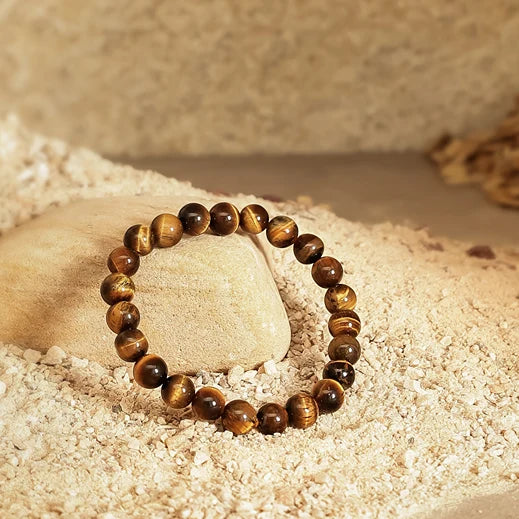
Tiger eye is a variety of quartz with a silky band of light that appears to slide across the surface as you turn it. That effect is called chatoyancy, and it is the single most reliable way to identify the stone: in genuine tiger eye the sheen is soft, wavy and uneven, following the direction of the fibres inside. In fibre-optic glass imitations it is a single razor-sharp straight line, identical on every bead. Tiger eye is quartz, so it rates 7 on the Mohs scale and is water-safe, though many pieces are waxed and prolonged soaking will strip that. Natural colours are golden brown, red-brown and blue-grey. Bright blue, green and pink are dyed.
Quartz that used to be asbestos
Tiger eye has an unusual origin, and it explains everything about how the stone behaves.
It begins as crocidolite — a fibrous blue amphibole mineral, one of the forms of asbestos. Over geological time, silica-rich fluids move through the rock and replace the crocidolite fibre by fibre with quartz. What emerges is a pseudomorph: quartz that has inherited the fibrous internal architecture of an entirely different mineral. The iron in the original crocidolite oxidises during the process, and that oxidation is what produces the familiar golden-brown colour.
Where the oxidation did not go as far, the original blue-grey survives. That material is sold as hawk’s eye, or blue tiger eye, and it is entirely natural. It is the one blue tiger eye that is not dyed.
The parallel fibres are the source of the optical effect, and they are also the reason tiger eye splits along a direction rather than breaking randomly. Cutters orient the stone deliberately so that the band falls across the finished face.
What chatoyancy actually is
Chatoyancy — from the French for cat’s eye — happens when light reflects off many parallel fibres at once. Each fibre reflects a narrow sliver of light, and because they are aligned, those slivers add up into a band. Rotate the stone and the band moves, because the angle at which the fibres return light to your eye has changed.
The important detail for identification is that natural fibres are never perfectly regular. They bend, they bunch, they vary in thickness. So the band in real tiger eye is a soft, undulating, silky sheen that shifts unevenly, brighter in some zones than others, sometimes splitting into wavy strands. It looks like light moving across brushed silk.
Manufactured fibre-optic glass, by contrast, is made of perfectly uniform parallel fibres. That produces a chatoyancy that is technically stronger and immediately wrong: a single hard, straight, brilliant line down the middle of every bead, identical on all of them. Once you have seen the two side by side you will not confuse them again.
The varieties, and which are treated
| Variety | Colour | Natural or treated |
|---|---|---|
| Golden tiger eye | Golden brown to honey with darker bands | Natural |
| Hawk’s eye (blue tiger eye) | Muted blue-grey to slate | Natural — less oxidised material |
| Red tiger eye | Deep red-brown | Usually gentle heat treatment of golden material; some natural red exists |
| Pietersite | Swirled brown, blue and gold, chaotic rather than banded | Natural — brecciated material where the fibres were broken and re-cemented |
| Bright blue, green, pink, purple | Vivid, unnatural | Dyed |
Heat-treated red tiger eye is a legitimate product and the change is permanent, in the same way heat treatment is accepted for other stones — but it should be disclosed. Dyeing is different: the colour sits in the surface and can fade, and vivid dyed tiger eye is often sold without any mention of it at all. If you see a stone with tiger eye banding in electric blue or candy pink, it has been dyed. Those colours do not occur.
How to check a piece
| Check | Real tiger eye | Fibre-optic glass | Dyed tiger eye |
|---|---|---|---|
| The band of light | Soft, wavy, uneven; varies across the piece | One hard, straight, perfect line, same on every bead | Genuine wavy band, but under an unnatural colour |
| Colour | Golden brown, red-brown or blue-grey | Any colour, often vivid | Bright blue, green, pink, purple |
| Bead-to-bead variation | Every bead differs in banding and tone | Beads are near-identical | Banding varies, colour is suspiciously even |
| Hardness | Mohs 7 — will scratch glass | About Mohs 5.5 — will not scratch glass | Mohs 7 |
| Temperature in the hand | Cool, stays cool for a moment | Warms up noticeably faster | Cool |
| Drill holes | Clean; colour continuous through the hole | May show conchoidal chipping at the rim | Often a darker ring of dye around the hole |
The quickest single test is the bead-to-bead one. Lay a bracelet flat and look along it. Natural stone was cut from rock that varied, so the banding, the tone and the position of the sheen change from bead to bead. Manufactured glass does not vary, because it was extruded.
The scratch test settles glass versus quartz definitively, but do it on an inconspicuous spot or on a piece of scrap glass rather than on the stone’s face. And note that it tells you nothing about dye — dyed tiger eye is still tiger eye and still Mohs 7.
Care
Tiger eye is one of the tougher stones to own, with two caveats.
- It is water-safe, but many pieces are waxed or oiled. Polished tiger eye is frequently finished with a light wax or oil to deepen the lustre. That coating survives a quick rinse but not a long soak or hot water. Clean with a damp soft cloth rather than by immersion, and dry it straight away.
- Avoid ultrasonic and steam cleaners entirely. The fibrous internal structure gives vibration something to work along, and any wax finish will be stripped. This is the one piece of care advice worth being strict about.
- Keep dyed pieces out of the sun. Natural golden tiger eye is comparatively stable, but dyed material fades, sometimes quite quickly. As a general rule none of your stones benefit from a sunny windowsill.
- Store it separately. At Mohs 7 it is hard, but so are the other quartz stones it is likely to be sitting next to, and they will scuff each other’s polish.
- Keep it away from chemicals. Bleach, solvents and strong cleaning products, and put perfume on before jewellery rather than after.
Is tiger eye dangerous because of asbestos?
This question comes up often enough to deserve a direct answer. In finished tiger eye the crocidolite has been replaced by quartz — the fibrous shape remains but the material is silica, not asbestos. Polished, tumbled and set tiger eye is inert and handling it poses no asbestos risk.
The genuine concern is confined to lapidary work: cutting and grinding raw material can release dust, and some raw specimens may retain unreplaced amphibole. That is a workshop matter, addressed with wet cutting and proper extraction. It has no bearing on wearing a bracelet.
Who traditionally wears it
Tiger eye is customarily associated in crystal practice with focus, courage, grounding and steadiness under pressure, and the eye-like band has long given it a place in protection traditions — the idea of a watchful eye that turns back ill intent. In Indian households it is commonly chosen alongside other protective pieces; our Raksha range groups those together.
These are traditional and contemporary beliefs, not established effects. Tiger eye is not a treatment for anxiety or any other condition and should not replace medical or professional care. It is also not one of the primary jyotish ratnas: a Vedic gemstone prescription is made by a qualified astrologer from a complete birth chart, taking account of the ascendant, the planetary lords and the running dasha. Tiger eye is generally worn as a personal choice rather than as a prescribed remedy, which makes it an easy stone to buy without a consultation.
How to choose a piece
Judge it in moving light. A photograph cannot show chatoyancy properly. Tilt the piece under a lamp; a good stone comes alive and the band travels. A flat, dull piece has been cut across the fibre direction rather than along it, and no amount of polishing fixes that.
Prefer variation to uniformity. Buyers often ask for perfectly matched beads. With tiger eye that instinct works against you, because uniformity is the signature of glass.
Be sceptical of vivid colour. Golden brown, red-brown and muted blue-grey are the natural range. Anything brighter has been dyed, and that should be reflected in both the description and the price.
Match the format to the use. A Natural Stone Bracelet is the usual choice and stands up well to daily wear. A Stone Pendant keeps the stone clear of knocks and washing-up, which suits a waxed finish. A Crystal & Gemstone Mala works if you want to count on it. The wider selection sits in All Gemstones and Gemstone Jewellery.
Frequently asked questions
What is chatoyancy in tiger eye?
It is the band of light that appears to move across the stone as you turn it, caused by light reflecting off millions of parallel fibres inside. In tiger eye those fibres are quartz that replaced the original crocidolite, and because natural fibres are irregular the effect is a soft, wavy, uneven silky sheen rather than a single sharp line.
How can I tell real tiger eye from glass?
Look at the band of light. Real tiger eye gives a soft, undulating sheen that varies from bead to bead, because the stone it was cut from varied. Fibre-optic glass gives one hard, perfectly straight line that is identical on every bead. Tiger eye also rates 7 on the Mohs scale and will scratch glass, while glass at about 5.5 will not scratch it, and glass warms up in the hand far faster.
Is blue tiger eye natural?
The muted blue-grey variety, known as hawk’s eye, is entirely natural — it is material where the iron oxidised less completely, leaving the original colour. Bright electric blue is dyed. The distinction is one of saturation: natural hawk’s eye is subdued and slaty, while dyed material is vivid.
Is red tiger eye dyed?
Usually it is heat-treated rather than dyed. Gentle heating turns golden tiger eye a deep red-brown, and the change is permanent and affects the stone itself. Some naturally red material exists but it is far less common. Heat treatment is an accepted practice provided the seller discloses it.
Does tiger eye contain asbestos?
Finished tiger eye does not pose a risk. It began as crocidolite, which is a form of asbestos, but the crocidolite was replaced by quartz over geological time — the fibrous shape survived, the material did not. Polished and set tiger eye is inert. The only genuine concern is cutting and grinding raw material in a workshop, which is handled with wet cutting and extraction.
Can tiger eye go in water?
Briefly, yes — it is quartz and rates 7 on the Mohs scale. But many pieces are finished with a light wax or oil to deepen the lustre, and a long soak or hot water will strip that. Clean with a damp soft cloth and dry immediately, and never use an ultrasonic or steam cleaner.
Who should wear tiger eye?
Anyone drawn to it. It is customarily associated with focus, courage and grounding, and the eye-like band has given it a long-standing place in protection traditions. These are traditional beliefs rather than established effects, and tiger eye is not a substitute for medical or professional care. It is not one of the primary jyotish gemstones, so it is generally worn as a personal choice rather than on prescription.


