 Cow Shelter/Donation

108 vs 54 vs 27 vs 21 Bead Mala: What Each Count Is For
August 31, 2026
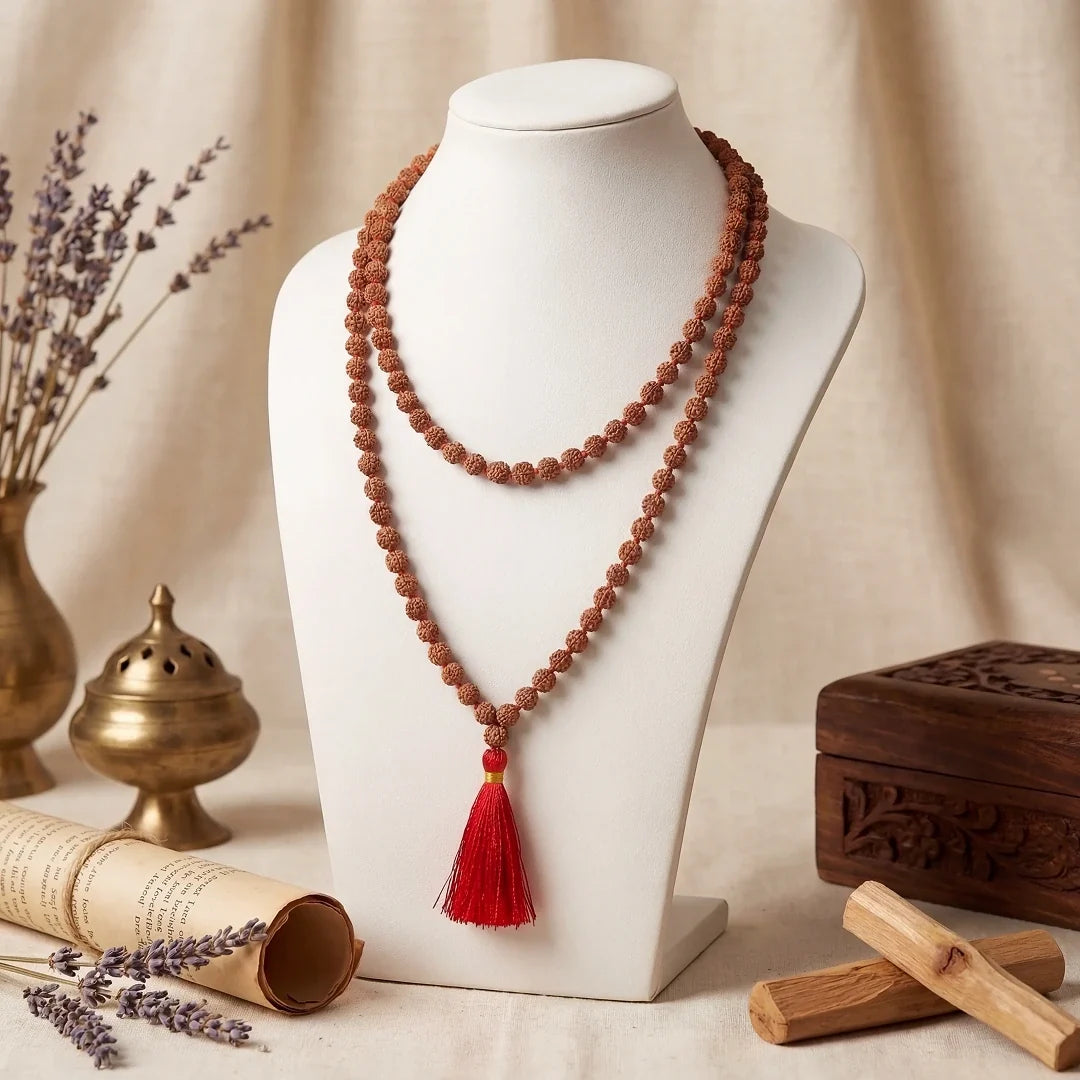
A full japa mala has 108 beads plus a sumeru. A 54-bead mala is half of it and two rounds make a full count. A 27-bead mala is a quarter, and four rounds make a full count. A 21-bead strand is not a divisor of 108 at all — it is a wrist size, made to fit an adult wrist with common bead diameters, and it is used for short recitations rather than for formal japa. If you are buying one mala for a seated practice, buy 108. If you want something you can wear all day and count on informally, 27 or 21 is the practical choice.
The four counts at a glance
| Beads | Relationship to 108 | Usual form | What it is typically used for |
|---|---|---|---|
| 108 | The full count | Long strand, worn over the head or held | Formal seated japa, sankalpas, temple and household practice |
| 54 | Exactly half — two rounds equal 108 | Short necklace or double-wrap wrist mala | Shorter sittings; a compromise between a full mala and a bracelet |
| 27 | Exactly a quarter — four rounds equal 108 | Wrist mala, worn wrapped | Japa on the move, travel, discreet daily practice |
| 21 | Not a divisor; a wrist measurement | Single-wrap bracelet | Short recitations, everyday wear, gifting |
Where 108 comes from
The number is old and the explanations are many. The one most directly relevant to a mala is astronomical: the sidereal zodiac contains 27 nakshatras, each divided into four padas, and 27 multiplied by 4 gives 108. Another common derivation multiplies the twelve rashis by the nine grahas. A third counts the 54 letters of the Sanskrit alphabet in their masculine and feminine forms.
Several proportional claims are also frequently repeated — that the distance between the Earth and the Sun is roughly 108 times the Sun’s diameter, and the Earth—Moon distance roughly 108 times the Moon’s. These are approximations rather than exact figures, and they vary as orbits vary, but they are widely cited. We have written about the number itself in more depth in Significance of 108 in Hinduism.
For buying purposes, the point is narrower: 108 is the count against which every other mala size is defined. Whatever strand you end up with, the tradition assumes you are working toward a multiple of 108.
The 108-bead mala
This is the standard, and if you intend to sit and chant it is the one to buy. The reason is practical rather than doctrinal. On a 108 mala you complete a round without stopping to multiply, and the sumeru gives you a single unambiguous marker for the end of it. On a 27-bead mala you have to keep a running tally of quarters in your head, which is precisely the sort of low-grade bookkeeping that pulls attention away from the mantra.
The trade-off is size. A 108-bead strand in 8mm beads is a substantial object — it hangs well below the chest and is not something most people wear discreetly under office clothes. Malas made for counting are also strung slightly loosely, with a little travel between beads, so the thumb can move cleanly. A tightly strung mala made for wear is noticeably harder to count on. Our Authentic Japa Mala range is strung for counting.
The 54-bead mala
Half of 108. Two rounds give you a complete count, so the arithmetic stays trivial. In practice the 54 occupies an awkward middle ground: too long for most wrists to wrap comfortably, too short to be a proper japa mala.

Where it earns its place is as a wearable necklace. A 54-bead strand in 6mm or 8mm beads sits at roughly collarbone-to-chest length, which is a comfortable everyday size, and it can be used for japa when needed. The number 54 also has its own traditional basis in the count of Sanskrit letters. If you want one object that is genuinely wearable and genuinely usable for counting, this is the compromise — see our Spiritual Necklace range.
The 27-bead mala
A quarter of 108, and the most useful of the short counts. Twenty-seven is also the number of nakshatras, so the count has a traditional basis of its own rather than being purely a fraction.
Twenty-seven beads at 6mm gives you roughly 16cm of strand, which wraps an average adult wrist once with a little to spare, or two or three times if the beads are smaller. That makes it the standard wrist mala size. It is what people carry when they want to chant on a commute, in a waiting room, or in any situation where a full-length mala is impractical. Four rounds and you have your 108.
Almost every wrist mala you will find in the 6mm range is a 27 or thereabouts — including most of our Rudraksha Bracelets and Karungali Bracelets.
The 21-bead strand, and why the number is what it is
Twenty-one does not divide into 108. It is worth being honest about this, because a good deal of writing online invents a cosmology for it after the fact.
The real reason 21 is so common is geometry. Strand circumference is roughly the bead count multiplied by the bead diameter. Twenty-one beads at 8mm gives about 17cm — which is close to the median adult wrist. Bracelets are made to fit wrists, and 21 is simply where 8mm beads land.
That said, 21 does carry independent traditional weight. Recitations of 21 repetitions appear in a number of household practices, and 21 mukhi is one of the rarest and most revered Rudraksha forms. So a 21-bead bracelet is not without meaning — it is just not a fraction of a japa round, and if you intend to chant 108 on it you will be counting five rounds plus three beads, which nobody enjoys.
Bead size and strand length
| Bead diameter | 21 beads | 27 beads | 54 beads | 108 beads |
|---|---|---|---|---|
| 6 mm | ~13 cm | ~16 cm | ~32 cm | ~65 cm |
| 8 mm | ~17 cm | ~22 cm | ~43 cm | ~86 cm |
| 10 mm | ~21 cm | ~27 cm | ~54 cm | ~108 cm |
These are approximate strand lengths before the sumeru, tassel or knots are added, and knotting between beads adds meaningfully to the total. Use them to sanity-check a listing: an adult wrist is typically 15–19cm, so anything under about 15cm of strand will not close.
Does a shorter mala count for less?
Traditionally, no — provided the arithmetic works out. Four rounds of 27 is 108 repetitions, and the repetitions are what the practice counts. What tradition does hold consistently is that the sumeru is not crossed on any mala, whatever its length, and that the count should be honest rather than estimated.
The 21-bead strand is the one exception in a practical sense, not a spiritual one. Because it does not divide into 108, a fixed number of rounds will never land exactly on a round figure, so it is generally treated as a wearable object with an informal counting function rather than as a japa instrument.
How to choose
If you have a daily seated practice: buy a 108. Nothing else removes the counting burden. Choose the material by the mantra you chant — Rudraksha and Tulsi are the two most common — and prefer a strand knotted or strung with a little play in it.
If you chant occasionally and want something wearable: 27 is the right answer. It divides cleanly, it fits the wrist, and it is the most common wrist mala size, so you will have the widest choice.
If you want a necklace that can also be counted on: 54. It is the only count that is comfortable to wear at chest length and still halves neatly into 108.
If you mainly want to wear it: 21, or whatever bead count fits your wrist in the size you like. Do not let a listing convince you that 21 has a numerological significance in mala tradition that it does not have. Buy it because it fits and you like it.
Whatever count you choose, check three things: that the bead sizes are matched rather than visibly graded, that the drill holes are clean and centred, and that the stringing material suits how you will use it. Browse the full range at Jaap Mala and Crystal & Gemstone Mala.
Frequently asked questions
Why do malas have 108 beads?
Several traditional derivations give the same figure. The most directly relevant to a mala is that the sidereal zodiac holds 27 nakshatras of four padas each, and 27 multiplied by 4 is 108. Others multiply the twelve rashis by the nine grahas, or count the 54 Sanskrit letters in masculine and feminine forms.
Can I do japa on a 27-bead mala?
Yes. Four rounds of 27 give you 108 repetitions, and the count is treated as complete. The only cost is that you have to keep track of quarters, which some practitioners find distracting during longer sittings.
Is a 21-bead bracelet a real mala?
It is a genuine strand of beads, but 21 does not divide into 108, so it is generally treated as a wearable piece with an informal counting use rather than as a japa instrument. The count is common mainly because 21 beads of 8mm fit a typical adult wrist.
Does a 108-bead mala include the sumeru?
No. The standard construction is 108 counting beads plus one larger sumeru, making 109 beads in total. The sumeru is never chanted on and is never crossed; it marks the turning point at the end of each round.
Which bead count is best for a beginner?
A 108 if you intend to sit and chant, because it removes any counting arithmetic. A 27 if you want something you can wear and use opportunistically. Both are entirely standard choices and neither is considered a lesser option.
How long is a 108-bead mala?
It depends almost entirely on bead size. Roughly 65cm of strand in 6mm beads, around 86cm in 8mm and about 108cm in 10mm, before the sumeru, tassel and any knotting are added. Knotting between beads adds noticeably to the finished length.
Can I use the same mala for different mantras?
Practice varies. Many traditions hold that a mala should be kept for a single mantra, on the reasoning that it becomes associated with that practice. Others treat one mala as serving all household chanting. If you have been given a mantra by a teacher, follow the instruction you were given.


