 Cow Shelter/Donation

Kuber Yantra vs Shree Yantra vs Pyrite Pyramid: How to Choose
September 02, 2026
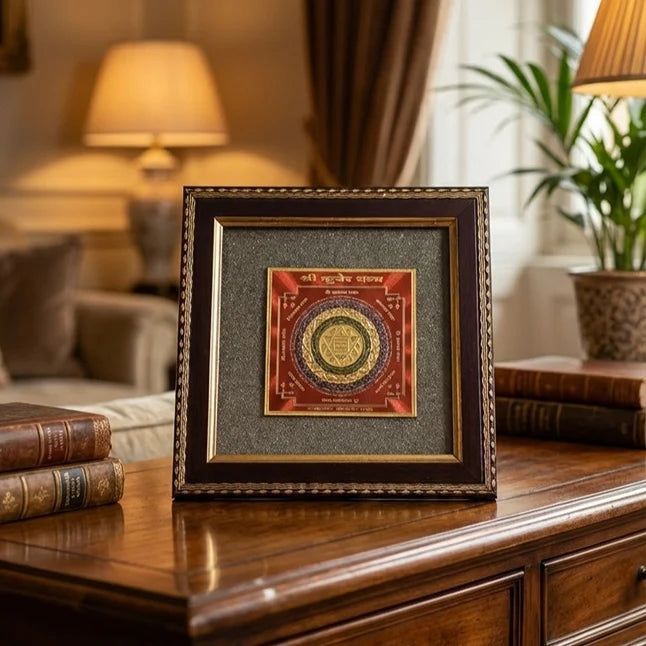
These three objects get sold side by side and are constantly treated as interchangeable. They are not. A Kuber Yantra is a numerical grid associated in Hindu tradition with Kubera, the treasurer of the gods and guardian of the north. A Shree Yantra is a geometric diagram of nine interlocking triangles associated with the Goddess. A pyrite pyramid is not a yantra at all — it is a piece of iron sulphide carved into a shape. The first two belong to ritual tradition and are energised with mantra; the third belongs to crystal practice and needs to be kept dry or it will rust. This guide sets out what each is actually for and how to choose.
Before anything else: everything below describes traditional Hindu belief and customary practice. None of these objects is a financial product, none of them produces income, and nothing on this page is financial advice.
Two of these are diagrams. One is a rock.
This distinction sounds pedantic and it is the most useful thing on the page.
A yantra is a ritual diagram. Its authority comes from its structure — specific lines, specific numbers, specific enclosures — and from the mantra recited over it. The material it is engraved on is secondary. Copper, brass, silver, wood, paper: the diagram is the object. A yantra is traditionally installed with prana pratishtha and worshipped.
A pyrite pyramid is a mineral specimen that has been shaped. Its associations come from the mineral itself — its metallic golden lustre, its density, its association in crystal practice with resolve and drive. The pyramid form is a modern shaping convention, not a scriptural prescription. Pyrite is not worshipped in the way a yantra is; it is kept, placed and handled.
The practical consequence is that they are cared for completely differently, and that keeping one does not substitute for keeping another. They belong to different systems.
Kuber Yantra
Kubera, in Hindu tradition, is the lord of wealth and the treasurer of the gods, and he is the dikpala — the guardian — of the north. That single fact explains almost all the customary practice around this yantra: the north placement, the locker, the cash box.
Unlike the Shree Yantra, the Kuber Yantra is not built from triangles. It is a magic square — a three-by-three grid of numbers. The version most commonly reproduced in Indian practice reads 27, 20, 25 across the top row, 22, 24, 26 across the middle and 23, 28, 21 across the bottom. Every row, every column and both diagonals add to 72. That constant sum is the point of the diagram: the grid is balanced in every direction it can be read.
Customarily it is kept where money is kept — inside a locker, a safe, a cash drawer or an almirah — or in the north of the puja room. Many households install it on Dhanteras or Diwali. It is frequently paired with Lakshmi worship rather than kept alone.
Shree Yantra
The Shree Yantra is the more elaborate of the two diagrams: nine interlocking triangles — four pointing up, five pointing down — intersecting to form forty-three smaller triangles, surrounded by rings of sixteen and eight lotus petals, three circles and an outer square with four gates. In Vedic tradition it is regarded as the visual form of the Goddess Lalita Tripura Sundari and it is central to the Sri Vidya stream of worship.

Its scope in tradition is much broader than wealth. It is a complete devotional object, worshipped enclosure by enclosure, and in Sri Vidya practice it is the primary focus rather than an accessory to something else. Households that keep one usually place it in the mandir as a central object. We have covered its structure, placement and energisation in detail in our full Shree Yantra guide.
Pyrite pyramid
Pyrite is iron disulphide, FeS2. It has a brassy metallic lustre convincing enough that it earned the nickname fool’s gold, although it is easy to separate from the real thing: gold is soft, heavy and malleable, while pyrite is brittle, considerably lighter and shatters rather than bends. It sits at about 6 to 6.5 on the Mohs scale.

In crystal practice it is customarily associated with drive, determination and confidence, and it is one of the stones most often chosen for a workspace or a shop. The pyramid shape is a modern crystal-practice convention rather than a traditional Indian form, and pyrite is also sold as raw clusters, tumbled pieces, spheres and bracelets.
Its serious drawback is chemical. Pyrite oxidises. In the presence of moisture and oxygen it breaks down, producing iron sulphates and sulphuric acid — a process collectors call pyrite decay or pyrite disease. The visible symptoms are a dulling of the lustre, a white or yellowish powder on the surface, rust-coloured spotting, and eventually crumbling. In a humid Indian monsoon this is not a theoretical risk. Pyrite must be kept dry, must never be soaked, and must never be cleansed in salt water, which accelerates the reaction badly.
Side by side
| Kuber Yantra | Shree Yantra | Pyrite pyramid | |
|---|---|---|---|
| What it is | A ritual diagram — a 3x3 numerical grid | A ritual diagram — nine interlocking triangles in nine enclosures | A mineral specimen (iron sulphide) carved to shape |
| Tradition it belongs to | Hindu ritual practice; Kubera worship | Hindu ritual practice; Sri Vidya | Modern crystal practice |
| Traditionally associated with | Wealth, custody of resources, the north direction | The Goddess; broad devotional scope | Drive, resolve, confidence |
| Usually kept | In a locker, safe or cash box; or the north of the mandir | In the mandir, as a central object | On a desk, shop counter or shelf — somewhere dry |
| Energised with mantra? | Yes, customarily | Yes, customarily | No ritual installation; cleansed by crystal-practice convention |
| Common materials | Copper, brass, silver; also wood | Copper, brass, wood, stone; also 3D Meru form | The mineral itself |
| Main care risk | Metal tarnishes and darkens | Metal tarnishes; wood must stay dry | Rusts and crumbles if damp — the most fragile of the three |
| Water? | Metal versions traditionally washed then dried fully | Metal versions traditionally washed then dried fully | Never. Dry cloth only |
Care, in one paragraph each
Yantras in metal. Copper and brass darken. This is normal oxidation, not damage. Clean gently with a traditional mild cleaner — tamarind pulp, or lemon and salt — rinse, and dry completely before returning it to the mandir, since trapped moisture is what causes lasting staining. Our Brass Collections follow the same care logic.
Yantras in wood. Wipe with a dry cloth. Do not wash. Our Karungali Yantra pieces are cut into government-lab-certified Karungali, which needs no polishing but should be kept away from water.
Pyrite. Dry cloth only, always. No water, no salt, no soaking, no humid bathroom shelf. In a monsoon climate, storing it in a closed box with a silica gel sachet is a sensible precaution. If rust spotting has already begun you can slow it by drying the piece thoroughly and keeping it dry, but you cannot reverse it. See our Pyrite Collection and Pyrite Jewellery, and our separate guide on where to keep a pyrite pyramid.
How to choose between them
Choose the Kuber Yantra if what you want is the specific, narrow, traditional wealth-custody object. It is the most focused of the three, it has a clear customary place — the locker or the cash box — and it does not ask for a permanent altar. It is the usual choice for a shop or a business, and for households that install something new at Dhanteras.
Choose the Shree Yantra if you want a devotional object with a much wider scope, and if you have a mandir where it can be the central focus. It carries a fuller worship tradition behind it, it rewards regular practice, and it is the choice for anyone drawn to Sri Vidya. It is not the right choice if what you actually want is a small object for a drawer.
Choose a pyrite pyramid if you are working within crystal practice rather than ritual tradition, and if you want something for a desk or a counter rather than for a puja room. Be honest with yourself about the humidity where you live: pyrite is the least forgiving of the three, and a piece kept in a damp room will spoil. Other Pyramid materials are available if that is a concern.
Can you keep all three? Yes, and many households do. There is no traditional prohibition on keeping multiple yantras, and pyrite belongs to a different system entirely so no conflict arises. The only real advice is to place them appropriately — the yantras raised and clean in the mandir or locker, the pyrite somewhere dry — and to keep whatever practice you commit to rather than accumulating objects. If you want a bundled starting point, our Dhan Varsha range groups the wealth-tradition pieces together.
Frequently asked questions
What is the difference between a Kuber Yantra and a Shree Yantra?
A Kuber Yantra is a three-by-three grid of numbers whose rows, columns and diagonals share a constant sum, associated in Hindu tradition with Kubera, the treasurer of the gods and guardian of the north. A Shree Yantra is a far more elaborate geometric diagram of nine interlocking triangles in nine enclosures, associated with the Goddess. The Kuber Yantra is narrow and specific to wealth custody; the Shree Yantra carries a much broader devotional tradition.
Is a pyrite pyramid a yantra?
No. A yantra is a ritual diagram whose meaning comes from its geometry and the mantra recited over it. A pyrite pyramid is a mineral specimen carved into a shape, belonging to modern crystal practice rather than to Hindu ritual tradition. They are different kinds of object and are kept and cared for differently.
Can I keep a Kuber Yantra and a Shree Yantra together?
Yes. There is no traditional prohibition on keeping more than one yantra, and the two are commonly found together in the same household — often with the Shree Yantra in the mandir and the Kuber Yantra in the locker or cash box. What matters more than the number is that each is kept clean, raised off the floor and treated respectfully.
Why does my pyrite have rust spots?
Pyrite is iron sulphide, and in the presence of moisture and oxygen it oxidises, forming iron sulphates and releasing sulphuric acid. The result is dulling, white or yellow powder and rust-coloured spotting, and over time the piece can crumble. It is caused by damp. Keep pyrite dry, never soak it, never cleanse it in salt water, and in a humid climate store it in a closed box with a silica gel sachet.
Which of the three is best for a shop or business?
Traditionally the Kuber Yantra is the object kept where money is kept, so it is the customary choice for a cash counter, drawer or safe. Pyrite is frequently chosen for a desk within crystal practice. Both are matters of custom and belief, and neither should be understood as a business strategy or as financial advice.
Do these objects need to be energised?
The two yantras customarily are. The traditional rite is prana pratishtha, performed in full by a qualified priest, though many households follow a simplified home procedure of cleaning the yantra, placing it on a fresh cloth, making offerings and chanting a set number of repetitions. Pyrite has no equivalent ritual installation; crystal practice uses its own cleansing conventions, and for pyrite those must be dry ones.
Do any of these guarantee wealth?
No. These are objects of traditional belief and customary practice, and no claim of a financial outcome can responsibly be attached to any of them. They are not financial products and nothing about keeping them constitutes financial advice.


