 Cow Shelter/Donation

Onam: The Mahabali Legend, the Ten Days, the Pookalam and the Onasadya
September 03, 2026
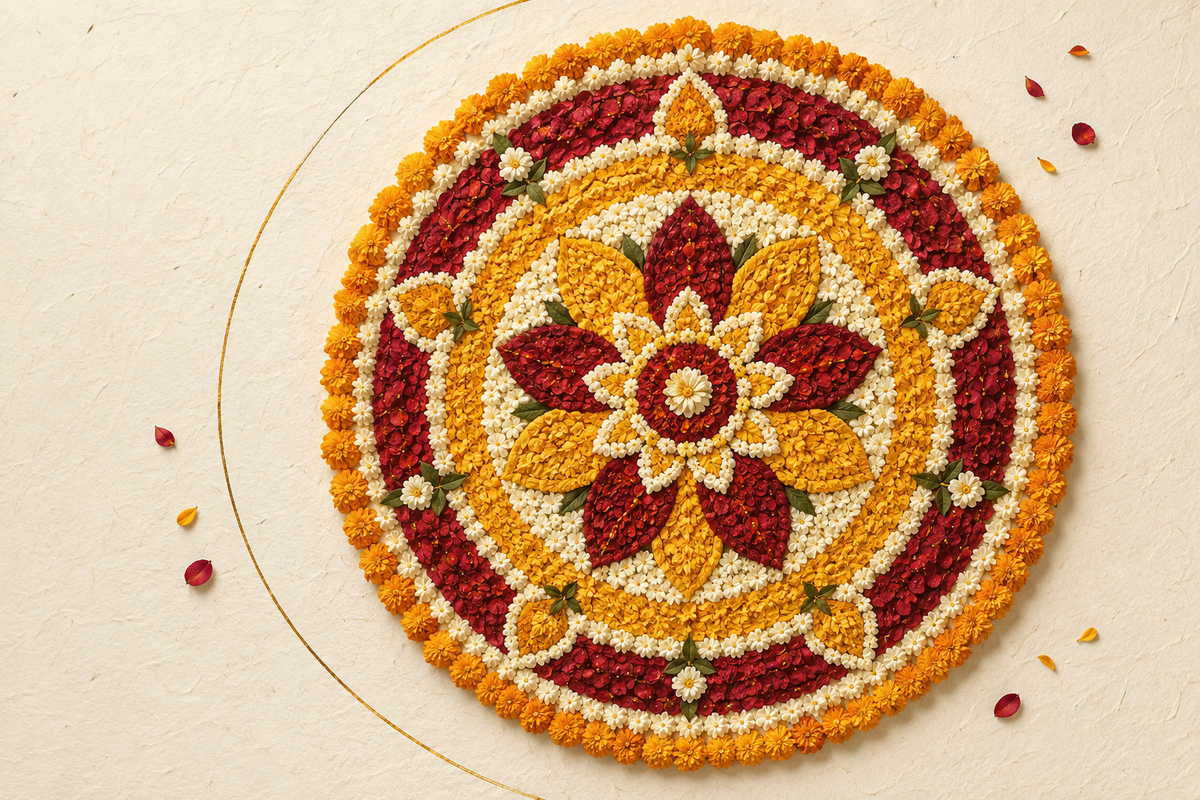
Onam is Kerala's harvest festival and its state festival — ten days set by the Malayalam solar calendar, beginning on the Atham star in the month of Chingam and ending on Thiruvonam. It commemorates the annual homecoming of Mahabali, the asura king of Kerala's remembered golden age, who was sent below by Vishnu in his Vamana form and granted the boon of returning once each year to see his people. Households mark it with a flower carpet that grows daily, new clothes, boat races and the great vegetarian feast. Onam is a harvest and cultural festival more than a temple one. Confirm the dates against a current panchang.
Why Onam is not quite like the other South Indian festivals
It is worth naming the difference at the outset, because it shapes everything else. Karthigai Deepam, Thai Pusam and Skanda Sashti are temple observances: the centre of gravity is the shrine, the liturgy and the deity's procession. Onam's centre of gravity is the house and the harvest.
The pookalam is laid in the courtyard, the sadya is eaten at home, the boat races are village against village, and the whole ten days are shaped around the return of a king rather than around a deity's festival calendar. Onam is also kept across religious communities in Kerala and among Malayalis abroad, as a shared cultural and seasonal festival. None of this makes it less serious. It makes it a different kind of thing, and it should be described as one.
The legend of Mahabali and Vamana
Mahabali — Maveli in Malayalam — ruled Kerala, and in the traditional account his reign was a time when there was no deceit, no poverty and no distinction of high and low. The old Malayalam verse that every Keralite child learns describes exactly that: everyone equal, no one in want, no falsehood anywhere.

His very virtue became the difficulty. In the account, Vishnu takes the form of Vamana, a small brahmin boy, and comes to Mahabali's sacrifice to ask for as much land as he can cover in three paces. Mahabali grants it despite being warned. Vamana then grows without limit; with one stride he covers the earth and with the second the heavens, and asks where the third is to be placed. Mahabali offers his own head. He is set below, in Patala, and is granted the boon of returning once a year to see whether his people are still well.
Onam is that visit. The pookalam, the new clothes and the feast are traditionally understood as the household showing Maveli that all is still well — which gives the festival its particular note of welcome and slight melancholy, quite unlike a festival of victory.
The ten days
The sequence follows the nakshatras from Atham to Thiruvonam.
| Day | Star | What it traditionally carries |
|---|---|---|
| 1 | Atham | The pookalam is begun, traditionally as a small single ring. At Thripunithura, the Athachamayam procession opens the season |
| 2 | Chithira | A second ring is added. Cleaning of the house begins in earnest |
| 3 | Chodhi | The pookalam grows again. Onakkodi, the new clothes, are traditionally bought around now |
| 4 | Vishakam | Preparation for the sadya begins; markets are at their busiest |
| 5 | Anizham | Associated with the snake boat races on the Pamba and elsewhere |
| 6 | Thriketa | Families travelling home begin to arrive |
| 7 | Moolam | A smaller sadya is served in many households and at temples |
| 8 | Pooradam | In many homes the Onathappan figures are placed at the centre of the pookalam |
| 9 | Uthradam | First Onam. The final day of buying and cooking; traditionally the eve of Maveli's arrival |
| 10 | Thiruvonam | The main day. Ritual bath, new clothes, the largest pookalam, offerings and the full Onasadya |
Some families continue to a third and fourth Onam on the days after Thiruvonam. Practice varies by district and by household.
The pookalam
The pookalam is a carpet of loose flower petals laid on the swept ground of the courtyard or the front of the house. It is not decoration added on the main day; it is a ten-day practice.
It begins on Atham as a small circle, traditionally of yellow flowers, and a ring is added each day so that it is at its largest and most intricate on Thiruvonam. Petals are separated and laid by hand rather than glued, and it is remade fresh each morning. Traditional flowers include thumba, thechi, chethi, mukkutti, marigold and hibiscus, though what is actually available locally governs.
In many households small conical figures of clay or mud, the Onathappan, are placed at the centre from Pooradam or Uthradam onwards. These are traditionally understood as representing Vamana or Mahabali, and households differ on which.
The Onasadya
The sadya is a vegetarian feast served on a fresh banana leaf, eaten with the hands and served in a fixed order, with the narrow end of the leaf to the diner's left. It is served at midday on Thiruvonam.
The dish count varies with the household and the region; anything from around twenty to more than twenty-six items is normal for a full sadya. What recurs almost everywhere:
- Tangy and sharp items at the top of the leaf — injipuli or puli inji, pickles of mango and lime, and one or two pachadi and kichadi preparations
- Vegetable dishes — avial, thoran, olan, kaalan, erissery, each with its own texture and coconut treatment
- Crisp accompaniments — pappadam, banana chips, sarkkara varatti
- Rice served in courses — with parippu and ghee first, then sambar, then rasam, then pulissery or moru
- Payasam to close — ada pradhaman, palada or semiya, often more than one
The order matters and is part of what makes a sadya a sadya rather than a large lunch. Folding the leaf towards yourself at the end is the conventional way of signalling that the meal was good.
Beyond the household
Three things happen outside the house and are inseparable from the season. Vallam Kali, the snake boat races, with crews of a hundred or more rowing to the vanchipattu on the backwaters. Pulikali, the tiger dance of Thrissur, performed on the days after Thiruvonam. And Thiruvathira Kali or Kaikottikali, the women's circle dance performed around the lamp.
The Thrikkakara Vamanamoorthy temple near Ernakulam is traditionally regarded as the home of Onam and as standing where Mahabali's capital stood, and it holds its own festival across the ten days.
Keeping Onam away from Kerala
- Start the pookalam on Atham, even if it is small. The daily growth is the practice, not the final size. Loose petals on a swept, dampened floor; no glue, no board.
- Light the lamp at the entrance and beside the pookalam each evening. A nilavilakku is the traditional form; see our guide to diyas and lamps.
- Buy Onakkodi for the household, and give to elders on Thiruvonam morning. Our note on gifts for parents and elders may help if you are away from home.
- Cook what you can of the sadya. A six- or eight-item sadya on a banana leaf is far closer to the spirit of the day than an elaborate meal on a plate.
- Eat together and eat at midday. The sadya is a shared meal; the sharing is most of the point.
For the general household sequence see how to do puja at home. Chingam follows Karkidakam, the Kerala month that runs parallel to the Tamil Aadi — a lean, inward month, which is exactly why the harvest month that follows it is kept as it is. Lamps, thalis and vessels are in the Diyas and Lamps, Pooja Thali and Kalash and Pooja Accessories collections.
Frequently asked questions
When is Onam observed?
Over ten days in the Malayalam month of Chingam, beginning on the Atham star and ending on Thiruvonam, which places it in August or September. Because it is fixed by nakshatra rather than by a Gregorian date, it moves each year. Confirm against a current panchang for your own city.
What is the story of Mahabali and Vamana?
Mahabali ruled Kerala in a remembered golden age of equality and honesty. Vishnu came to him as Vamana, a small brahmin boy, and asked for as much land as he could cover in three paces. Vamana then grew without limit, covering earth and heaven in two strides, and Mahabali offered his own head for the third. He was sent below and granted the boon of returning once a year to see his people.
What are the ten days of Onam?
They follow the nakshatras from Atham through Chithira, Chodhi, Vishakam, Anizham, Thriketa, Moolam, Pooradam and Uthradam to Thiruvonam. The pookalam grows through them, preparation intensifies, and the main day is Thiruvonam. Some households continue for a further day or two afterwards.
What is a pookalam?
A carpet of loose flower petals laid by hand on swept ground in front of the house. It is begun on Atham as a small ring, traditionally of yellow flowers, and a ring is added each day so that it reaches its full size on Thiruvonam. It is remade fresh each morning rather than preserved.
What is served in an Onasadya?
A vegetarian feast on a banana leaf, served in a set order and eaten with the hands. Typically injipuli and pickles, pachadi and kichadi, avial, thoran, olan, kaalan and erissery, pappadam and banana chips, rice served in courses with parippu, sambar, rasam and pulissery, and payasam to close. A full sadya may run past twenty-six items, but a modest one is entirely proper.
Is Onam a religious festival?
It has a clear traditional basis in the Mahabali and Vamana account, and the Thrikkakara temple holds its own festival across the ten days. But Onam is kept primarily as a harvest and cultural festival, at home rather than at the shrine, and it is observed across religious communities in Kerala and among Malayalis abroad.
What is Thiruvonam, and how does it differ from Uthradam?
Uthradam is First Onam, the eve: the last day of buying and cooking, traditionally the day Maveli is said to arrive. Thiruvonam is the main day, with the ritual bath, new clothes, the largest pookalam, offerings and the full sadya at midday.


