 Cow Shelter/Donation

Selenite: Why It Must Never Touch Water, Care & Cleansing Other Stones
September 03, 2026
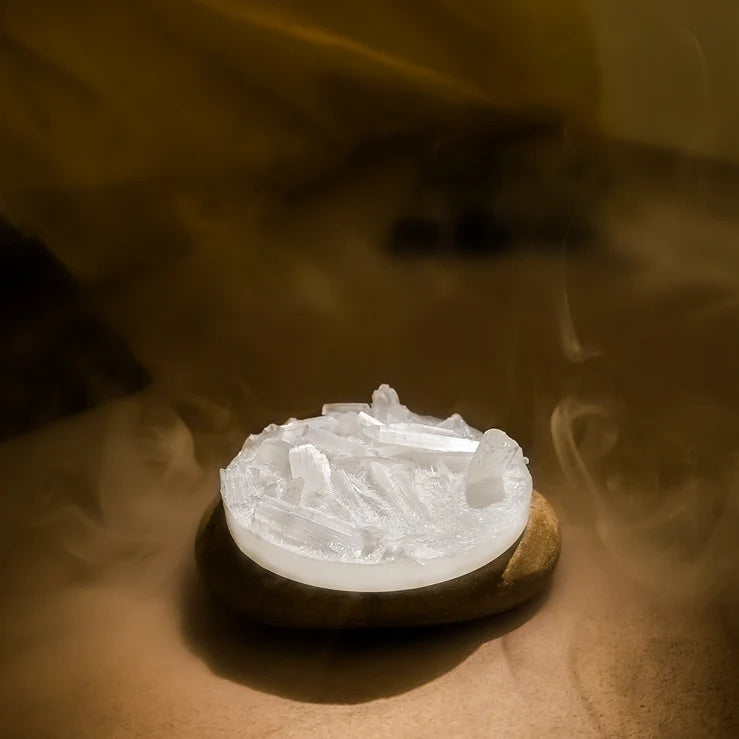
Selenite is a crystalline form of gypsum — calcium sulphate dihydrate — and it behaves nothing like the quartz stones it sits next to on a shelf. It rates 2 on the Mohs scale, soft enough to scratch with a fingernail, and it is soluble in water. Soak a selenite wand and the surface dissolves, goes chalky and begins to flake apart along its fibres. There is no way to reverse it. This is the one crystal where the care rule is absolute: clean it dry, keep it out of humidity, and never use water on it. Its main practical use — cleansing other stones — works precisely because it is a dry method.
Gypsum, not quartz
Almost every crystal a household owns is quartz or a relative: clear quartz, rose quartz, amethyst, citrine, tiger eye, agate. All of them sit at around 7 on the Mohs scale, all are chemically stable, all can be rinsed under a tap.
Selenite is in a different category altogether. Chemically it is CaSO4 with two water molecules built into its structure — calcium sulphate dihydrate. It is the same mineral family as the plaster on your walls. Gypsum is slightly soluble in water, which sounds harmless and is not: slightly soluble is more than enough to ruin a polished surface, and the effect compounds every time it is repeated.
The name comes from Selene, the Greek goddess of the moon, given for the soft pearly sheen the fibrous varieties show when light runs along them.
Selenite against a typical quartz stone
| Selenite | Quartz stones (rose quartz, citrine, tiger eye) | |
|---|---|---|
| Mineral | Gypsum — calcium sulphate dihydrate | Quartz — silicon dioxide |
| Hardness | 2 — a fingernail scratches it | 7 — scratches glass |
| Water | Dissolves. Never | Safe |
| Humidity | Dulls and degrades over time | No effect |
| Sunlight | Not a fading risk; avoid sustained heat | Rose quartz, amethyst and citrine fade |
| Cleaning | Dry cloth or soft brush only | Lukewarm water and mild soap |
| Physical handling | Chips, dents and splinters easily | Robust for daily wear |
What happens when selenite gets wet
The damage runs in stages and each is permanent.
- The polish goes. Water dissolves the outermost layer, leaving a dull, slightly rough surface where there was a satin sheen.
- The surface turns white and chalky. As dissolved material redeposits and the surface breaks down, a powdery bloom appears.
- The fibres separate. In the long fibrous varieties, water works between the fibres and they begin to split and lift, so the piece starts shedding fine splinters.
- Structural failure. Repeated soaking, or one long one, and the piece crumbles or breaks along the fibre direction.
Humidity does the same thing more slowly. A selenite tower left in a bathroom, or on a windowsill in monsoon season, will lose its lustre over months without ever being rinsed. This is worth taking seriously in an Indian climate. Salt water is worse than plain water, so the salt-bowl cleansing method that suits some stones must never be used on this one.
Softness is the other trap
At Mohs 2, selenite is softer than a fingernail, softer than a coin, and very much softer than every other crystal likely to be in the same box. In practice that means:
- It will pick up scratches from ordinary handling and from being set down on grit.
- Any harder stone stored touching it will mark it.
- It dents rather than resisting — a knock leaves a permanent depression.
- It is a poor choice for a ring or a bracelet, which is why you rarely see it set that way. Pendants are the practical limit for wear.
- The fibrous varieties splinter along the fibre direction, and the splinters are sharp enough to be worth handling carefully.
Selenite, satin spar and desert rose
Here is something almost no shop mentions. The long white fibrous wands, towers and charging plates sold everywhere as selenite are, mineralogically speaking, usually satin spar. True selenite is the transparent, glassy, tabular variety. Both are gypsum, both behave identically in water, and the trade uses the names interchangeably — so this is a matter of accuracy rather than of anyone being cheated.
| Name | What it looks like | Note |
|---|---|---|
| Selenite (strictly) | Transparent, glassy, tabular or blade-like crystals | The variety the name properly belongs to |
| Satin spar | White or cream, fibrous, with a silky sheen that runs along the length | What most wands, towers and charging plates actually are |
| Desert rose | Rosette clusters of bladed crystals with sand grains included | Gypsum, sometimes baryte; formed in arid conditions |
| Gypsum flower | Curling, petal-like formations | The most fragile of the group |
The practical takeaway: whichever of these you own, the care rules are the same, because they are all gypsum.
Using selenite to cleanse other stones
The most common reason people buy selenite is to cleanse other crystals with it, usually by resting them on a flat selenite plate or bar overnight. It is worth being straightforward about what this is: a convention of modern crystal practice, not a Vedic or scriptural tradition. Selenite is not one of the traditional Indian ritual stones, and its cleansing role is a contemporary belief rather than an established effect.

That said, as a practical method it has one genuine, non-mystical advantage: it is dry. The two most popular alternatives are water and sunlight, and both actively damage a long list of common stones. A selenite plate damages none of them.
| Stone | Why water or sun is a problem | Dry method suitable? |
|---|---|---|
| Pyrite | Oxidises with moisture — rust spotting, powdering, eventual crumbling. Salt water is worst | Yes — the only sensible option |
| Rose quartz | Water safe, but prolonged sunlight fades the pink permanently | Yes |
| Citrine and amethyst | Water safe, but both fade in sustained sun | Yes |
| Tiger eye | Often waxed; long soaking strips the finish | Yes |
| Selenite itself | Dissolves in water | Yes — dry cloth only |
So if you keep a mixed collection, a selenite plate is a sensible default simply because you cannot get the care wrong with it. Our guides to rose quartz and tiger eye go into the individual care rules in more detail, and the Pyrite Collection is the category where dry handling matters most.
Two things it will not do. It will not repair a stone, and it does not need cleansing itself in any physical sense — the common claim that selenite is self-cleansing is part of the same set of beliefs, not a property you can test.
How to care for selenite
- Dust it dry. A soft dry cloth, or a soft dry brush for a textured piece. Nothing damp. Not a baby wipe.
- No water, no salt, no oil. None of the three. Oil soaks into the porous surface and cannot be removed.
- Keep it out of humid rooms. Bathrooms and kitchens are the worst places in the house for it. In a humid climate, storing it in a closed box with a silica gel sachet is a reasonable precaution.
- Store it apart from harder stones. Its own box, or wrapped in soft cloth. Anything else in the drawer will scratch it.
- Set it down carefully and keep it away from table edges. Selenite does not survive being dropped.
- Avoid sustained heat. Gypsum contains structurally bound water and prolonged heat is not good for it. This is not a fading risk of the kind rose quartz has, but a hot windowsill is still not the right shelf.
Who uses it, and how to choose
Selenite is customarily associated in modern crystal practice with clarity, calm and clearing a space, and it is most often kept as a lamp, a tower or a flat charging plate rather than worn. Those associations are beliefs, not established effects, and selenite is not a treatment for any condition.
If you are buying:
Choose a plate if the purpose is cleansing. A flat bar or slab that other pieces can sit on is the practical form, and it does not need to be large.
Check the edges before you buy. Look for chips, dents and any place where fibres have begun to lift. Damage on a soft stone tends to spread rather than stay put.
Look at the sheen along the length. Good satin spar has an even silky lustre that travels as you tilt it. A dull, chalky or patchy surface usually means the piece has already been wet at some point.
Do not buy it as jewellery you will wear hard. At Mohs 2 a selenite ring will not last. If you want a stone for daily wear, the quartz family is the right place to look — see Natural Stone Bracelets, Stone Pendants or the wider All Gemstones and Gemstone Jewellery ranges. For a display piece that shrugs off handling, a Crystal Tree is a more forgiving choice than a selenite tower.
Frequently asked questions
Why can selenite not go in water?
Because it is gypsum — calcium sulphate dihydrate — and gypsum is soluble in water. Immersion dissolves the surface, leaving it dull and chalky, and works between the fibres so the piece begins to split and flake. The damage is permanent, and repeated exposure will eventually destroy the piece.
What happens if my selenite already got wet?
Dry it immediately and thoroughly with a soft dry cloth, then leave it somewhere dry and warm but not hot. Surface dulling and any chalkiness cannot be reversed, but drying it promptly stops further damage. Do not attempt to polish it back — at Mohs 2 you will only remove more material.
Can selenite be cleaned at all?
Yes, dry. A soft dry cloth for smooth pieces, a soft dry brush for textured ones. No water, no damp cloths, no salt and no oil. Oil in particular soaks into the porous surface and cannot be removed.
Is selenite the same as satin spar?
Both are varieties of gypsum, and the trade uses the names interchangeably. Strictly, selenite refers to the transparent glassy crystals, while the white fibrous wands, towers and charging plates sold as selenite are usually satin spar. Since they are the same mineral, the care rules are identical.
How does selenite cleanse other crystals?
Resting stones on a selenite plate is a convention of modern crystal practice rather than a Vedic tradition, and its cleansing role is a matter of belief rather than an established effect. What it does have is a real practical advantage: it is a dry method, so unlike water or sunlight it will not rust pyrite, fade rose quartz or amethyst, or strip the wax finish from tiger eye.
Can I wear selenite jewellery every day?
Not really. At 2 on the Mohs scale it is softer than a fingernail, so it scratches, dents and chips with ordinary handling, and it is a poor choice for a ring or bracelet. A pendant worn occasionally and kept clear of water is about the limit. For daily wear, choose a quartz-family stone instead.
Does selenite need to be cleansed itself?
It is often described as self-cleansing, which belongs to the same set of contemporary beliefs as the practice of cleansing with it. In physical terms it needs dusting with a dry cloth and nothing else — and specifically it must never be cleansed in water or salt, both of which will damage it.


