 Cow Shelter / Donation

1 Mukhi Nepali Rudraksha Complete Guide 2027: Forms, Who Wears It, How to Verify and How to Wear
Published · Updated
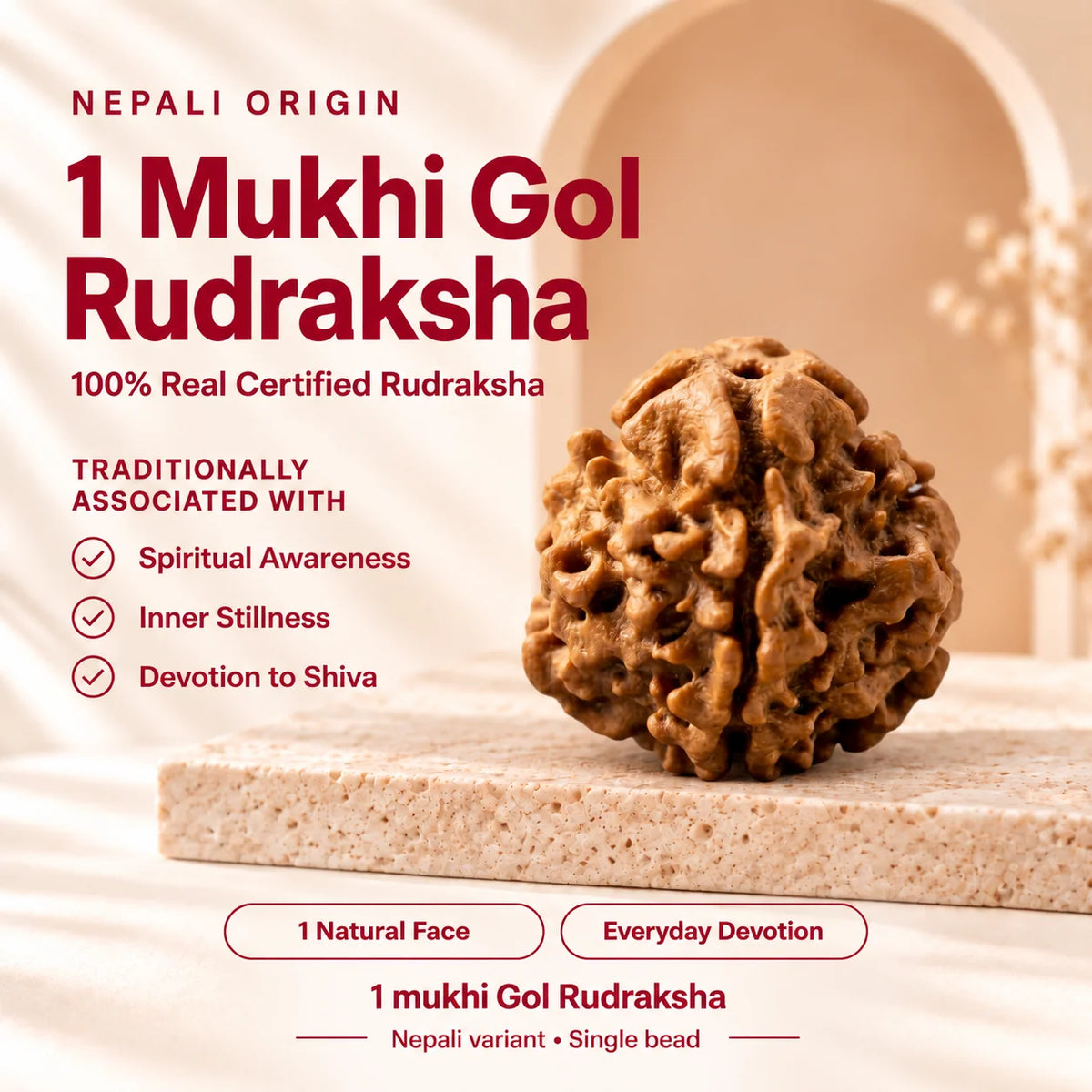
A 1 mukhi (ek mukhi) Rudraksha has a single natural line and, under X-ray, a single seed chamber. The round Nepali form is very rare; most 1 mukhi beads sold are the half-moon (kaju-dana) form. Tradition links the bead to Shiva and Surya; it is worn on a Monday with Om Namah Shivaya, once an X-ray report confirms one chamber.
The Divine Hindu App is here.
Chat with astrologers, generate your Kundli, book temple Puja and Chadhava, and check today's Panchang — all in one app.
What a 1 mukhi Rudraksha is
Rudraksha is the dried seed of Elaeocarpus ganitrus, a tree of the Himalayan foothills whose most prized beads come from the eastern hills of Nepal. The "mukhi" are the natural lines that run from the top of the bead to its bottom, and each line corresponds to an internal chamber that holds a seed. A 1 mukhi, or ek mukhi, Rudraksha therefore has one line outside and one chamber inside.
The inside is what a laboratory checks, because a line can be carved but a chamber cannot be added. In the most widely followed chart the 1 mukhi is the bead of Shiva and of the graha Surya, which is why it is the most imitated bead in the market. The chart is in the ruling planet and deity chart for 1 to 14 mukhi; origin and what to check before paying are in the Nepali Rudraksha buying guide 2027.
The three forms of 1 mukhi: round Nepali, half-moon and carved
Anyone searching for an original ek mukhi Rudraksha meets three different objects under one name. Two are natural; one of those is common.
| Form | What it is | How common | What the X-ray shows |
|---|---|---|---|
| Round Nepali 1 mukhi (gol) | A full, round Elaeocarpus ganitrus bead from Nepal with one natural line running pole to pole | Extremely rare; a handful in a season, if at all | A single seed chamber, no internal partitions |
| Half-moon 1 mukhi (kaju-dana, chandrakar) | A flat, crescent-shaped bead from Indonesia or south India with one line along its length | The common form; the honest 1 mukhi most devotees own | A single chamber inside a flattened seed |
| Carved or fabricated "1 mukhi" | A multi-mukhi bead, betel nut or wood with a line, Om, trishul, Shivling or snake cut into it; sometimes a glued line | Widely sold, usually with a story attached | Several chambers, a solid body with none, or filled grooves |
A bead with a snake, Shivling, trishul or Om said to have "formed naturally" on it is carved; those shapes do not grow on a seed. A large, round 1 mukhi sold on a verbal assurance should be treated with scepticism until an X-ray shows one chamber. How the two natural forms compare in hand is covered in 1 mukhi round Nepali vs Indonesian half-moon.
Honest availability: what you can actually buy
Most 1 mukhi beads sold anywhere, including at Divine Hindu, are the half-moon form. A natural round Nepali 1 mukhi does exist, and the store lists it separately as the 1 Mukhi Gol (round) Rudraksha, but it is rare enough that it should never be the default expectation.
The half-moon 1 Mukhi Rudraksha is a complete and traditional bead with one line, one chamber and the same deity association. What matters is that form and origin are stated plainly and the X-ray report is supplied; every bead in the 1 mukhi Rudraksha collection is lab-certified on exactly those points. A seller who does not say which form a 1 mukhi is has given the first warning.
Deity, graha and who wears 1 mukhi in tradition
By the most widely followed chart the 1 mukhi is the bead of Shiva himself and of Surya among the grahas; the texts describe it as the seed of detachment. Traditions differ on these pairings, so the deity named on one list may not match another.
The wearers tradition names are Shiva devotees, seekers of a sannyasi temperament, those who practise single-pointed japa, and people at a stage of life where they wish to loosen their hold on worldly ties. Tradition is equally frank about who it is not for: the bead suits a contemplative temperament more than a householder engaged in family and trade.
Many gurus therefore point a working householder to the 5 Mukhi Rudraksha, the all-purpose bead of Guru, and suggest keeping the 1 mukhi in the puja room, worshipped daily and taken up on fasts and on Shivaratri.
Surya-ruled Simha (Leo) Moon-sign natives are often pointed to the 1 mukhi or the 12 Mukhi Rudraksha as the rashi-lord bead; the sign-wise map is in Rudraksha for 2027 by rashi and the full year in the Simha Rashi 2027 horoscope. Age and custom exceptions are in who should not wear Rudraksha.
How to verify a 1 mukhi before and after you buy
The only reliable test for a 1 mukhi is imaging. An X-ray or CT scan of a real ek mukhi shows one seed chamber; a carved bead shows the several chambers of the seed it was cut from, and a betel-nut or wooden fake shows none. A glued line appears as a seam under a magnifier; the water test proves nothing, since a dense fake sinks as readily as a real bead.
The certificate should carry an X-ray image you can match to your bead, state species, origin and form, give weight and size, and declare the bead natural and untreated. How to read such a report, and which home tests are myths, is explained in Rudraksha lab certificate and X-ray report explained. Typical sizes for both forms, and why a bigger bead is rarer rather than stronger in tradition, are in the Nepali Rudraksha size chart.
How to wear a 1 mukhi Rudraksha
| Element | Convention |
|---|---|
| Day | Monday, the day of Shiva; many begin on Maha Shivaratri or a Shravan Monday |
| Mantra | Om Namah Shivaya, or the beej mantra Om Hreem Namah, 108 times at the first wearing |
| Setting | Silver or gold cap, or red or yellow thread; worn as a pendant near the heart, or kept on the puja altar |
| Preparation | Washed in Ganga water, offered raw milk and sandal paste, placed before a Shivling, then worn |
| Companions | Worn alone, or with a 5 mukhi mala; a Gauri Shankar bead in some lineages |
| Time | Morning after bathing, before food, facing east |
The mantra for every bead is in the Rudraksha beej mantra chart. Daily customs, such as removing the bead before sleep or a funeral, are in Rudraksha wearing rules for men and Rudraksha wearing rules for women.
Care of a 1 mukhi
A Rudraksha is a seed and is looked after like one. Keep it away from soap, perfume, chemical hair oil and chlorinated water. Once a month rub a drop of plain mustard or coconut oil into the grooves and leave it overnight so the surface does not crack. Dry it in shade, never in direct sun. Re-string a pendant once a year and check the cap; a bead on the altar is wiped dry after each abhishek.
2027: traditional days to begin
Devotees who wish to begin wearing a 1 mukhi in 2027 usually choose one of two windows. The first is Maha Shivaratri, 6 Mar 2027, whose vrat vidhi is in Mahashivratri 2027 date and vrat vidhi. The second is the Shravan month, approximately 19 Jul to 17 Aug 2027 in the north (regional calendars differ by about a fortnight), when the Shravan Mondays carry the same observance.
For Simha natives the year also brings Guru into their own sign from 26 Jun 2027, a window many astrologers prefer for beginning a Surya bead. On the chosen day the bead is worn in the morning after the mantra and the day is kept vegetarian.
Frequently Asked Questions
Is a 1 mukhi Nepali Rudraksha real?
Yes, but it is extremely rare. Most 1 mukhi beads sold are the half-moon form from Indonesia or south India, which is also natural. A round Nepali 1 mukhi should be accepted only with an X-ray report showing one seed chamber.
What is the difference between round and half-moon 1 mukhi?
The round (gol) form is a full bead with a single line from pole to pole; the half-moon (kaju-dana) form is a flat crescent with one line along its length. Both are natural and both show one chamber on X-ray; only their shape and rarity differ.
Who should wear 1 mukhi Rudraksha?
Tradition names Shiva devotees, seekers of a contemplative or sannyasi temperament, and those practising single-pointed japa. Householders are often pointed to the 5 mukhi instead, with the 1 mukhi kept in the puja room.
How do I identify an original ek mukhi Rudraksha?
Rely on an X-ray or CT image showing a single seed chamber, matched to the bead by the certificate. Carved beads show several chambers, fakes show none, and motifs such as Om, trishul, Shivling or a snake are always cut by hand.
On which day and with which mantra is 1 mukhi worn?
Monday, in the morning after bathing, with Om Namah Shivaya or the beej mantra Om Hreem Namah recited 108 times at the first wearing. Maha Shivaratri (6 Mar 2027) and the Shravan Mondays are the traditional starting days.
Can a 1 mukhi be worn with other beads?
Yes. It is commonly worn alone as a pendant or with a 5 mukhi mala, and some lineages add a Gauri Shankar bead. Combining it with gemstones is decided from the birth chart.
Which rashi is 1 mukhi for?
By the most widely followed chart the 1 mukhi belongs to Surya, so it is most often suggested for Simha (Leo) Moon-sign natives, alongside the 12 mukhi. Other rashis wear it for devotion to Shiva rather than for the rashi lord.
Choose Your 1 Mukhi With the Report in Hand
Both natural forms are listed with their X-ray certificates: the half-moon 1 Mukhi Rudraksha and, when available, the round 1 Mukhi Gol Rudraksha, alongside every other mukhi in the Nepali Rudraksha collection. If you are unsure whether a Shiva bead or a rashi-lord bead suits your chart, the Rudraksha recommendation report reads your Moon sign, lagna and dasha and names the mukhi, day and mantra.
This article describes traditional Vedic astrology and is intended for guidance and self-reflection only; it does not guarantee any outcome. Spiritual products are worn as a matter of faith and tradition and are not a medical treatment.


