 Cow Shelter/Donation

Green Aventurine: Aventurescence, Natural vs Dyed Quartz, Care and Who Wears It
September 03, 2026
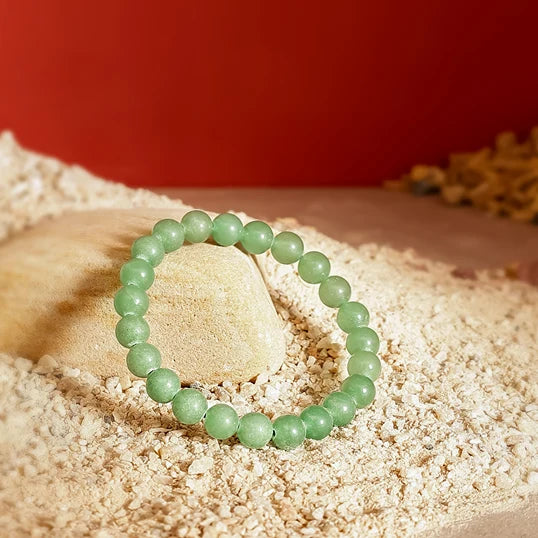
Green aventurine is a quartz containing platy inclusions of fuchsite, a chromium-rich mica, and those inclusions are what give it both its green colour and its characteristic glitter. That glitter has a name: aventurescence. It is the single most useful thing to know about the stone, because dyed green quartz, which is very common in the market, has no mica in it and therefore has no sparkle. Aventurine is roughly 6.5 to 7 on the Mohs scale, tolerates water, and should be kept away from ultrasonic cleaners, harsh chemicals and long spells in direct sun.
What aventurine actually is
Aventurine is not a single crystal in the way an amethyst point is. It is a compact, granular quartz, often better described as a quartzite rock, in which countless small platy mineral flakes are suspended through the mass. Those flakes are the whole point of the material. Without them the stone would simply be a dull green quartz.
In green aventurine the flakes are fuchsite, a variety of muscovite mica coloured by chromium. In the reddish-brown and orange varieties the flakes are usually hematite or goethite, which is why those stones flash a metallic copper rather than a green. Blue, grey and peach aventurine also exist and take their colour from other included minerals. The body colour and the sparkle come from the same source, which is unusual and worth remembering.
Aventurescence, and the word it came from
Aventurescence is the correct gemmological term for the glittery, spangled shimmer produced when light reflects off flat mineral platelets scattered through a translucent host. It is a different effect from chatoyancy, the single moving band of a tiger eye, and different again from the sheen effects seen in feldspars.
The name has an odd history. It comes not from the mineral but from aventurine glass, a copper-flecked Venetian glass said to have been produced by accident, a ventura. That glass is still made and sold today under the name goldstone. It is a manufactured material, and while it is perfectly legitimate when described honestly, it is not a gemstone and should never be sold as aventurine. Our guides to chatoyancy in tiger eye and to natural versus dyed rose quartz cover the two effects most often confused with this one.
What is actually in the market
| Material | What it is | How it looks | Honest or not |
|---|---|---|---|
| Green aventurine | Quartz with fuchsite mica inclusions | Mottled green, visible flecks, clear aventurescence when tilted in light | The genuine article |
| Dyed green quartz | Pale or colourless quartz treated with dye | Flat, even, often over-saturated green; no sparkle; dye concentrating in cracks | Legitimate if disclosed, dishonest if sold as aventurine |
| Dyed howlite or magnesite | A soft white stone taken up with dye | Opaque, chalky, fine grey veining showing through the green | Sold as aventurine only dishonestly |
| Green glass | Manufactured glass | Very even colour, gas bubbles, swirl lines, sometimes mould seams | Sold as aventurine only dishonestly |
| Goldstone or aventurine glass | Manufactured copper-flecked glass | Dense, regular metallic spangles in a glassy body | Legitimate under its own name |
Checking a piece at home
- Look for the sparkle first. Tilt the stone slowly under a single strong light. Genuine aventurine throws small scattered glints from within. A complete absence of aventurescence in something sold as aventurine is the most telling sign there is.
- Read the colour distribution. Natural material is mottled, with lighter and darker zones and visible flecks. A perfectly uniform, slightly acidic green across an entire strand suggests dye.
- Inspect the drill holes and any cracks. Dye pools where it can. A darker green ring around the hole, or dark green lines tracing fractures, is a strong indicator.
- Look for bubbles and seams. Round gas bubbles, swirl marks and a faint seam are glass, not stone.
- Test the hardness gently. Aventurine at roughly 6.5 to 7 will not be scratched by a steel blade. Dyed howlite and magnesite are far softer and will mark easily. Do this on a hidden spot, or not at all on something you value.
- Try a damp white cloth. Some dyes transfer with rubbing. This does not catch stable dyes, so a clean cloth proves nothing on its own.
- Ask the seller directly whether the material is natural, dyed or coated, and expect a straight answer in writing.
None of these tests is individually conclusive, and colour treatment is not in itself dishonest. The problem is only ever non-disclosure. A dyed green quartz sold as dyed green quartz is a perfectly reasonable thing to buy.
Caring for aventurine
- Water is fine. Warm water, a drop of mild soap and a soft brush around the drill holes, then dry thoroughly. Unlike selenite, aventurine does not dissolve or spoil in water, as our note on selenite and water explains.
- No ultrasonic or steam cleaners. The mica platelets and any internal fractures are exactly what vibration and thermal shock exploit.
- Keep it out of long direct sun. Dyed material fades noticeably and some natural colouring can weaken over long exposure. A windowsill is the worst place to keep it.
- Avoid chemicals. Perfume, hairspray, cleaning products, chlorinated pool water and salt water all shorten the life of the polish. Put jewellery on last and take it off first.
- Store it separately. Anything harder will scratch it and it will scratch anything softer. A soft pouch or a lined compartment is enough.
- Avoid abrasive salt cleansing. Dry salt is abrasive and lodges in the granular surface. If you follow a cleansing practice, the gentler methods in our guide to cleansing and charging crystals are kinder to the stone.
Who wears it, and what is actually being claimed
Green aventurine is not one of the navaratna and it does not appear in classical jyotish texts under that name. Its popularity comes from modern crystal traditions, in which it is associated with the heart chakra and is often described as a stone of opportunity and of new beginnings. That is a belief within a living tradition, and it should be presented as exactly that.
In Indian retail it is sometimes offered as a green colour-alike where an emerald would otherwise be indicated. This is a market convention rather than a rule from shastra, and anyone selecting a stone for a specific astrological purpose should consult a qualified astrologer with their own chart rather than choosing by colour. Our rashi stone chart sets out the classical associations, and our guide to healing crystal bracelets covers how these stones are commonly worn.
It should go without saying, but it is worth saying: no gemstone is a medical treatment and none of this constitutes health or financial advice. Aventurine is a handsome, hard-wearing, affordable stone with a genuinely interesting optical property, and that is reason enough to like it. You will find it among our gemstones, in crystal malas and in gemstone jewellery.
Green Aventurine: Frequently Asked Questions
What causes the sparkle in green aventurine?
Platy inclusions of fuchsite, a chromium-rich variety of muscovite mica, scattered through the quartz. Light reflecting off those flat flakes produces a spangled shimmer called aventurescence. The same inclusions give the stone its green colour, so body colour and sparkle come from one source. In reddish-brown and orange aventurine the flakes are usually hematite or goethite instead, which is why those varieties flash metallic copper.
How do I tell natural aventurine from dyed green quartz?
Start with the sparkle. Dyed quartz has no mica in it and therefore shows no aventurescence, so a stone with a flat, even green and no internal glints is very likely dyed. Then look at the drill holes and any cracks, where dye tends to pool as darker green rings or lines. Natural aventurine is mottled with lighter and darker zones rather than uniformly coloured.
Is dyed green quartz a fake?
Not in itself. Dyeing is a normal and long-established treatment and a dyed quartz sold openly as dyed quartz is a perfectly reasonable purchase. The dishonesty lies only in non-disclosure, in selling dyed material as natural aventurine, or in charging aventurine prices for it. Ask the seller whether the material is natural, dyed or coated and expect a clear written answer.
What is goldstone and is it the same thing?
No. Goldstone, also called aventurine glass, is a manufactured copper-flecked glass, traditionally associated with Venice, and the word aventurescence actually derives from it. It is a legitimate material under its own name and it has a dense, regular metallic spangle that natural stone does not. It is not a gemstone and it should never be sold as aventurine.
Can aventurine go in water?
Yes. It is around 6.5 to 7 on the Mohs scale and is not water sensitive, so warm water with a little mild soap and a soft brush is fine, followed by thorough drying. What it should not meet is an ultrasonic or steam cleaner, since vibration and thermal shock exploit the mica platelets and any internal fractures. Dry salt is also best avoided, because it is abrasive and lodges in the granular surface.
Will green aventurine fade?
Dyed material can fade noticeably in sunlight, and even natural colouring can weaken over very long exposure. A windowsill is the worst place to keep it. Perfume, hairspray, household cleaners, chlorinated water and salt water all shorten the life of the polish as well, so put jewellery on last and take it off first.
Who traditionally wears green aventurine?
It is not one of the navaratna and does not appear in classical jyotish texts under that name. Its following comes from modern crystal traditions, where it is associated with the heart chakra and described as a stone of opportunity and new beginnings. Anyone choosing a stone for a specific astrological purpose should consult a qualified astrologer with their own chart rather than selecting by colour.
Is aventurine suitable for everyday jewellery?
Reasonably so. At around 6.5 to 7 it is harder than feldspar stones and considerably tougher than obsidian, which makes it a sensible choice for bracelets and malas that get daily wear. Store it separately from harder stones, take it off for housework and swimming, and it will hold its polish for years.


