 Cow Shelter / Donation

Rudraksha Kavach: Which Kavach for Which Goal (Business, Study, Protection, Navgraha and More)
Published · Updated
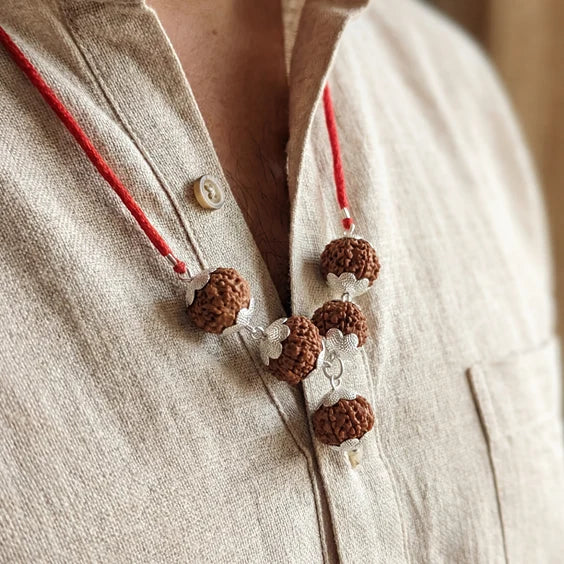
A Rudraksha kavach is a set of mukhi beads strung as one combination, assembled in tradition for a single purpose. Choose by goal first: Business Kavach for trade, Saraswati Kavach for study, Navgraha Kavach for the nine grahas, Hanuman Kavach for Shani periods such as Sade Sati 2027. Then let your chart confirm the beads before you wear them.
The Divine Hindu App is here.
Chat with astrologers, generate your Kundli, book temple Puja and Chadhava, and check today's Panchang — all in one app.
What a Rudraksha kavach is
Kavach means armour. In the Rudraksha tradition the word is used for a set of beads of different mukhi strung together as one wearable piece, usually a short pendant string or a bracelet, in which every bead is traditionally associated with the same purpose. A single 5 mukhi is worn for general well-being; a kavach is worn when a devotee has one clear intent, such as a new shop, an examination year, a Shani period or the household.
A siddha mala is the larger form of the same idea: a full set of 1 to 14 mukhi beads, often with Gauri Shankar and Ganesh mukhi added, worn or kept in the puja room.
The classical pairings of bead, deity and graha that every kavach is built on are in the ruling planet and deity chart for 1 to 14 mukhi, and the logic of combining beads is in the Rudraksha combinations and sacred malas guide. Note that the Shani Kavach recited for Sade Sati is a stotra, not a bead set; that text is explained in Shani Kavach path.
Which kavach for which goal
The table lists each kavach against the goal it is traditionally assembled for and the deities or grahas its beads are associated with by the most widely followed chart. Traditions differ on some pairings; the exact beads in each set are listed on the product page.
| Goal (in tradition) | Kavach | Beads and deities traditionally associated | Traditional day to begin in 2027 |
|---|---|---|---|
| A new venture, shop or trade | Business Kavach | Beads of Ganesha and Mahalakshmi (commonly 8 and 7 mukhi), with a Surya bead in some lists | Akshaya Tritiya, 9 May; Dhanteras, 27 Oct |
| Devotion to Lakshmi in the household | Laxmi Kavach | Beads traditionally associated with Lakshmi (7 mukhi) and Ganesha (8 mukhi) | Diwali and Lakshmi Puja, 29 Oct; Fridays |
| Study, speech and learning | Saraswati Kavach | Beads of Brahma and Budh (4 mukhi) and Kartikeya (6 mukhi) | Vasant Panchami, 11 Feb |
| Devotion to Dhanvantari, the deity of Ayurveda and well-being in tradition | Dhanwantari Kavach | Beads of Agni and Guru (3 and 5 mukhi) in the common lists | Dhanteras, 27 Oct, observed as Dhanvantari Jayanti |
| All nine grahas in one set | Navgraha Kavach | One bead for each graha, 2 to 9 mukhi with a Surya bead (1 or 12 mukhi) | Any Saturday; many choose Shani Jayanti, 4 Jun |
| Shiva and Shakti together; couples | Shiv Shakti Kavach | Gauri Shankar bead with the 2 mukhi of Ardhanarishvara | Maha Shivaratri, 6 Mar; Mondays |
| The household as a whole | Family Protection Kavach | Beads of Ardhanarishvara and Guru (2 and 5 mukhi), Gauri Shankar in some sets | Guru Purnima, 18 Jul |
| Protection; traditionally worn against negative energy | Protection Kavach | Beads of Durga, Vishnu and Hanuman (9, 10 and 11 mukhi) | Sharad Navratri, 30 Sep to 8 Oct |
| Home and premises | Vaastu Kavach | Beads of Ganesha and Vishnu (8 and 10 mukhi) in the common lists | Griha pravesh or Vishu, 14 Apr |
| Devotion to Hanuman; Shani periods | Hanuman Kavach | Beads of Hanuman (11 and 14 mukhi) | Hanuman Jayanti, 20 Apr; Tuesdays and Saturdays |
| Devotion to Durga | Durga Kavach | Bead of Durga (9 mukhi), with Ganesh mukhi in some sets | Chaitra Navratri from 7 Apr; Sharad Navratri from 30 Sep |
| Marriage and household harmony | Lakshmi Narayan Kavach | Beads of Lakshmi and Vishnu (7 and 10 mukhi) | Tulsi Vivah, 11 Nov; Thursdays |
The full range, including the siddha sets, is in the Rudraksha kavach collection and the Rudraksha combo sets. Dates follow the Delhi panchang and may differ by a day in your region.
How to choose: goal first, then the chart
Start with the purpose, because that is how the tradition builds the set. A student does not need a business set; a person in Sade Sati does not need a Saraswati set. Once the goal is clear, the chart decides whether any bead in the set belongs to a graha the astrologer would rather not strengthen for you, and whether a single bead would serve better.
By the classical rule Rudraksha is considered gentle, and the lists do not name beads that cannot be worn together, so a kavach is usually worn without a reading. Where the goal is tied to a transit such as Shani, the matching bead is read against the Moon sign; the sign-wise table is in Rudraksha for Sade Sati 2027. The goal-wise combination articles go a level deeper than the table: for business, for students, for protection, for marriage and for Sade Sati.
2027: the Navgraha and Shani sets in a Shani-in-Mesha year
Two transits shape which kavach is asked for most in 2027. Shani enters Mesha (Aries), its debilitation sign, on 3 Jun, turns retrograde on 9 Aug and returns to Meena (Pisces) on 20 Oct, bringing Sade Sati to Vrishabha (Taurus) and Dhaiya to Kanya (Virgo) and Makara (Capricorn) for that window. Rahu stays in Makara and Ketu in Karka (Cancer) all year by the panchang reckoning.
Devotees in those signs traditionally look to the Shani beads, the 7 Mukhi Rudraksha and 14 Mukhi Rudraksha, or to the Hanuman Kavach, since Hanuman worship on Saturdays is the oldest of the Shani customs. Those who would rather address the whole sky in one piece choose the Navgraha Kavach. For the phase map with pause and resume dates for each rashi, see Sade Sati and Shani Dhaiya 2027.
How a kavach is worn
| Element | Convention |
|---|---|
| Day | The day of the set's deity: Monday for Shiva, Tuesday or Saturday for Hanuman, Friday for Lakshmi, Thursday for Vishnu |
| Mantra | Om Namah Shivaya for any set, then the beej mantra of each bead, 108 times at the first wearing |
| Stringing | Red or yellow thread for daily wear; silver or panchdhatu caps for a pendant worn long-term |
| Preparation | Washed in Ganga water, offered raw milk, placed before the deity, then worn after bathing |
| Where | Pendant near the heart or on the wrist; a siddha mala is kept in the puja room if not worn |
| Removal | Custom varies; many families remove it before sleep, at a funeral and during a period |
Each bead's mantra is in the Rudraksha beej mantra chart; the daily customs are in Rudraksha wearing rules for men and Rudraksha wearing rules for women.
When a single bead is better than a kavach
A kavach suits a goal that is broad and shared, as a household or a business is. A single bead suits a chart that points to one graha: a Sade Sati native with no other concern is usually given a 7 or 14 mukhi alone, a Simha native with a Surya emphasis a 12 mukhi, a seeker a 1 mukhi or a 5 mukhi mala.
Wearing a kavach and a single bead together is common. A reading through the Rudraksha recommendation report is the way to know which of the two the chart prefers.
Certification: what to check before you buy a set
A kavach is only as honest as its weakest bead, and higher mukhi beads are the most imitated. Each bead in a Divine Hindu kavach is lab-certified, with an X-ray image showing the internal chambers that match the stated mukhi, the origin, and a natural, untreated declaration.
Ask any seller for per-bead reports rather than one certificate for the set. How to read the report, and why the water and copper-coin tests prove nothing, is in Rudraksha lab certificate and X-ray report explained; what to check on origin and size is in the Nepali Rudraksha buying guide 2027.
Frequently Asked Questions
What is a Rudraksha kavach?
A set of Rudraksha beads of different mukhi strung together as one pendant or bracelet, assembled in tradition for a single purpose such as business, study, protection or a Shani period. A siddha mala is the full 1 to 14 mukhi set.
Which kavach is for business?
The Business Kavach, built on beads traditionally associated with Ganesha and Mahalakshmi, commonly the 8 and 7 mukhi. Akshaya Tritiya (9 May 2027) and Dhanteras (27 Oct 2027) are the customary days to begin wearing it.
Which kavach is for students?
The Saraswati Kavach, with beads of Brahma and Budh (4 mukhi) and Kartikeya (6 mukhi), the beads tradition links to learning and speech. Many families begin it on Vasant Panchami, 11 Feb 2027.
Which kavach for Sade Sati 2027?
Devotees in Sade Sati or Dhaiya traditionally choose the Shani beads, 7 mukhi and 14 mukhi, or the Hanuman Kavach, worn on a Saturday with the Shani mantra. The Navgraha Kavach is chosen when all nine grahas are to be addressed at once.
Can I wear two kavach sets together?
Yes. The classical lists do not name Rudraksha beads that cannot be worn together, so two sets or a set with a single bead is common. Keep the strings separate so each can be removed and cleaned on its own.
Does a kavach need to be energised?
By custom it is washed in Ganga water, offered raw milk, placed before the deity and worn after the mantra on the chosen day. Many devotees repeat this on the set's festival day.
Are the beads in a kavach certified?
Each bead in a Divine Hindu kavach is lab-certified, with an X-ray image of the internal chambers, the stated origin and a natural, untreated declaration. Ask any seller for per-bead reports rather than one certificate for the set.
Choose Your Kavach, Then Confirm It With Your Chart
Every set in the table is listed in the Rudraksha kavach collection, and the single beads that pair with them are in the Nepali Rudraksha collection. If you are torn between two goals, or between a kavach and a single bead, the Rudraksha recommendation report reads your Moon sign, lagna and dasha and names the set, the day and the mantra.
This article describes traditional Vedic astrology and is intended for guidance and self-reflection only; it does not guarantee any outcome. Spiritual products are worn as a matter of faith and tradition and are not a medical treatment.


