 Cow Shelter/Donation

Bhai Dooj 2026: Date, the Yama–Yamuna Story, Tilak Vidhi Step by Step & Regional Traditions
July 18, 2026
Bhai Dooj 2026 falls on Wednesday, 11 November 2026, on Kartik Shukla Dwitiya, the second day of the bright fortnight that follows Diwali. It is the last of the five days of Diwali and the one that belongs entirely to brothers and sisters: the sister applies a tilak to her brother's forehead, performs his aarti and feeds him with her own hand, and the brother gives her a gift and, in the tradition, his word that he will stand by her. The day recalls the visit of Yama, the lord of death, to the home of his sister Yamuna, which is why it is also called Yama Dwitiya. Some calendars list it on Tuesday, 10 November, because the Dwitiya tithi begins that afternoon; both readings, and the reason for them, are set out below. The day before it, Govardhan Puja, has its own guide — see Govardhan Puja 2026: date, Annakut and vidhi.
The Divine Hindu App is here.
Chat free with top astrologers for your first 5 minutes every week, generate your Kundli, book temple Puja & Chadhava, and check today's Panchang — all in one app.
Bhai Dooj 2026 date: Wednesday, 11 November
Bhai Dooj is fixed by a tithi, not a calendar date: it is kept on the Dwitiya, the second lunar day of the bright fortnight of Kartik, two days after the Amavasya of Diwali. In 2026 the Diwali Amavasya is current on the evening of Sunday, 8 November, the Pratipada that follows carries Govardhan Puja on Tuesday, 10 November, and the Dwitiya falls on Wednesday, 11 November. Here is the sequence as most panchangs print it.
| Observance | 2026 date | Panchang detail |
|---|---|---|
| Govardhan Puja (Annakut) | Tuesday, 10 November 2026 | Kartik Shukla Pratipada — see the Govardhan Puja 2026 guide |
| Bhai Dooj (Yama Dwitiya) | Wednesday, 11 November 2026 | Kartik Shukla Dwitiya |
| Dwitiya tithi | Begins 2:00 PM on Tuesday, 10 November; ends 3:53 PM on Wednesday, 11 November | Drik Panchang and Prokerala give the same minute for both |
| Tilak time | Aparahna — the afternoon stretch — on Wednesday, 11 November | The window differs by city; take it from a current panchang on the day |
Why some calendars say 10 November, and which day to keep
The Dwitiya tithi begins at 2:00 PM on Tuesday, 10 November 2026, and runs until 3:53 PM on Wednesday, 11 November. The Bhai Dooj tilak is traditionally done in the aparahna, the afternoon portion of the day, and the rule most panchangs follow is to take the day on which the Dwitiya is present in the aparahna — and, where it is present on both days, the second of them, because the tithi is also current at sunrise that morning. On that reading, which is the one both Drik Panchang and Prokerala publish, Bhai Dooj 2026 is Wednesday, 11 November. A few calendars take the day on which the tithi first appears in the afternoon and therefore print Tuesday, 10 November; on that day the Dwitiya is present only from 2:00 PM onward, so it covers the latter part of the afternoon and not the morning. Neither reading is careless — they simply apply the rule differently — and the practical advice is this: families in India who follow the standard panchangs should keep Wednesday, 11 November; a family whose own priest or regional calendar says Tuesday should follow it; and where a brother can only visit on the Tuesday, a tilak after 2:00 PM that afternoon still falls within the Dwitiya tithi, which is what most families would consider the essential thing.
A word on aparahna. The daylight hours between sunrise and sunset are divided into five equal parts, and aparahna is the fourth of them — roughly the early-to-mid afternoon. Because sunrise and sunset differ from city to city, the window shifts by some minutes between Delhi, Mumbai, Kolkata and Bengaluru, and panchang publishers differ from one another by a few minutes on the same city, so we deliberately do not print a single national tilak time. Take the aparahna window for your own city from a current panchang on the day. Where the afternoon is impossible for the family, the tilak is done in the morning while the Dwitiya is current; tradition asks for the tithi first and the muhurat second. Readers abroad should note that a tithi is checked against local sunrise and local afternoon, so panchangs for North America may show the day differently; follow the panchang of the city where the tilak will be done.
If early-to-mid November looks late for Bhai Dooj, it is: the whole Diwali week has moved about three weeks later than in 2025 because an extra month, Adhik Maas, was inserted into the calendar between May and June 2026. The full explanation is in our Dhanteras 2026 guide.
The story of Yama and Yamuna
Every Bhai Dooj begins with a story, and it is worth telling in full, because the whole shape of the day — the invitation, the bath, the tilak, the meal, the brother's promise — is drawn from it.
Surya, the sun, and his wife Sanjna had twin children: a son, Yama, and a daughter, Yami, who is the river Yamuna. The two were close in childhood, but Yama was given the heaviest office in creation — the lordship of death and the judgement of the dead — and the work never ended. Yamuna, who had married and made her own home, sent for him again and again. Each time he meant to come; each time the work held him. Years went by.
At last, on the second day of the bright fortnight of Kartik, Yama set his duties aside and went to his sister's house. Tradition tells that Yamuna saw him coming and was overcome — she bathed him, applied a tilak to his forehead, seated him and fed him a feast she had prepared with her own hands, and the brother who is feared in every world sat in his sister's courtyard and was simply a brother. When he rose to leave he asked her to name a gift. Yamuna asked for two things: that he come to her home on this day every year, and that any brother who is welcomed and given a tilak by his sister on this day, and any sister who gives it, should have his blessing. In the traditional telling Yama granted both, and added that a brother and sister who bathe together in the Yamuna on this day would be freed from the fear of him. That is why the day is Yama Dwitiya, why the tilak is at its centre, and why at Vishram Ghat in Mathura brothers and sisters still go down into the river together on Bhai Dooj afternoon, holding hands. Whether the blessing works as the story says is a matter of faith; that the story has been told for a very long time, and that it made brothers and sisters visit each other once a year, is a matter of record.
A second account is told in many homes, and it belongs to the same week. After Krishna killed the demon Narakasura — the event of Naraka Chaturdashi, the day before Diwali — he went to see his sister Subhadra, who welcomed him with a lamp, a tilak and sweets. Some families, particularly in the west and south, understand Bhai Dooj through this visit rather than Yama's. A third, told in Bengal, holds that on this day Yama's messengers may not come for a brother whose sister has marked his forehead. These are traditional accounts handed down through the community rather than fixed history; the one your own family tells is the one to keep.
What the day means
Bhai Dooj is understood in the tradition as the sister's day. On Raksha Bandhan, in August, she ties a thread and asks for her brother's protection; on Bhai Dooj, in Kartik, she is the one who blesses — with the tilak, the aarti and the meal — and the brother receives. The two festivals are two halves of one relationship, and many families that have grown apart during the year use Bhai Dooj as the day the sibling bond is renewed, whatever has passed between them. It is also, quietly, the day that closes Diwali: after wealth has been welcomed on Lakshmi Puja and the earth thanked on Govardhan Puja, the last of the five days is given to the family itself. No outcome is promised by any of this. A tilak is a blessing and a prayer, offered in the Vedic manner as an expression of love and intent, and it is best kept in that spirit.
Bhai Dooj across India: Bhau Beej, Bhai Phonta, Bhai Tika and Yama Dwitiya
The festival has one shape and a great many accents, and the name changes as you travel. In Maharashtra, Goa and Gujarat the day is Bhau Beej — in Gujarati, Bhai Bij — and it comes the morning after Diwali Padwa and, in Gujarat, the day after the new year of Bestu Varas. The sister draws a square, the chaukat, on the floor with rice flour or rangoli and seats her brother inside it, applies the tilak and performs his aarti, and the meal that follows is basundi and puri or shrikhand; the brother's gift is called ovalani, after the aarti itself. In Bengal the day is Bhai Phonta, from phonta, the mark: the sister fasts until she has made it, and the mark is made with sandalwood paste, kajal and a touch of curd or ghee, applied with the little finger of the left hand, while she recites a rhyme that, in plain English, says that she has placed the mark on her brother's forehead and set a thorn at the door of Yama. She sprinkles him with water from a conch and touches his head with paddy and durva grass, and the meal that follows — luchi, several vegetables, fish in many homes, and a great deal of mishti — is the sister's gift. Assam keeps the day as Bhai Phota too, and Odisha as Bhai Juntia in some districts, with its own vrat.
In Nepal the day is Bhai Tika, the fifth and final day of Tihar and, for many Nepali families, the most important day of the year. The sister draws a circle of oil around her seated brother, applies the saptarangi tika — seven colours in a vertical band — places a garland of makhamali, the globe amaranth that does not wilt, around his neck, and gives him sagun: fruit, sweets, roasted grains, a walnut broken open at the door. Brothers give tika to their sisters in return. The tika time in Nepal is announced each year by the national panchang committee, and the day is a public holiday. In Uttar Pradesh, Bihar, Delhi and Rajasthan the day is Bhaiya Dooj or Bhardutiya, and in the Braj region it is Yama Dwitiya above all, kept with the Yamuna bath at Mathura. Parts of Bihar keep a striking older custom: the sisters first curse their brothers in mock anger and prick their own tongues with a thorn in penance, on the reasoning that a curse spoken by a sister's mouth on this day takes away the harm a real one might do, and only then perform the tilak. In the south the day is Yama Dwitiya and, in Telugu-speaking homes, Bhagini Hastha Bhojanam — literally, the meal from the sister's hand — which tells you exactly where the tradition places the weight; in Kannada speech it is Sodara Bidige, the sibling's second day. Manipur keeps a cousin of the festival, Ningol Chakouba, on a different date, when married daughters are invited home to a feast by their brothers and parents. Under every one of these names the day is the same: a sister's blessing, a brother's visit, and a meal eaten together.
Bhai Dooj tilak vidhi, step by step
The household form below is the one most North Indian families keep. It takes fifteen or twenty minutes, needs no priest, and is done in the aparahna on Wednesday, 11 November 2026 — or in the morning if the afternoon is impossible. Follow your own family's order where it differs.
- The sister prepares. She bathes in the morning and, in many families, keeps a fast — without food, or with fruit and water — until the tilak is done. The puja corner or the place where the brother will sit is cleaned. In Maharashtra and Gujarat a chaukat is drawn on the floor; in most northern homes a low chowki or an asan is set out facing east or north.
- The thali is laid out. Roli or kumkum, chandan, akshat, a diya, a sweet, a piece of dry coconut, a flower, a kalava, and a small lota of water — the full list is in the table below. The gifts for the brother, if any, are set beside it.
- The brother arrives and is seated. Tradition asks that the brother come to his sister's home on this day; where the sister lives with her parents or the brother's home is the family home, she seats him there. He sits on the chowki or inside the chaukat, facing east or north, with his head covered in many families.
- The diya is lit and Ganesha invoked. The sister lights the diya on the thali and offers a short prayer to Ganesha, as every Hindu rite begins. In many homes she invokes Yama and Yamuna as well, and in Bengal the rhyme of the phonta is recited at this point.
- The tilak. With the ring finger of the right hand she applies roli or chandan to the centre of the brother's forehead — in Bengal the chandan, kajal and curd with the little finger — and presses a few grains of akshat onto it. Some families tie a kalava on his right wrist. This is the heart of the day, and the prayer said silently with it is for his long life and well-being.
- The aarti. She circles the lit diya before him three or seven times, sprinkles a little water from the lota, and places a flower or a garland. In Nepal this is the moment of the makhamali garland; in Maharashtra, the ovalani.
- The sweet and the dry coconut. She feeds him a sweet with her own hand, and in northern homes places a piece of dry coconut — gola or sukha nariyal — in his hands with the sweet. The coconut is the sister's traditional gift to the brother on Bhai Dooj across Uttar Pradesh, Delhi and Punjab.
- Feet and blessings. The younger touches the feet of the elder — a younger brother his sister's, a younger sister her brother's — and the elder blesses. The brother gives his gift and, in the tradition, his word.
- The meal. The brother eats at his sister's table. Tradition is unusually clear on this: the sister is meant to cook or arrange the meal, and the brother is meant to eat it — this is the feast of Yamuna's courtyard, and in the south the day is named for it. In most homes it is a festive vegetarian meal; in Bengal fish is customary.
- Where more than one brother or sister. Each sister does the tilak for each brother in turn, eldest first; the thali is not remade between them. Cousins are included in most families, and a brother with no sister, or a sister with no brother, is given a place at a cousin's ceremony — more on this below.
What the sister prepares: the Bhai Dooj thali
Most of this is already in the house. Treat it as a preparation list.
| Item | What it is for |
|---|---|
| Roli or kumkum, chandan | The tilak itself; in Bengal chandan with kajal and a touch of curd |
| Akshat (unbroken rice) | Pressed onto the wet tilak |
| Diya, ghee or oil, wicks | Lit for the aarti — see diyas and lamps |
| Kalava or mauli | Tied on the brother's right wrist in many families |
| Sweets | Peda, laddoo or barfi in the north; mishti in Bengal; basundi in Maharashtra; payasam in the south — fed to the brother by hand |
| Dry coconut (gola) | The sister's traditional gift in Uttar Pradesh, Delhi and Punjab |
| Flowers or a garland | Placed after the aarti; makhamali in Nepal |
| Paan and supari | Set on the thali as an offering in many homes |
| A lota of water | For sprinkling after the aarti; a conch in Bengal |
| Paddy and durva grass | Touched to the brother's head in Bengal and Assam |
| A thali to hold it all | A brass pooja thali, or the family's Raksha Bandhan thali, which most households keep for both days |
What the brother gives
The brother's gift has never been priced in the tradition, and the story sets the standard: Yama gave his sister a promise, not an object. In most families the gift is clothes or fabric, a sweet box, jewellery where the brother can, or shagun — an amount of money with a coin added to make it odd. In Maharashtra the ovalani is placed in the aarti thali itself; in Nepal brothers give money and tika in return. The brother touches the feet of an elder sister, or blesses a younger one, and the word he gives — that he will be there — is understood to be the real gift. Where a sister has come to her parental home for the day, her parents customarily send her back with clothes and sweets for her own household. None of this needs to be expensive, and a gift bought on borrowed money misses the point of a day whose whole meaning is that the brother came.
When brother and sister are apart
A very large number of siblings now live in different cities or countries, and the tradition has always made room for distance. The oldest arrangement is tika by post: the sister sends a small packet of roli, akshat and a dry coconut, with a sweet and a note, and the brother — or his wife, or his mother — applies the tilak on the day, facing east, with the sister on the telephone. Its modern form is the video-call tilak: the sister sets out her thali and lights the diya at her end, the brother sits with a little roli and rice at his, and she performs the aarti to the screen while he applies the mark as she directs. Many families now keep it this way and do not consider it a lesser Bhai Dooj; the tithi and the intent are the same.
Where a sister has no brother living, tradition offers her the moon. Children across northern India call the moon Chanda Mama, the mother's brother, and a sister without a brother performs her aarti to the moon on Bhai Dooj evening and offers it the sweet. A brother without a sister traditionally takes his tilak from a cousin, a family friend's daughter, or a woman the family has adopted as a dharam behen; and by the Yama Dwitiya tradition he may bathe in the Yamuna, or at any river, on the afternoon of the day. Sisters who cannot reach a brother in time still lay out the thali, light the diya and do the aarti before his photograph, and send the sweet on. The tradition is clear that what is being kept is the bond, not the logistics.
Bhai Dooj and Raksha Bandhan: how the two differ
The two sibling festivals are easily confused and they are not the same. Raksha Bandhan falls on Shravana Purnima in August, and its act is the sister tying a rakhi on the brother's wrist and asking for his protection; the movement is from him to her. Bhai Dooj falls on Kartik Shukla Dwitiya at the close of Diwali, and its act is the sister's tilak, aarti and feast for the brother; the movement is from her to him. Rakhi has the thread; Bhai Dooj has the tilak and the meal. Many families keep both, and most consider Bhai Dooj the more intimate of the two, because it asks the brother to sit down at his sister's table rather than simply to hold out his wrist.
The five days of Diwali 2026 at a glance
Bhai Dooj is the last of the five. Seen together, the 2026 week looks like this; the detail for each day is in the linked guide.
| Day | 2026 date | What is done |
|---|---|---|
| Dhanteras | Friday, 6 November 2026 | New metal brought home; Dhanvantari, Lakshmi and Kubera puja — Dhanteras 2026 guide |
| Naraka Chaturdashi (Choti Diwali) | Sunday, 8 November 2026, pre-dawn | The oil bath before sunrise; some calendars list Saturday 7 November |
| Diwali — Lakshmi Puja | Sunday, 8 November 2026, evening | Lakshmi-Ganesha puja at pradosh — Diwali Lakshmi Puja 2026 vidhi |
| Govardhan Puja (Annakut) | Tuesday, 10 November 2026 | The cow-dung hill, the Annakut offering, gau puja — Govardhan Puja 2026 guide |
| Bhai Dooj (Yama Dwitiya) | Wednesday, 11 November 2026 | The sister's tilak, aarti and meal for the brother — this guide |
Each of these is a tithi mapped onto a calendar day and can move by one with your city's sunrise, so confirm against a current panchang before you observe. Chhath Puja closes the season from 13 to 16 November — see the Chhath Puja 2026 guide — and the whole holy month is laid out in our Kartik month 2026 guide. The full year is in the Hindu Festival Calendar 2026, with fasting days in the Ekadashi 2026 list and the Purnima and Amavasya 2026 list.
Frequently Asked Questions
When is Bhai Dooj in 2026?
Bhai Dooj 2026 falls on Wednesday, 11 November 2026, on Kartik Shukla Dwitiya, the second day of the bright fortnight after Diwali. It is the fifth and last day of the Diwali festival, following Govardhan Puja on Tuesday, 10 November. Both Drik Panchang and Prokerala place the day on 11 November. Because the observance is tied to a lunar tithi, the calendar date can differ by a day for readers outside India, so confirm with a current panchang for your own city.
Is Bhai Dooj on 10 or 11 November 2026?
The Dwitiya tithi begins at 2:00 PM on Tuesday, 10 November 2026 and ends at 3:53 PM on Wednesday, 11 November. Most panchangs, including Drik Panchang and Prokerala, take the day on which the tithi is present through the afternoon and also current at sunrise, which is Wednesday, 11 November. A few calendars print Tuesday, 10 November because the tithi first appears that afternoon. Families in India following standard panchangs should keep Wednesday, 11 November; a family whose own priest or regional calendar says Tuesday should follow it, and a tilak after 2:00 PM on the Tuesday still falls within the Dwitiya tithi.
What is the tilak muhurat for Bhai Dooj 2026?
The Bhai Dooj tilak is traditionally done in the aparahna, the afternoon portion of the day, on Wednesday, 11 November 2026. Aparahna is the fourth of the five equal parts into which the daylight hours are divided, and because sunrise and sunset differ from city to city the window shifts by some minutes between cities, while panchang publishers differ from one another by a few minutes on the same city. Take the aparahna window for your own location from a current panchang on the day. Where the afternoon is impossible for the family, the tilak is done in the morning while the Dwitiya tithi is current.
What is the story behind Bhai Dooj?
Bhai Dooj recalls the visit of Yama, the lord of death, to his twin sister Yamuna, the river goddess, on Kartik Shukla Dwitiya after years of being kept away by his duties. Yamuna bathed him, applied a tilak, and fed him a feast she had cooked herself, and when Yama asked her to name a gift she asked that he visit every year on this day and that any brother who receives a tilak from his sister on this day be blessed. Tradition holds that Yama granted both, which is why the day is also called Yama Dwitiya. A second account tells of Krishna visiting his sister Subhadra after killing Narakasura. These are traditional accounts rather than fixed history.
How is the Bhai Dooj tilak done?
The sister bathes, prepares a thali with roli or chandan, akshat, a diya, a sweet, a dry coconut and a flower, and seats her brother facing east or north. She lights the diya, offers a short prayer to Ganesha, applies the tilak to the centre of his forehead with the ring finger, presses akshat onto it, ties a kalava on his wrist in many families, and performs his aarti by circling the diya before him. She then feeds him a sweet and gives him the dry coconut, the younger sibling touches the feet of the elder, the brother gives his gift, and the brother eats a meal at his sister's table. Regional forms differ in detail, such as the chaukat in Maharashtra and the sandalwood and kajal phonta in Bengal.
What should a sister keep in the Bhai Dooj thali?
The Bhai Dooj thali traditionally holds roli or kumkum and chandan for the tilak, akshat, a diya with ghee or oil, a kalava, a sweet such as peda, laddoo or barfi, a piece of dry coconut, a flower or garland, paan and supari, and a small lota of water for sprinkling after the aarti. In Bengal the thali also carries kajal, curd, a conch, paddy and durva grass, and in Nepal the seven-coloured tika and a makhamali garland. Most families use the same brass pooja thali they keep for Raksha Bandhan and the Diwali puja.
What does the brother give on Bhai Dooj?
The brother's gift is a token rather than a price. In most families it is clothes or fabric, a box of sweets, jewellery where the brother can afford it, or shagun, an amount of money with a coin added to make it odd. In Maharashtra the gift, called ovalani, is placed in the aarti thali; in Nepal brothers give money and tika in return. In the tradition the real gift is the brother's word that he will stand by his sister, following the promise Yama made to Yamuna, and no gift needs to be expensive.
What can siblings do if they cannot meet on Bhai Dooj?
Tradition has long made room for distance. The sister can send tika by post, a small packet of roli, akshat and dry coconut with a sweet, which the brother or a woman of his household applies on the day while the sister is on the telephone. Many families now keep a video-call tilak, with the sister performing the aarti to the screen while the brother applies the mark as she directs. A sister without a brother traditionally performs her aarti to the moon, called Chanda Mama, and a brother without a sister takes his tilak from a cousin or an adopted dharam behen, or bathes at a river in the Yama Dwitiya tradition. What is kept is the bond, not the logistics.
What is Bhai Dooj called in different parts of India?
The same day is Bhau Beej in Maharashtra and Goa and Bhai Bij in Gujarat, Bhai Phonta in Bengal and Bhai Phota in Assam, Bhai Tika in Nepal where it is the last day of Tihar, Bhaiya Dooj or Bhardutiya in Uttar Pradesh and Bihar, and Yama Dwitiya in the Braj region and across the south, where Telugu speakers also call it Bhagini Hastha Bhojanam, the meal from the sister's hand, and Kannada speakers Sodara Bidige. The rituals differ in detail, from the chaukat drawn on the floor in Maharashtra to the seven-coloured tika in Nepal, but the sister's tilak, the aarti and the shared meal are common to all of them.
Can a sister do Bhai Dooj if she has no brother?
Yes. In the tradition a sister without a brother performs the Bhai Dooj aarti to the moon on the evening of the day, since the moon is addressed as Chanda Mama, the mother's brother, in northern Indian homes, and offers it the sweet from her thali. Many families also give a cousin, a family friend, or a man adopted as a dharam bhai the place of the brother. A sister whose brother has died lights the diya and performs the aarti before his photograph, and the observance is considered complete.
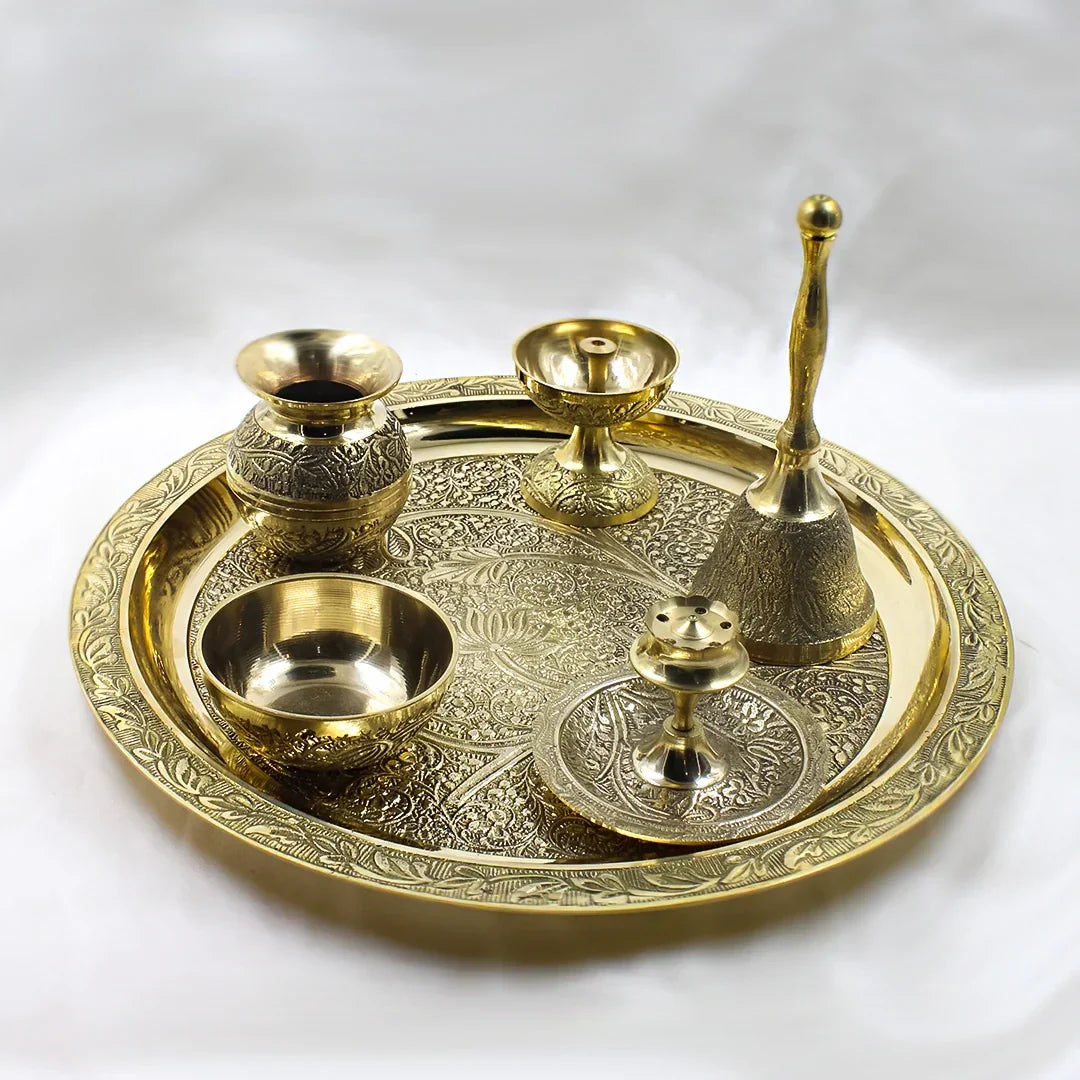
A brass pooja thali is traditionally used to carry the roli, akshat, diya and sweets for the tilak and to perform the brother's aarti; if your family does not have one set aside for Bhai Dooj and Raksha Bandhan, the antique gold brass pooja thali set — a thali with diya, bell, dhoop stand and roli-chawal containers — is the kind most households keep for both days and for the Diwali week. Browse the wider pooja thali collection, diyas and lamps and gifting range online, or visit Divine Hindu Store, Jayanagar 3rd Block East, Bengaluru 560011.
This guide is for educational and devotional purposes and reflects traditional practice, which varies by region, community and family. Tithi-to-date mapping shifts with sunrise and location, so please confirm the Bhai Dooj 2026 date and the aparahna window with a current panchang for your city before you observe. The blessings described are matters of traditional belief and personal faith, not guaranteed outcomes.


