 Cow Shelter/Donation

Govardhan Puja 2026: Date, the Krishna–Indra Story, Annakut & Puja Vidhi at Home
September 08, 2026
Govardhan Puja 2026 falls on Tuesday, 10 November 2026, on Kartik Shukla Pratipada, the first day of the bright fortnight after the Amavasya of Diwali. It is the fourth of the five days of Diwali and the one given to Krishna, to the hill he lifted, and to the cows and the land that feed a household. Families build a small hill of cow dung in the courtyard, dress it with flowers and lamps, walk around it, and set before Krishna the Annakut — the mountain of food, fifty-six dishes in the fullest form — that gives the day its other name. In Gujarat the same morning is the new year, in Maharashtra it is Padwa and Bali Pratipada, and in the temples of Braj and Nathdwara it is the largest offering of the year. Bhai Dooj follows the next day and has its own guide — see Bhai Dooj 2026: date, tilak vidhi and story.
The Divine Hindu App is here.
Chat free with top astrologers for your first 5 minutes every week, generate your Kundli, book temple Puja & Chadhava, and check today's Panchang — all in one app.
Govardhan Puja 2026 date: Tuesday, 10 November
Govardhan Puja is kept on the Pratipada, the first tithi of the bright half of Kartik, and the puja is traditionally done in the pratahkal, the morning, while that tithi is current. In 2026 the Pratipada begins a little after half past twelve in the afternoon of Monday, 9 November and ends at 2:00 PM on Tuesday, 10 November — Drik Panchang and Prokerala agree on the end to the minute and differ by a single minute on the start. Because the tithi is current at sunrise on the Tuesday and not on the Monday, every standard panchang places Govardhan Puja on Tuesday, 10 November 2026, with the puja completed in the morning before the Pratipada runs out at 2:00 PM. The morning muhurat itself differs between cities by a few minutes and between panchang publishers by a few more, so we do not print a single national time; take the pratahkal window for your city from a current panchang on the day, and where the morning is impossible, panchangs also allow the puja in the late afternoon of the same day.
| Observance | 2026 date | Panchang detail |
|---|---|---|
| Diwali — Lakshmi Puja | Sunday, 8 November 2026, evening | Kartik Amavasya current at pradosh — Diwali 2026 vidhi |
| Amavasya day | Monday, 9 November 2026 | Amavasya current at sunrise; kept for the Diwali snan and dev puja, with no separate festival |
| Govardhan Puja (Annakut, Padwa, Bali Pratipada, Gujarati New Year) | Tuesday, 10 November 2026 | Kartik Shukla Pratipada; tithi ends 2:00 PM, so the puja is done in the morning |
| Bhai Dooj (Yama Dwitiya) | Wednesday, 11 November 2026 | Kartik Shukla Dwitiya — Bhai Dooj 2026 guide |
Two things about the 2026 calendar are worth knowing. First, there is a gap day: Diwali is on Sunday evening, Monday is the Amavasya morning with nothing new to observe, and Govardhan Puja is on Tuesday — this happens whenever the Amavasya tithi runs past sunrise on the day after Lakshmi Puja, and it is normal. Second, the whole week is about three weeks later than in 2025, because an extra lunar month, Adhik Maas, was inserted between May and June 2026; the explanation is in our Dhanteras 2026 guide. Families in Maharashtra, Gujarat and the south, who count months by the amanta system, will find this same Pratipada listed as the first day of Kartik rather than its sixteenth — the label changes, the day does not, and in Gujarat it is literally the first day of the new year, Vikram Samvat 2083.
The story of Govardhan: Krishna, Indra and the hill
The account is told in the tenth book of the Bhagavata Purana, and it is the reason for everything that is done on the day.
Every autumn the cowherds of Vraja, led by Nanda, Krishna's foster father, made a great sacrifice to Indra, the king of the gods and the lord of rain. It was an old custom and nobody questioned it — the rains fed the grass, the grass fed the cows, the cows fed Vraja, and Indra sent the rains. Krishna, then a boy of seven, watched the preparations and asked his father what the sacrifice was for. Nanda explained. Krishna, in the Purana's telling, argued back. Rain falls by the nature of the seasons, he said, and by the karma of those it falls on; what actually sustains Vraja is right in front of us — the cows, the brahmanas, and Govardhan hill, whose grass the cows eat and whose streams water the pastures. Worship what is near and what feeds you, he told the cowherds, not a distant king who has to be flattered. Let the grain, ghee and sweets gathered for Indra be offered to the hill instead, and let the cows be bathed, decorated and fed.
The cowherds, who could not refuse the boy, did as he said. They cooked everything they had — rice, dal, sweets made of milk, vegetables, breads — and carried it in a great procession to the foot of the hill, arranged it in a heap and offered it with lamps and songs while the cows, garlanded and painted, were walked around the hill. And then, the Purana says, Krishna took a second form, vast, seated on the hill, and declared I am the mountain — and ate the offering with both hands, so that the people saw their own hill accept what they had brought. That is the first Annakut.
Indra, denied his sacrifice, was furious, and sent the Samvartaka clouds — the clouds that end a world-age — to drown Vraja. Rain came in sheets and columns, the pastures flooded, the cows lowed in fear, and the cowherds ran to Krishna. He walked to Govardhan, bent, and lifted the hill from the earth with his left hand, holding it up on the tip of his little finger like a child holding a mushroom, and told the people to come in under it with their cows and their carts. For seven days and nights Vraja stood dry under the hill while the storm broke on its slopes, and the boy stood with the mountain on his finger, talking and laughing with the children, until Indra understood what he was fighting and called the clouds home. When the sky cleared Krishna set the hill down where it had stood. Indra came down with the celestial cow Surabhi, bathed Krishna with her milk and the water of the heavenly Ganga, asked his forgiveness, and gave him the name Govinda — the lord of the cows, the one who protects the cows. Tradition treats the account as sacred history rather than fable; whichever way a family reads it, the meaning is plain enough. What sustains you is close at hand, gratitude is owed to it, and pride, even a god's, is not.
What the day means
Govardhan Puja is, in the traditional reading, a day of thanks to what actually feeds a household — the cow, the field, the hill, the rain understood as part of the seasons rather than as a favour to be begged — and to Krishna as the protector of all of them. It sits inside Diwali for a reason. Dhanteras brings the new vessel home, Lakshmi Puja welcomes wealth, and the next morning the family turns and gives back: a mountain of food, offered and then shared, and the cattle honoured before anyone eats. Every Annakut ends in distribution, and that is the point. Farming communities in the north and west also treat the day as the turn of the agricultural year — the kharif harvest is in, the rabi sowing is about to begin — which is why the offering is made of grain, and why the Gujarati calendar starts its year here. Nothing about the day promises an outcome; the Annakut is an act of gratitude and the parikrama a prayer, kept as such.
Annakut: the mountain of food and the fifty-six bhog
Anna is grain, or food; kut is a heap or hill. The Annakut is the offering that stands in for Govardhan itself — cooked food built up into a mound, with the largest dish, almost always rice, at the centre and the others arranged around and below it in tiers, so that the whole thing rises like a hill before the deity. In the temples of Braj and in the Pushtimarg havelis of Nathdwara, Kankroli and Kota the Annakut is an immense sight: a mountain of rice several feet high, heaped by hand on the temple floor, surrounded by hundreds of dishes in brass and silver, and after the offering the community — in some temples, tribal families with a hereditary right — takes the rice away in armfuls. The Swaminarayan temples build Annakuts of a thousand or more items; the ISKCON temples, large ones too; the Vaishnava temples of Vrindavan and Mathura hold theirs through the day and into the evening. In a home the same offering is made in miniature.
The fullest form of the Annakut is the chhappan bhog, the fifty-six offerings. The number is traditionally explained by the seven days under the hill: Krishna, it is said, ate eight times a day as a child of Vraja, and for the seven days he stood holding Govardhan he ate nothing at all, so when the storm ended the cowherds cooked him eight meals for each of the seven days — fifty-six dishes — and the number stayed. There is no single fixed list. The Pushtimarg tradition has its own, worked out over centuries and different at each haveli; most household versions draw from the same families of food: several kinds of rice and khichdi; dals and kadhi; a range of seasonal vegetables, always without onion and garlic; puris, rotis, parathas and stuffed breads; pickles, chutneys and raita; fruit; and a great many sweets — peda, laddoo, barfi, halwa, kheer, malpua, rabri, jalebi, mohanthal, and whatever the family makes best. Where fifty-six is impossible, tradition is unbothered: sixteen, twenty-one, or a single kheer, a khichdi and a sabzi, offered with intent, are an Annakut, and the number has never been what was weighed.
A home Annakut: what is traditionally included
| Category | Typical dishes | Note |
|---|---|---|
| The hill | Plain rice, often coloured yellow with turmeric or saffron, heaped in the centre | The rice is Govardhan; it is built up first and everything else is arranged around it |
| Grain and dal | Khichdi, kadhi, chana dal, moong dal, rajma or chhole | Kadhi and khichdi are almost universal in the Braj and Gujarati Annakut |
| Vegetables | Mixed seasonal sabzi, aloo, methi, gobhi, lauki, bhindi, undhiyu in Gujarat | Sattvic — no onion or garlic in the offering |
| Breads | Puri, roti, paratha, bajra or makki roti, thepla | Stacked to one side of the hill |
| Sweets | Kheer, peda, laddoo, barfi, halwa, malpua, rabri, jalebi, mohanthal, shrikhand | The largest group in most Annakuts; makhan-mishri is placed nearest Krishna |
| Sides | Pickle, chutney, raita, papad, salad | Small bowls at the edge of the arrangement |
| Fruit and dry fruit | Banana, apple, pomegranate, coconut, almonds, cashews, raisins | Set among the dishes, and offered where cooking is limited |
| Milk and water | Panchamrit, a glass of milk, a lota of water, tulsi leaves | Tulsi is placed on the naivedya in Vaishnava homes |
The dishes are cooked fresh on the morning of the puja, in a clean kitchen, without tasting, and are arranged on a clean cloth or on banana leaves before the image of Krishna or before the Govardhan hill in the courtyard. Once offered — with a bell, a lamp and the Govardhan aarti — the whole Annakut becomes prasad and is eaten by the family and given away, and a share is set aside for the cows. Nothing from the Annakut is thrown away; that is understood in the tradition to defeat the purpose of the day.
Govardhan Puja vidhi at home, step by step
The form below is the one most households in Uttar Pradesh, Haryana, Rajasthan, Delhi and Gujarat keep. It is done on the morning of Tuesday, 10 November 2026, before the Pratipada tithi ends at 2:00 PM. Follow your own family's order where it differs.
- Bathe and prepare the courtyard. The family bathes early; the courtyard, the doorstep or a corner of the terrace is washed and a small area marked with rangoli. In Haryana and western Uttar Pradesh the Govardhan is built at the doorstep; in flats, a tray or a large thali on the balcony serves.
- Build the hill. Fresh cow dung is shaped by hand into a low mound, or a long reclining figure, that stands for Govardhan; in Haryana it is often a full figure with a head at one end. Where dung cannot be had, the hill is made of cooked rice, or a clay or brass image of Govardhan or a printed picture is placed on a heap of grain. The hill is decorated with flowers, akshat, kumkum, blades of grass, small twigs standing for trees, and clay figures of cows, cowherds and a Krishna with a flute set around it — a miniature Vraja.
- Set Krishna before it. A Laddu Gopal, a picture of Krishna lifting the hill, or the family's Krishna image is placed at the hill's head on a chowki with a clean cloth. A kalash of water with mango leaves and a coconut is set beside it.
- Sankalp. Water is taken in the right palm with the name, gotra, place and tithi — Kartik Shukla Pratipada, 10 November 2026 — and the intent of the puja, which by tradition is gratitude for the sustenance of the household and the well-being of its cattle and land; the water is released.
- Ganesha, then Govardhan. A short prayer to Ganesha opens the puja. Then the hill is offered water, roli, akshat, flowers, a lamp and incense, and the family speaks its prayer to Govardhan and to Krishna as Govinda. Many households recite the Govardhan aarti — Shri Govardhan Maharaj, tere mathe mukut viraj raheo — and a verse or two of the Bhagavata episode is read aloud in some homes.
- Offer the Annakut. The cooked dishes are arranged before the hill and before Krishna, the rice built into its mound, the sweets nearest the deity. Tulsi leaves are placed on the naivedya, a bell is rung, and the food is offered with a lamp. In Vaishnava homes the offering is made to Krishna first and then, as prasad, to the hill and the cows.
- Parikrama. The family walks around the Govardhan clockwise — seven times in most homes, four or once where space is short — with the eldest carrying a lota of water and pouring a thin stream along the route, so that a line of water encircles the hill, and the others following with flowers and akshat. In Braj this is the day of the great parikrama of the real hill, described below.
- Gau puja. Where the family keeps cows, or can visit a gaushala, the cows are bathed, their horns oiled and painted, garlands and bells put on, tilak applied, and they are fed green fodder, jaggery and a share of the Annakut; the calf is included. The prayer made is for their well-being. Households with no access to a cow set a portion of the Annakut aside and send it to a gaushala or give it to a cowherd.
- Aarti and distribution. The Govardhan aarti is sung with camphor on the thali, and the Annakut is then distributed as prasad — to the family, to neighbours, to anyone who comes to the door — and eaten together. In the evening the hill is given a lamp again, and on the following morning the cow-dung Govardhan is broken up and used as fuel or put in the garden; in many villages the dried dung is kept for the winter fires.
Govardhan Puja samagri
| For | What is traditionally kept ready |
|---|---|
| The hill | Fresh cow dung, or cooked rice, or a clay or brass Govardhan; flowers, akshat, kumkum, grass, twigs, clay cows and cowherds |
| The deity | A Laddu Gopal, a Krishna or Radha-Krishna image, or a picture of Krishna lifting Govardhan — see Lord Krishna idols and the Radha Krishna collection; a chowki and clean cloth |
| The kalash | A copper or brass kalash, water, mango leaves, a coconut — kalash and accessories |
| The thali | A pooja thali with roli, akshat, chandan, a bell, camphor, a lota; agarbatti and dhoop |
| Lamps | Clay diyas with ghee or oil for the hill, the deity and the evening — diyas and lamps |
| The Annakut | The dishes in the table above, on a clean cloth or banana leaves, with tulsi leaves for the naivedya |
| For the cows | Green fodder, jaggery, chapati, a garland, kumkum, oil for the horns, a share of the prasad |
| If you cannot be at home | An online puja or pooja seva in the family's name, or a gau seva offering through our donation page |
Gau puja: the cow at the centre of the day
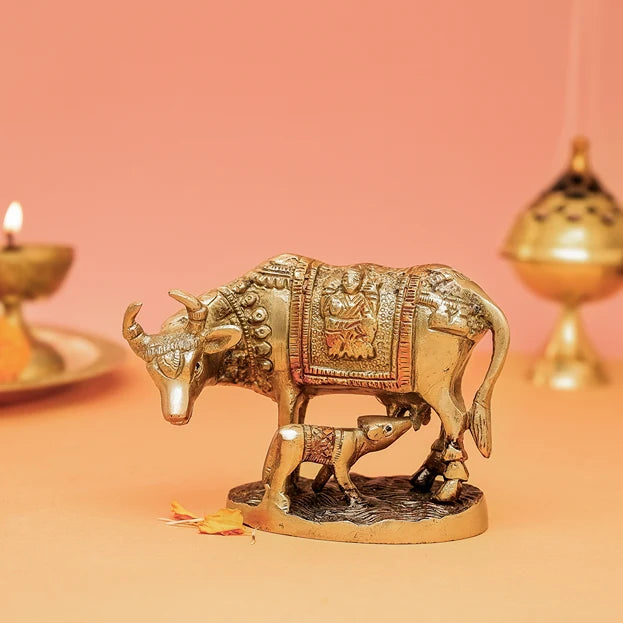
The Bhagavata account puts the cows at the centre of the first Govardhan puja — Krishna's whole argument to his father was that the cows, and the hill that fed them, deserved the offering — and the day has kept them there. Across the north and west, Govardhan Puja morning is when cattle are washed, their horns oiled and painted, their bodies marked with hand-prints of colour, bells and garlands put on, and the herd walked past the Govardhan or, in villages, driven over it, so that the hill is broken by the hooves of the cows it was built to honour. The cows are fed before the family eats. Farming households in Haryana and Punjab also honour the bullocks and their tools on the day, and in Gujarat the whole herd is brought out for the new year. The cow in Hindu tradition is Gau Mata, the mother, and Kamdhenu, the wish-fulfilling cow who rose from the churning of the ocean and is the mother of all cattle, is the form in which she is worshipped; a brass Kamdhenu with her calf, kept in the home mandir, is the customary substitute where a family has no cow of its own. What is offered to her on Govardhan Puja is understood as gratitude, and the prayer made is for her well-being and the household's, not a bargain.
Govardhan parikrama in Braj
The real Govardhan is a low ridge of sandstone about eight kilometres long near Mathura, and its parikrama — the circuit of roughly twenty-one kilometres on foot, from Mansi Ganga through Radha Kund, Kusum Sarovar, Govind Kund and Jatipura and back — is walked by pilgrims through the year and by lakhs of them on Govardhan Puja day and on the Purnima of Kartik. Tradition holds that the hill is a form of Krishna himself and is never climbed, only circled; stones from it are kept in Vaishnava homes as Giriraj shilas and worshipped with milk and tulsi. The parikrama on Govardhan Puja is barefoot for most, and some pilgrims perform it as a dandavat parikrama, prostrating full-length at every step, which takes days. In the temples along the route — at Jatipura and Dan Ghati especially — the Annakut is offered to the hill itself on the afternoon of the day, with the mountain of rice built against the rock face. A family in Bengaluru or Mumbai cannot walk it, but the seven circuits of the cow-dung hill in the courtyard are understood in the tradition to be the same act in small.
Across India: Annakut, Padwa, Bali Pratipada and the Gujarati New Year
The same Pratipada carries several festivals, and they overlap in the same houses. In Uttar Pradesh, Haryana, Delhi, Rajasthan and Madhya Pradesh, and above all in Braj, the day is Govardhan Puja and Annakut in the form described above; in the Pushtimarg havelis of Rajasthan and Gujarat the Annakut is the great darshan of the year. In Gujarat the morning is Bestu Varas, the new year of the Vikram Samvat — 2083 begins on 10 November 2026 — and it is kept with an early bath, new clothes, the greeting Saal Mubarak, a visit to the temple for the Annakut, and the settling of the old year's accounts, which were closed in the Chopda Pujan of Diwali night; the first day of business is begun and sweets are exchanged. In Maharashtra the day is Diwali Padwa, and also Bali Pratipada, and both are kept: in the morning the wife performs an aarti for her husband and receives a gift — the Padwa half — and the day recalls the asura king Bali, the devotee whom Vishnu as Vamana pressed into the netherworld with his third step, granting him, in the traditional account, the right to return to his kingdom on earth for one day each year; images of Bali are drawn in rice flour or the story is read, and in Karnataka the same day is Bali Padyami, kept with the lighting of lamps for the returning king. Goa keeps the day as the new year and Bali Pratipada together. In Nepal the Pratipada falls inside Tihar: it is Goru Puja, when the oxen are honoured, and in the Newar community the morning is Mha Puja, the worship of one's own body and self, which opens the Nepal Sambat new year. Across the south the day is quieter — Deepavali in Tamil Nadu is the oil bath of Naraka Chaturdashi, and the Pratipada is kept mainly in Vaishnava temples and by families with northern roots — but the Annakut is offered in the Krishna temples of Udupi and Guruvayur, and the Gujarati and Marwari communities of Chennai, Bengaluru and Hyderabad keep the new year exactly as they would at home. Under every name it is the same tithi: the morning after Diwali, the food offered, the cows honoured, and a year begun.
What is traditionally done, and what is set aside
The customs of the day are few and gentle. The house is kept as it was for Diwali, with the lamps at the door; a fresh Govardhan is built rather than a reused one; the Annakut is cooked without tasting and offered before anyone eats; the cows are fed first; and the prasad is shared widely — the tradition dislikes an Annakut that feeds only the family. It is a day for new beginnings in the west, so accounts are opened, shops are opened for a token first sale, and journeys begun. By custom, several things are set aside on Govardhan Puja: eating before the offering is made, cutting or harming trees and grass, since the day honours the hill and its pastures, the sale or ill-treatment of cattle, and in most homes the moon is not looked at on the Pratipada, an old custom kept in Braj and Gujarat on the first day of the bright fortnight. These are the etiquette of the day rather than prohibitions with stated consequences, and family practice varies; where your household has always done something differently, do it your way.
The five days of Diwali 2026 at a glance
Govardhan Puja is the fourth of the five. Seen together, the 2026 week looks like this; the detail for each day is in the linked guide.
| Day | 2026 date | What is done |
|---|---|---|
| Dhanteras | Friday, 6 November 2026 | New metal brought home; Dhanvantari, Lakshmi and Kubera puja — Dhanteras 2026 guide |
| Naraka Chaturdashi (Choti Diwali) | Sunday, 8 November 2026, pre-dawn | The oil bath before sunrise; some calendars list Saturday 7 November |
| Diwali — Lakshmi Puja | Sunday, 8 November 2026, evening | Lakshmi-Ganesha puja at pradosh — Diwali Lakshmi Puja 2026 vidhi |
| Govardhan Puja (Annakut) | Tuesday, 10 November 2026 | The cow-dung hill, the Annakut, gau puja and parikrama — this guide |
| Bhai Dooj (Yama Dwitiya) | Wednesday, 11 November 2026 | The sister's tilak, aarti and meal — Bhai Dooj 2026 guide |
Each of these is a tithi mapped onto a calendar day and can move by one with your city's sunrise, so confirm against a current panchang before you observe. Chhath Puja closes the season from 13 to 16 November — see the Chhath Puja 2026 guide — and the holy month in which all of this falls is laid out in our Kartik month 2026 guide. The full year is in the Hindu Festival Calendar 2026, with the fasting days in the Ekadashi 2026 list. For Krishna's birthday earlier in the year, see Krishna Janmashtami 2026.
Frequently Asked Questions
When is Govardhan Puja in 2026?
Govardhan Puja 2026 falls on Tuesday, 10 November 2026, on Kartik Shukla Pratipada, the first day of the bright fortnight after the Diwali Amavasya. Diwali and Lakshmi Puja are on Sunday, 8 November, Monday, 9 November is the Amavasya morning with no separate festival, and Bhai Dooj follows on Wednesday, 11 November. Drik Panchang and Prokerala both place Govardhan Puja on 10 November. The Pratipada tithi ends at 2:00 PM that day, so the puja is done in the morning.
What is the Govardhan Puja muhurat for 2026?
Govardhan Puja is traditionally done in the pratahkal, the morning, on Tuesday, 10 November 2026, while the Pratipada tithi is current; the tithi ends at 2:00 PM. The exact morning window differs between cities by a few minutes because it is reckoned from local sunrise, and panchang publishers differ from one another by a few minutes more on the same city, so take the window for your own location from a current panchang on the day. Where the morning is impossible, panchangs also allow the puja in the late afternoon of the same day.
Why is there a gap between Diwali and Govardhan Puja in 2026?
Diwali is kept on the evening on which the Amavasya tithi is current at pradosh, which in 2026 is Sunday, 8 November. The Amavasya tithi runs on past sunrise on Monday, 9 November, so that day is counted as the Amavasya morning, used for the Diwali snan and dev puja, and the Pratipada that carries Govardhan Puja is current at sunrise only on Tuesday, 10 November. A one-day gap between Diwali and Govardhan Puja occurs in many years for this reason and is entirely normal.
What is the story behind Govardhan Puja?
The Bhagavata Purana tells that the cowherds of Vraja made a yearly sacrifice to Indra, the god of rain, until the boy Krishna persuaded them to offer it instead to Govardhan hill, whose grass and streams fed their cows. When the offering was made, Krishna appeared as the hill and accepted it. Indra, enraged, sent devastating rain, and Krishna lifted Govardhan on the little finger of his left hand and sheltered the people and cattle of Vraja beneath it for seven days until Indra relented. Indra then bathed Krishna with the milk of the celestial cow Surabhi and gave him the name Govinda, protector of the cows. Tradition treats the account as sacred history.
What is Annakut and why are there 56 dishes?
Annakut means a mountain of food. It is the offering of cooked dishes, built up around a central mound of rice so that it rises like a hill, that is placed before Krishna and the Govardhan on this day, recalling the first offering the cowherds made to the hill. The fullest form is the chhappan bhog, fifty-six dishes, traditionally explained by the seven days Krishna held up the hill without eating: the cowherds cooked him eight meals for each of the seven days when the storm ended. There is no single fixed list, and an Annakut of sixteen, twenty-one or even three dishes offered with intent is considered complete.
How is Govardhan Puja done at home?
The family bathes, cleans the courtyard or a corner of the terrace, and shapes a small hill of fresh cow dung, or of cooked rice where dung is not available, decorating it with flowers, akshat, grass and clay figures of cows and cowherds. A Krishna image is placed at its head with a kalash. After the sankalp and a prayer to Ganesha, the hill is offered water, roli, flowers, a lamp and incense, the Govardhan aarti is sung, the Annakut is arranged and offered with tulsi leaves and a bell, and the family walks around the hill clockwise, usually seven times, pouring a thin line of water along the route. Cows are bathed, decorated and fed where the family has access to them, and the Annakut is distributed as prasad.
What is Gau puja on Govardhan Puja?
Gau puja is the worship of the cow on Govardhan Puja morning, following the Bhagavata account in which Krishna asked the cowherds to honour the cows and the hill that fed them. Cattle are washed, their horns oiled and painted, garlands and bells put on, tilak applied, and they are fed green fodder, jaggery and a share of the Annakut before the family eats. Households with no cow set aside a portion of the prasad for a gaushala or a cowherd, or keep a brass Kamdhenu, the wish-fulfilling cow of tradition, in the home mandir and make the offering before her. The prayer made is one of gratitude for the animal's well-being and the household's.
Is Govardhan Puja the same as the Gujarati New Year and Bali Pratipada?
They fall on the same tithi, Kartik Shukla Pratipada, and are kept together in many homes. In Gujarat the morning is Bestu Varas, the first day of the Vikram Samvat year, and 2083 begins on 10 November 2026, with new clothes, the greeting Saal Mubarak and the Annakut darshan at the temple. In Maharashtra and Karnataka the day is Bali Pratipada or Bali Padyami, recalling the devotee king Bali who is believed to return to earth for one day each year, and in Maharashtra it is also Diwali Padwa, when the wife performs an aarti for her husband. In Nepal it is Goru Puja within Tihar and the Newar Mha Puja that opens the Nepal Sambat year.
What is traditionally avoided on Govardhan Puja?
By custom nobody eats before the Annakut has been offered, the cows are fed before the family, and the prasad is shared widely rather than kept. Cutting or harming trees and grass is set aside because the day honours the hill and its pastures, the sale or ill-treatment of cattle is avoided, and in Braj and Gujarat the moon is traditionally not looked at on this Pratipada. Nothing from the Annakut is thrown away. These are the etiquette of the day rather than rules with stated consequences, and family practice varies.
Can Govardhan Puja be done in a flat without cow dung?
Yes. Where fresh cow dung is not available, the Govardhan is shaped from cooked rice, from clay, or represented by a brass or clay image or a printed picture of Krishna lifting the hill placed on a heap of grain in a large thali or tray. The decoration, the offering, the aarti and the parikrama are done exactly as they would be in a courtyard, with the family walking around the tray. An Annakut of whatever the household can cook is offered, and a share is sent to a gaushala or given to a cowherd in place of feeding a cow directly.
A brass Kamdhenu is traditionally kept in the home mandir as the form of Gau Mata before whom the Govardhan Puja offering is made when a family has no cow of its own; if your mandir does not have one, the Lord Krishna with Kamdhenu cow and calf brass idol — Krishna beside the wish-fulfilling cow and her calf — is the kind most households keep for this puja and for daily worship through the year. Browse the wider Lord Krishna collection, brass idols and diyas and lamps online, or visit Divine Hindu Store, Jayanagar 3rd Block East, Bengaluru 560011.
This guide is for educational and devotional purposes and reflects traditional practice, which varies by region, community and family. Tithi-to-date mapping shifts with sunrise and location, so please confirm the Govardhan Puja 2026 date and the morning muhurat with a current panchang for your city before you observe. The blessings described are matters of traditional belief and personal faith, not guaranteed outcomes.


