 Cow Shelter/Donation

Idol Size and Height for a Home Mandir: Traditional Proportion Rules and How to Measure
September 03, 2026
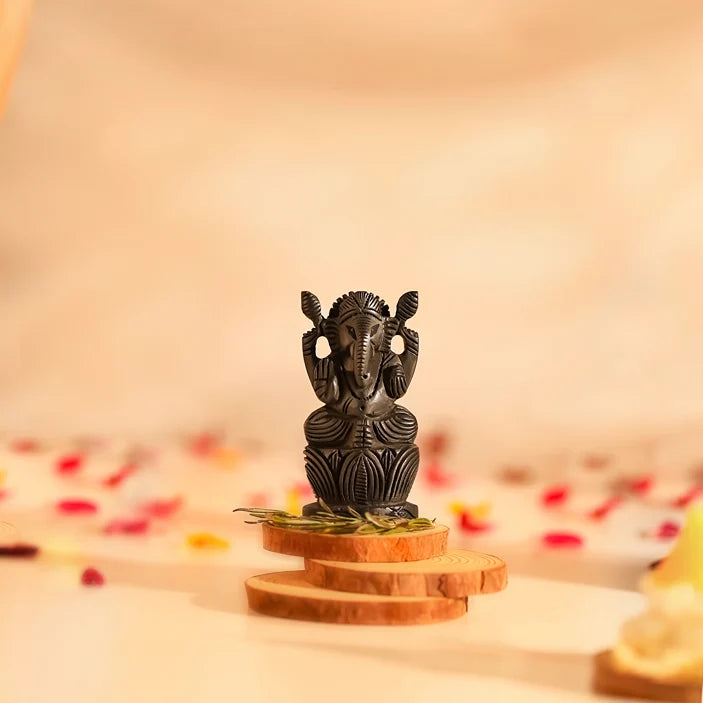
Traditional guidance keeps household murtis small. The figure most commonly cited is a vitasti, the span of an outstretched hand from thumb to little finger, taken as roughly nine inches, with twelve inches often given as an outer limit for a home shrine. A Shivling kept at home is customarily smaller still. The mandir itself is traditionally raised so that the deity sits above the seated devotee rather than below, with the face at or a little above eye level. Practice varies by region and sampradaya, and your family priest or elder is the right authority for your own household.
Why home murtis are kept small
The reasoning behind the rule is worth understanding, because it explains every other number in this article. In the shilpa and agama traditions, the scale of a murti is tied to the scale of the seva it requires. A large, formally installed murti implies daily worship at temple standard: abhishek at fixed hours, alankaram, naivedya, the full sequence of upacharas, performed without interruption by someone qualified to do it, for as long as the murti remains installed.
A household cannot honestly promise that. People travel, fall ill, move cities and have spells when the shrine is neglected. Tradition therefore scales the murti to what a family can realistically sustain. The rule is not about aesthetics or apartment space. It is about not undertaking more than you can maintain.
This is also why the same tradition is relaxed about framed pictures and small unenergised figures, which carry no comparable obligation. Our guide to Hindu idols and murtis for the home temple covers how a murti differs from a decorative figure.
The traditional units
Classical iconometry works in body-derived units rather than inches. The angula is the base unit, roughly the width of a finger and conventionally about three quarters of an inch. Twelve angulas make one vitasti, the hand span, which lands at about nine inches. The tala, a face-length, is the unit used for proportioning the figure itself in systems such as dasa-tala, where a standing image is laid out across ten face-lengths.
Because these are body-derived, the older texts describe a relationship rather than a fixed measurement, which is a more sensible way to read the guidance than treating nine inches as a boundary. A murti one person can lift, bathe and dress alone is the practical test the units point at.
Commonly cited height guidance
| What is being placed | Height commonly cited | Reasoning usually given |
|---|---|---|
| Main deity in a home shrine | Up to about one vitasti, roughly nine inches; twelve inches often given as an outer limit | Keeps the daily seva within what a household can sustain |
| Secondary deities in the same shrine | Smaller than the main murti | The pradhan murti is customarily the tallest and centrally placed |
| Shivling at home | Very small; commonly described as no larger than the thumb | A Shivling is held to require particularly regular abhishek |
| Framed images and printed pictures | No traditional height rule | Not formally installed, so no comparable obligation attaches |
| Temple murti | Large, proportioned by the shilpi to the sanctum | Full daily seva is performed by qualified priests without interruption |
| Deity face relative to the devotee | At or slightly above the seated eye level | Darshan is customarily taken looking up or level, never down |
Every figure above should be read as commonly cited guidance rather than as a single settled rule. Different sampradayas, regions and family traditions give different numbers, and some give none at all. Where your family already has a practice, that practice is your answer.

How high the mandir itself should sit
The general principle is that the deity is not placed below the devotee. In practical terms:
- Not on the floor. The shrine base is customarily raised on a platform, chowki or the plinth of the mandir unit itself, rather than the murti standing directly on the ground.
- Above the seated waist. A commonly given benchmark is that the murti should sit above the level of the devotee's navel when seated for puja.
- Face at or just above seated eye level. High enough that darshan is taken looking up or level, low enough that aarti, abhishek and offerings can be performed comfortably without reaching.
- Reachable without a stool. If you cannot garland the murti or wipe it down without climbing, the shelf is too high, whatever the guidance says.
- An asana for the devotee. A mat or asana for the person doing puja is the usual complement to a raised shrine.
Where the shrine sits in the house is a separate question from how high it sits, and is covered in our guides to where to place idols at home and pooja room vastu.
Proportion inside the mandir
This is where most people get caught out, because a murti that is technically within the height guidance can still be wrong for the cabinet it goes into.
- Leave headroom. A useful workshop rule is that the murti should occupy no more than about two thirds of the clear internal height of the shelf. The remaining third accommodates the crown, any prabhavali or arch, and a garland.
- Leave depth in front. The shelf has to hold the thali, a lamp, an agarbatti stand and the day's offerings. A murti pushed to the front leaves nowhere for any of it.
- Leave a gap at the back. Customarily the murti does not touch the rear wall of the shrine. A small clearance also makes cleaning possible.
- Account for the base. Many brass and panchaloha murtis are supplied on an integral asana or pedestal that is included in the stated height, and many are not. Ask which.
- Account for the footprint. Seated murtis are often much deeper than they are tall. A nine-inch seated Ganesha can easily need seven or eight inches of shelf depth.
- Account for weight on wall units. Brass is dense. A wall-mounted mandir has a load limit and the fixing matters more than the shelf.
Measuring before you buy
- Measure the clear internal height of the shelf the murti will stand on, from the shelf surface to whatever is above it. Not the outside of the cabinet.
- Measure the usable depth and subtract the space you need in front for the thali and lamp.
- Measure the width and decide now how many murtis will share the shelf.
- Sit down where you will sit for puja and measure the height of your own eye level from the floor. Compare it with the shelf height plus the murti height.
- Apply the two-thirds rule to get your maximum murti height, then check it against the traditional guidance and take the smaller of the two.
- Ask the seller three questions in writing: the total height, whether that includes the base, and the maximum depth and width at the widest point.
- Decide the hierarchy before ordering. Choose the main deity first and size everything else below it, rather than buying piecemeal and discovering later that a secondary murti towers over the pradhan murti.
Material affects weight and cleaning far more than it affects the sizing rules, and our comparison of brass, panchaloha and marble covers that choice. Once a murti is in the house, the installation is a separate step described in our guide to prana pratishtha at home, and routine upkeep in our note on cleaning brass idols.
Common mistakes
- Buying the murti before measuring the mandir. The single most frequent problem, and the least fixable.
- A secondary deity taller than the main one. Easy to do when murtis are bought at different times.
- Duplicates. Multiple murtis of the same deity in one shrine are traditionally avoided, along with certain forms that are customarily not kept at home. Our note on which idols are traditionally not kept at home covers this.
- A shrine so full there is no room to do puja. The shelf is a working surface, not a display case.
- Scaling up without scaling up the seva. If the murti gets larger, the daily obligation is traditionally understood to get larger with it.
- Assuming an apartment cannot follow the guidance. Small is the tradition, not a compromise. Our guide to setting up a mandir in an apartment works through the constraints.
Murtis in the sizes discussed here sit in our sacred god idols and brass idols collections, with dimensions stated on each product. As with everything in this article, treat the numbers as traditional guidance rather than as rules, and settle anything you are unsure about with your family elder or priest.
Idol Size for a Home Mandir: Frequently Asked Questions
How tall should an idol be for a home mandir?
Traditional guidance keeps household murtis small. The figure most often cited is a vitasti, the span of an outstretched hand from thumb to little finger, taken as roughly nine inches, with twelve inches frequently given as an outer limit. Practice varies by region and sampradaya, and some traditions give no figure at all. Where your family already follows a practice, that practice is the one to follow.
Why are temple idols large and home idols small?
Because scale is traditionally tied to the seva the murti requires. A large formally installed murti implies daily worship at temple standard, performed at fixed hours without interruption by someone qualified to do it. A temple is organised to provide that; a household is not. Keeping the murti small keeps the obligation to one a family can realistically sustain over years.
How high off the floor should the mandir sit?
The principle is that the deity is not placed below the devotee. The murti is customarily raised on a platform or plinth rather than standing on the floor, commonly above the level of the devotee's navel when seated, with the face at or a little above seated eye level so that darshan is taken looking up or level. It should still be low enough to garland and clean without a stool.
What size Shivling can be kept at home?
Household tradition keeps a Shivling notably small, and the guidance most often repeated is that it should be no larger than the thumb. The reasoning usually given is that a Shivling is held to require particularly regular abhishek, so the size is kept to what a household can maintain daily. Families following a specific parampara should follow what their own priest advises.
How much space should be left above and around the idol?
A practical workshop rule is that the murti should occupy no more than about two thirds of the clear internal height of the shelf, leaving room for the crown, any prabhavali and a garland. Leave depth at the front for the thali, lamp and offerings, and a small gap behind so the murti does not touch the back wall and can be cleaned.
Should all the idols in one shrine be the same size?
No. The pradhan murti, the main deity of the household, is customarily the tallest and placed centrally, with other deities smaller and flanking it. Choose the main deity first and size everything else below it. Buying piecemeal is how people end up with a secondary murti towering over the principal one.
Do these rules apply to framed pictures too?
Generally not. The height guidance attaches to formally installed murtis, because it follows from the seva they require. Framed images, printed pictures and small unenergised figures carry no comparable obligation and no traditional size limit, which is why many households keep a large picture alongside a very small murti without any conflict.
What should I measure before buying an idol?
Measure the clear internal height of the shelf, its usable depth after allowing space for the thali and lamp, and its width. Sit where you will sit for puja and measure your own eye level. Then ask the seller for the total height of the murti, whether that height includes the base, and its maximum depth and width at the widest point.


