 Cow Shelter/Donation

Rudraksha Bead Size: What the mm Means, How Long a Mala Will Be and How Many Beads for a Wrist
September 03, 2026
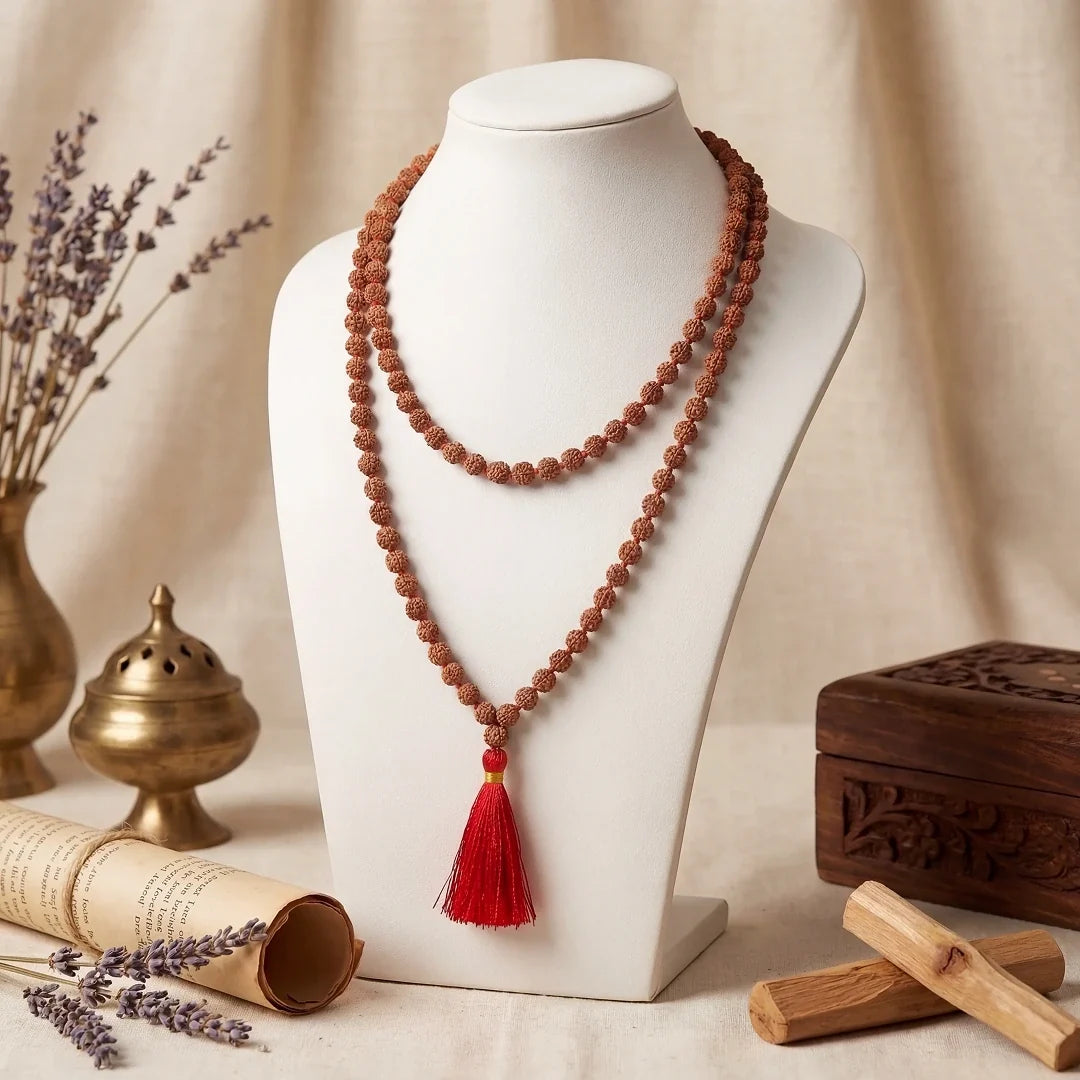
The millimetre figure attached to a rudraksha is its diameter across the widest point, measured at right angles to the drill hole. It is the single number that decides how long a mala will be, how heavy it will feel and how many beads a bracelet needs. As a working rule, a 108-bead mala measures about 108 times the bead diameter in strung length, and a bracelet needs roughly your wrist circumference plus a centimetre of ease, divided by the bead size. Size is independent of mukhi, and a larger bead is not automatically a better one.
What the millimetre actually measures
Rudraksha are seeds, not ball bearings. Almost none of them is a perfect sphere, and most are slightly wider across the middle than they are tall from hole to hole. The convention in the trade is to quote the widest diameter measured perpendicular to the drill hole, taken with a vernier caliper. That is why a bead described as 10 mm can look a little squat or a little tall depending on the individual seed.
Two consequences follow. First, a tolerance of roughly half a millimetre either way is normal for natural material, and a seller who sorts beads to that tolerance is doing careful work rather than cutting corners. Second, when someone quotes a size without saying whether it is the diameter or the height, ask. On an irregular bead the two can differ by a millimetre or more, which across 108 beads is the difference between a mala that sits on the chest and one that reaches the navel.
Why Nepali and Indonesian beads sit in different size bands
The two main sources produce beads of noticeably different scale, and this is a botanical fact rather than a quality judgement. Nepali and Himalayan beads generally run larger and heavier, with deeper, more pronounced surface contours. Indonesian beads, grown mainly in Java, run smaller and smoother.
In practice this means most Nepali 108-bead malas are strung from beads in the smaller end of the Nepali range, because a full mala of genuinely large Nepali beads becomes very long and heavy to wear daily. Larger Nepali beads are therefore usually sold as singles for a pendant, or made up into shorter counts. Indonesian beads, being smaller, are what the fine, light, closely strung malas are usually made from. If you have seen a slim rudraksha mala that sits neatly under a collar, it was almost certainly Indonesian.
Neither is a substitute for the other and neither is a fake. They are different beads with different price structures, and our guide to what actually drives the cost of a bead sets out how origin, mukhi, size, surface and symmetry combine.
The arithmetic of a 108-bead mala
Strung length is close to bead count multiplied by bead diameter. Knots between beads add roughly one to two millimetres per gap, so a fully knotted mala runs measurably longer than the same beads strung plain. The sumeru or guru bead adds a little more.
| Bead size | Approx strung length, 108 beads | Roughly where it sits when worn as a single loop | Practical note |
|---|---|---|---|
| 6 mm | About 65 cm | Upper chest | Light and discreet; usually Indonesian |
| 8 mm | About 86 cm | Mid chest toward the solar plexus | The common all-rounder for daily wear |
| 10 mm | About 108 cm | Around the navel | Substantial; good in the hand for japa |
| 12 mm | About 130 cm | Below the navel | Most people wear this doubled |
| 14 mm | About 151 cm | Well below the navel | Usually kept for japa rather than worn |
These are approximations for plain-strung beads and they shift with knotting, spacers, capping and the size of the wearer. If you need a specific finished length, ask the seller for the measured length of the actual piece rather than calculating it. For why the count itself matters, see our guide to 108 versus 54 versus 27 versus 21 bead malas.
How many beads for a wrist
Measure the wrist circumference, add about 10 to 15 mm of ease so the bracelet turns freely without sliding over the hand, then divide by the bead diameter. The table below uses 12 mm of ease and rounds to the nearest whole bead.
| Wrist circumference | 6 mm beads | 8 mm beads | 10 mm beads | 12 mm beads |
|---|---|---|---|---|
| 14 cm | 25 | 19 | 15 | 13 |
| 15 cm | 27 | 20 | 16 | 14 |
| 16 cm | 29 | 22 | 17 | 14 |
| 17 cm | 30 | 23 | 18 | 15 |
| 18 cm | 32 | 24 | 19 | 16 |
| 19 cm | 34 | 25 | 20 | 17 |
Two adjustments are worth making. If you want a traditional count, round to 27 or 21 beads and pick the bead size that lands you closest rather than forcing the count. And if the bracelet is on elastic, subtract a bead: elastic stretches with wear, and a bracelet that is loose on day one will be sliding off within months. Our comparison of thread, knotted and silver-capped construction explains which build holds its size longest.
Does a bigger bead mean a better bead?
No, and this is worth stating plainly because size is the easiest thing for a listing to shout about. Size is one variable among several. What tradition and the trade both weigh more heavily is the mukhi, whether the faces run cleanly and continuously from hole to hole, the origin, the condition of the surface and the symmetry of the bead. A well-formed 8 mm bead with clean, unbroken lines is a better bead than a large one with a chipped face or a suspiciously smooth line.
Size does matter for two honest reasons. Larger beads of the same mukhi are scarcer, which is reflected in what they cost. And larger beads are physically easier to feel and count during japa, which is why practitioners often keep a larger mala for chanting and a smaller one for wearing. Our guide to japa technique covers how the beads are actually moved.
Choosing a size: a short decision path
- Decide what it is for. Wearing under clothes, wearing visibly, or japa in the hand. These pull in different directions and one mala rarely does all three well.
- For discreet daily wear, smaller beads in a 108 or a 54 count keep the weight and the length down.
- For japa, go a size up from what you would wear. Beads you can feel clearly without looking are beads you will not lose count on.
- For a bracelet, measure first, then use the table. Do not buy a stated bead count without knowing the bead size, because 21 beads at 6 mm and 21 beads at 10 mm are entirely different objects.
- Check the beads are matched. In a uniform mala the beads should be sorted to a consistent diameter. In a graduated mala they should step evenly from the sumeru outward. Random variation is a sign of unsorted material.
- Ask for the measured size in writing, along with origin and mukhi, and buy from a seller offering lab certified and X-ray tested beads. Our guide on buying authentic rudraksha covers what a seller should be willing to state.
Measuring at home
For a wrist, wrap a strip of paper or a tailor's tape snugly around the wrist bone, mark where it overlaps and measure the length flat. Do not pull it tight. For a bead you already own, a vernier caliper is ideal; failing that, line several identical beads against a steel rule and divide the total by the number of beads, which averages out the irregularity of any single seed. For an existing mala, lay it flat in a circle and measure the strung length rather than trying to guess it from how it hangs.
If you are matching a new piece to something you already wear, the most reliable instruction you can give a seller is a measured finished length in centimetres plus a bead size in millimetres. Descriptions like medium or standard mean different things to different workshops. Browse by form at rudraksha bracelets, rudraksha necklaces and japa malas, and check the stated size on the individual product rather than assuming a house standard.
Rudraksha Bead Size: Frequently Asked Questions
What does the mm size of a rudraksha bead mean?
It is the diameter of the bead across its widest point, measured at right angles to the drill hole, normally with a vernier caliper. Because rudraksha are natural seeds and rarely perfectly spherical, a tolerance of about half a millimetre either way is normal. If a listing does not say whether the figure is the diameter or the height of the bead, ask, because on an irregular bead the two can differ noticeably.
Are Nepali beads bigger than Indonesian beads?
Generally yes. Nepali and Himalayan beads run larger and heavier with more pronounced surface contours, and Indonesian beads grown in Java run smaller and smoother. That is a difference of origin, not of authenticity. It is why fine, light, closely strung malas are usually Indonesian, and why larger Nepali beads are more often sold as singles for a pendant than strung into a full 108.
How long will a 108-bead mala be?
Roughly the bead diameter multiplied by 108. That gives about 65 cm at 6 mm, about 86 cm at 8 mm, about 108 cm at 10 mm and about 130 cm at 12 mm, before knots. Knotting between beads adds one to two millimetres per gap, so a knotted mala runs longer. For a specific finished length, ask the seller to measure the actual piece rather than relying on the calculation.
How many beads do I need for a bracelet?
Take your wrist circumference, add 10 to 15 mm of ease so it turns freely without sliding over your hand, and divide by the bead size. A 16 cm wrist works out at roughly 29 beads at 6 mm, 22 at 8 mm, 17 at 10 mm and 14 at 12 mm. If the bracelet is strung on elastic, take one bead off, because elastic stretches with wear and a loose bracelet only gets looser.
Is a bigger rudraksha bead a better bead?
Not by itself. Mukhi, the cleanliness and continuity of the faces from hole to hole, origin, surface condition and symmetry all weigh more heavily than size alone. Larger beads of the same mukhi are scarcer and therefore cost more, and they are easier to feel during japa, but a well-formed smaller bead with unbroken lines is a better bead than a large one with a damaged or suspiciously smooth face.
Which bead size is easiest for japa?
Most practitioners find a slightly larger bead easier, because you can feel each one clearly and roll it past the thumb without breaking rhythm or looking down. A common approach is to keep one larger mala for chanting and a smaller, lighter one for wearing, since the two uses genuinely pull in different directions.
Should every bead in a mala be the same size?
In a uniform mala, yes, the beads should be sorted to a consistent diameter within the normal tolerance for natural material. In a graduated mala the beads step evenly in size from the sumeru outward, which is deliberate. What you do not want is random unsorted variation, which suggests the beads were strung without being graded.
How do I measure my wrist at home?
Wrap a strip of paper or a tailor's tape snugly but not tightly around the wrist bone, mark the overlap, then lay it flat against a ruler. Use that figure with the bead-count table. When ordering, give the seller a measured length in centimetres and a bead size in millimetres rather than words like medium or standard, which mean different things to different workshops.


