 Cow Shelter/Donation

Sharad Purnima 2026: Date, the Kheer in Moonlight, Kojagiri, Kumar Purnima & Raas Purnima
September 08, 2026
Sharad Purnima 2026 falls on the night of Sunday, 25 October 2026, with the Purnima tithi running from a little before noon that day until 9:41 AM on Monday, 26 October. It is the full moon of Ashwin, the one night of the year on which, in the tradition, the moon is held to shine with all sixteen of its kalas, and the night on which families across India set a vessel of kheer out under the open sky and keep a vigil for Lakshmi. Maharashtra keeps it as Kojagiri Purnima, Bengal as Kojagori Lokkhi Pujo, Odisha as Kumar Purnima, Gujarat as Sharad Poonam, and the temples of Braj as Raas Purnima, the night of Krishna's great dance. Because the tithi is also current at sunrise on the Monday, many calendars — including our own Purnima and Amavasya 2026 list — print Sharad Purnima as 26 October; both readings, and what each is used for, are explained below. The same Purnima day, Monday, 26 October, is also Valmiki Jayanti, the birth anniversary of the sage who composed the Ramayana.
The Divine Hindu App is here.
Chat free with top astrologers for your first 5 minutes every week, generate your Kundli, book temple Puja & Chadhava, and check today's Panchang — all in one app.
Sharad Purnima 2026 date: the night of Sunday, 25 October
Sharad Purnima is a night observance, and that decides the date. The Purnima tithi of Ashwin begins on Sunday, 25 October 2026 a few minutes before midday — Drik Panchang gives 11:55 AM and Prokerala 11:56 AM — and ends at 9:41 AM on Monday, 26 October, a time both sources give to the minute. The moon rises on the Sunday evening at around five o'clock across most of India, a little earlier in the east and later in the west, and by the time it is high the Purnima is current and stays current until after sunrise. On the Monday night there is no Purnima moon at all; the tithi has gone by breakfast. So the kheer, the Kojagiri vigil, the Lakshmi puja and the Raas all belong to Sunday night, 25 October 2026, and that is the date Drik Panchang and Prokerala both print for Sharad Purnima and for Kojagara.
The Monday is not wrong; it is a different thing. Panchangs name a calendar day by the tithi current at its sunrise, and on Monday, 26 October the Purnima is current at sunrise, so 26 October is the Ashwin Purnima day — the day for the Purnima snan, for daan and for a Satyanarayan puja, the day on which Valmiki Jayanti is kept, and the day on which the Kartik snan of the coming month traditionally begins. The Purnima fast is a slightly different matter: Drik Panchang lists the Ashwin Purnima vrat on Sunday, 25 October alongside Kojagara, because the fast is traditionally kept on the day the Purnima moon is seen, while families that fast by the sunrise tithi keep it on the Monday; follow your own family's rule. Calendars that list Sharad Purnima on 26 October are naming the Purnima day; calendars that list 25 October are naming the Purnima night. If you are setting out kheer, keeping the Kojagiri jagran, or going to a Raas, it is Sunday night. If you are bathing or giving in the name of the Purnima, it is Monday morning. Readers outside India should check the tithi against their own city's moonrise, since it can shift the night by a day.
| What | When in 2026 | Panchang detail |
|---|---|---|
| Sharad Purnima night — kheer, Kojagiri jagran, Lakshmi puja, Raas Purnima | Sunday, 25 October 2026, from moonrise | Purnima tithi current from late morning on the 25th through the night |
| Ashwin Purnima day — snan, daan, Satyanarayan puja, Valmiki Jayanti | Monday, 26 October 2026, morning | Purnima current at sunrise; ends 9:41 AM. Drik Panchang and Prokerala both list Valmiki Jayanti on this day |
| Moonrise on the night | Around 5 PM, varying by city | Take the exact minute from a current panchang for your city |
| Kartik month begins (purnimanta) | Tuesday, 27 October 2026 | See the Kartik month 2026 guide |
If a full moon in the last week of October looks late for Sharad Purnima, it is: every tithi-based festival in the second half of 2026 has moved about three weeks later than in 2025 because of the extra month, Adhik Maas, inserted between May and June. The explanation is in our Dhanteras 2026 guide.
Why the Ashwin full moon is held apart
There are twelve full moons in a year and this is the one the tradition singles out, for several reasons that sit together. The first is the season. Sharad is the autumn of the Indian calendar, the two months after the monsoon withdraws, and the Ashwin Purnima is its centre: the sky has cleared, the humidity has gone, the nights have turned cool, and the moon on this night is, quite literally, the clearest full moon most of the country will see all year. The poets of Sanskrit and every regional language have said as much for two thousand years — the sharad chandrika, the autumn moonlight, is the standard of brightness against which everything else is measured.
The second is the sixteen kalas. In the tradition the moon has sixteen kalas, or phases and powers, and on Sharad Purnima alone it is held to show all sixteen at once — the one night of the year on which it is complete. The same count is applied to the divine: Krishna is described as the purna avatar born with all sixteen kalas, while Rama is said to have had twelve, which is one reason this night is Krishna's. The third reason is agricultural. The kharif harvest is coming in, and the day is also Navanna Purnima, the full moon of the new grain, on which the first rice of the year was traditionally cooked — as kheer — and offered before the family ate it. The fourth is Lakshmi, who in the Puranic account was born from the ocean on this night and who is believed to come down and walk the earth on it. And the fifth is Ayurvedic: the tradition holds that the moon's rays on this particular night carry a cooling, nourishing quality, and that food left in them takes it up. Whether one reads that as physiology or as faith, it is the reason for the kheer.
The kheer in the moonlight and the amrit tradition
The one custom kept in nearly every home that keeps Sharad Purnima at all is this: a vessel of kheer — rice cooked slowly in milk with sugar, and cardamom, saffron, almonds and pistachio as the family likes — is made in the evening, offered to the deity, and then carried up to the terrace or out to the courtyard and left under the open sky in the moonlight for several hours, in many homes for the whole night. In the morning it is eaten as prasad. Tradition holds that the moon on this night rains amrit, the nectar of the gods, and that the kheer absorbs it; some families say the moon is at its nearest to the earth, some that its rays on this night alone have healing properties, and Ayurvedic practice has long associated the cooling of Sharad with the settling of pitta built up through the monsoon. None of this is a promise, and no one should expect a bowl of kheer to cure anything. It is a very old, very lovely act of trust in the season, and it is best kept in that spirit.
How it is traditionally done. The kheer is made with cow's milk where possible, and in many homes in a silver or brass vessel rather than steel, because silver is the moon's own metal in the tradition; a silver coin or a silver spoon dropped into the kheer serves the same purpose in families that have no silver bowl. It is offered first to the household deity and to the moon — a small arghya of water is given to the risen moon from a lota, with a flower and a few grains of rice — and is then set out, uncovered or under a fine muslin or a mesh cover that lets the light through but keeps insects out, in a place where the moonlight falls directly on it: the terrace, a balcony, a window ledge, the courtyard. It stays there from around nine or ten at night until midnight at least, and until dawn in most traditional homes. In the morning it is taken in, offered again, and eaten by the family as prasad, with a share given to children, to neighbours and to the poor. A little practical care is in order: keep the vessel covered against insects and animals, do not leave it where it can be knocked over, and in a warm city bring it in after midnight rather than at dawn and refrigerate it if it will not be eaten at once. Anyone diabetic or unwell should treat the kheer as they would any sweet, and a small spoonful taken as prasad is understood in the tradition to be as complete as a bowl.
The kheer is not the only dish. In Gujarat the night's food is doodh-pauva, sweetened milk poured over flattened rice, left in the moonlight in the same way; in Maharashtra it is masala doodh, milk boiled down with saffron, nutmeg, cardamom and dry fruit, drunk hot on the terrace after midnight; in Bengal the offering to Lakshmi is payesh with khoi, puffed rice, and narkel naru, coconut sweets; in Odisha it is khai, puffed rice, with coconut, banana and jaggery. Every one of them is white, milky and sweet, and every one is left to the moon.
Lakshmi and the night of "who is awake": Kojagara
The other name of the night comes from a Sanskrit question. Ko jagarti — who is awake? Tradition holds that on the night of the Ashwin Purnima Lakshmi descends and moves through the world asking it, and that she stays where she finds a household awake, its lamps lit and its door open, and passes by the one that has gone to sleep. From the question comes Kojagara, and from Kojagara the Maharashtrian Kojagiri and the Bengali Kojagori. The vrat is the Kojagara vrat: a fast through the day, a Lakshmi puja in the evening, and a jagran — a vigil — through the night, with lamps kept burning, songs, stories and games, the kheer under the moon, and the household deliberately not sleeping until the small hours. What Lakshmi grants to the household she finds awake is, in the tradition, her presence; the vrat is kept as a prayer for that, not as a transaction, and no outcome is promised by staying up.
Two stories are read on the night. The first is the katha of the Kojagara vrat as it is told in Bengal and Mithila. A poor and learned Brahmin named Valit had a wife whose whole nature was to do the opposite of whatever he asked, and who, at his father's shraddha, threw the offerings into the river rather than lay them out. Valit left home in grief and wandered into the forest, where on the night of the Ashwin Purnima he came upon the serpent-maidens of the netherworld playing dice under the full moon, awake for Lakshmi. He kept the night with them, and in the traditional telling Lakshmi, finding him awake, restored to him a wife of a better disposition and the wealth he had lost. The second is the story of the two sisters, told with the Sharad Purnima vrat across the north: a merchant's two daughters both kept the Purnima fast, the elder completely and the younger in half measure, breaking it before the day was done; the younger's children did not live, until on one Sharad Purnima she laid her newborn son on a seat and asked her elder sister to sit there, and the touch of the sister's skirt — the fruit of a vrat kept whole — revived him. Both are traditional accounts handed down in the community rather than fixed history, and both make the same point: what is kept is kept fully, or it is not kept.
Kojagiri, Kumar Purnima, Sharad Poonam and Raas: the night across India
The night has as many forms as it has names, and they are all kept on the same moon. In Maharashtra it is Kojagiri Purnima, and it belongs to the terrace: families and whole housing societies gather after dinner, the masala doodh is boiled in a large vessel and set under the moon, songs are sung and games played until it is drunk after midnight, and the eldest child of the house — the jyeshtha — is honoured with an aarti and a gift, because the night is said to be theirs. In Bengal it is Kojagori Lokkhi Pujo, the Lakshmi puja that follows Durga Puja by five days: the floor of the house is painted with alpana in rice paste, Lakshmi's footprints drawn from the door inward to show her the way, a clay or painted image of the goddess with her owl set on a decorated seat, and the offering of khoi, payesh and coconut sweets made late in the evening while the family keeps awake. In Assam the same night is Lokkhi Purnima, and in Mithila and parts of Bihar the Kojagara vrat is kept with betel nut and makhana, especially for a newly married son.
In Odisha the night is Kumar Purnima, and it belongs to unmarried girls. It is named for Kartikeya, the handsome son of Shiva, and the girls of the house rise before dawn, bathe, and offer the rising sun an arghya of flowers and puffed rice; in the evening they offer the same to the risen moon — chanda — with khai, coconut, banana, cucumber and jaggery in a decorated tray, sing the Kumar Purnima songs, and play a game called puchi in the courtyards. The prayer made is, in the tradition, for a good husband, and the Lakshmi puja of the night is kept alongside. In Gujarat the night is Sharad Poonam, the last great night of the garba season that began at Navratri: the doodh-pauva is left to the moon and the dancing goes on under it until late, and in many towns it is the largest garba of the year. In Nepal it is Kojagrat Purnima, the night that closes Dashain, kept with a Lakshmi puja and a vigil. In the Braj region — Vrindavan, Mathura, Barsana, Nathdwara — the night is Raas Purnima, and it belongs to Krishna, as described below. In Uttar Pradesh, Bihar, Rajasthan and Delhi the kheer under the moon is the whole of the observance for most families, with a Lakshmi puja and a lamp at the door for those who keep the vrat, and the day is the last one on which the Purnima vrat of the year is begun by newly married women. The south keeps the Ashwin Purnima more quietly — the Tamil calendar has its own great moon at Karthigai — but the Lakshmi puja is kept in many homes, and the Gujarati, Marwari and Bengali communities of Bengaluru, Chennai and Hyderabad keep the night exactly as they would at home.
Raas Purnima: Krishna and the great dance
The Bhagavata Purana places the Maha Raas on this night. In the tenth book, on the full-moon night of Sharad — the text names the season, and the tradition names the tithi — Krishna played his flute in the forest of Vrindavan, and the gopis of Vraja left whatever they were doing and came to him. What followed was the raas, the circular dance of the cowherd women with Krishna, in which, the Purana says, he multiplied himself so that each gopi found him at her side and each believed he danced with her alone, while the moon stood still and the night lengthened to the length of a night of Brahma. The theologians of the Vaishnava tradition read the Raas as the highest image of the soul's love for God and of God's love returned to each soul entire; the poets read it as the most beautiful night in Indian literature; and the temples of Braj simply keep it. On Raas Purnima the shrines of Vrindavan and Mathura hold extended darshans and the Raas Lila is performed through the night, the deities at Nathdwara are dressed in white and offered kheer under the open sky, and pilgrims fill the ghats of the Yamuna to see the moon rise over the river. A family at home marks it by dressing Laddu Gopal or the Radha-Krishna image in white, offering kheer and makhan-mishri, and singing the Raas bhajans of Surdas or Meera or whichever tradition is theirs. Our Krishna Janmashtami 2026 guide covers Krishna's birth earlier in the year.
Valmiki Jayanti: the sage's birthday on the same full moon
The Ashwin Purnima is also Valmiki Jayanti, the day on which the birth of the sage Valmiki — the Adi Kavi, the first poet, who composed the Ramayana — is traditionally observed. In 2026 it falls on the Purnima day, Monday, 26 October, the date both Drik Panchang and Prokerala print, and in Punjab, Haryana, Delhi and western Uttar Pradesh, where the day is also called Pargat Diwas, it is kept with processions and shobha yatras, readings of the Ramayana at Valmiki temples, and community kitchens; it is a public or restricted holiday in several northern states. The traditional account of the sage, told in the Puranas and the later legends rather than in the Ramayana itself, is that he began life as a hunter or highwayman named Ratnakar, was turned by the sage Narada to the repetition of Rama's name, and sat in meditation so long that an anthill — valmika — grew over him, from which he took his name. The Ramayana's own opening tells how the grief he felt on seeing a hunter kill one of a pair of curlews came out of him as the first shloka, and how Brahma then asked him to set down the story of Rama in the same metre. In the epic he is also the sage who shelters Sita in his ashram after her exile and raises her twin sons, Lava and Kusha, teaching them to sing the poem to their father. Families who keep the day read a portion of the Ramayana, often the Sundara Kanda, offer a lamp and flowers before a picture of the sage or before Rama, and give food; where a Valmiki temple is at hand, the community gathers there. Drik Panchang lists Meerabai Jayanti on the same Purnima. Neither observance changes the Sharad Purnima night that precedes it: the kheer goes out under the Sunday moon, and the sage is honoured the next morning.
What is traditionally done on Sharad Purnima, and what is set aside
The observance is gentle and mostly domestic, and it fits into an evening. Most families keep some or all of the following.
| Traditionally done | How, and why in the tradition |
|---|---|
| A morning bath and, for those who keep it, a fast | The Kojagara vrat is a day fast broken after the moon puja; many keep it on fruit and milk. Anyone unwell, pregnant, elderly or on medication should keep a modified form or none, and consult a doctor first |
| Lakshmi puja in the evening | A Lakshmi image or picture on a clean cloth, a lamp, flowers, kheer or a sweet, and the Lakshmi aarti; in Bengal the alpana and the footprints — see our Lakshmi mantra guide for the chanting |
| Arghya to the moon | Water from a lota poured out towards the risen moon, with a flower and a few grains of rice, and a short prayer to Chandra |
| Kheer under the moon | Offered, then left in the open in a silver or brass vessel under a fine cover, and eaten as prasad in the morning |
| Lamps at the door and a night vigil | The jagran of Kojagara: lamps kept lit, the household awake with songs, stories and games — see diyas and lamps |
| Sitting in the moonlight | Tradition holds the autumn moonlight to be cooling and restorative, and the family simply sits out in it after the puja |
| Charity | White things — rice, milk, sugar, white cloth — are traditionally given on the Purnima, on the Monday morning as much as the Sunday night |
| White clothes and white offerings | The colour of the moon and of Lakshmi's cool form on this night; deities are dressed in white in Braj |
A few things are set aside by custom, none of them with a stated consequence. Heavy, spiced, fried or non-vegetarian food is avoided through the day, and onion and garlic in most homes that keep the vrat; the meal is light and sattvic, and the kheer is the centre of it. Black clothes are set aside for the night, as they are for Lakshmi on Diwali. Harsh words and quarrels are avoided, on the reasoning that Lakshmi is said to pass by an unhappy house. The night is not one for sleeping early, if the vrat is being kept, though nobody is asked to keep a vigil who cannot. And the kheer is not tasted before it is offered, and not thrown away afterward. Where a family has always done something differently, its own custom is the one to keep.
What Sharad Purnima opens: the season that follows
Sharad Purnima is the hinge between the two halves of the festive autumn. Behind it are Navratri and Dussehra, five days earlier; ahead of it is the whole of Kartik, which by the North Indian calendar begins on Tuesday, 27 October and runs to Kartik Purnima on 24 November. The Kartik snan, the month of pre-dawn baths, traditionally begins on the Purnima day itself, Monday, 26 October, and the month carries Karwa Chauth on Thursday, 29 October, Ahoi Ashtami on Sunday, 1 November, Dhanteras on Friday, 6 November, Diwali on Sunday, 8 November, Govardhan Puja and Bhai Dooj on 10 and 11 November, Chhath from 13 to 16 November, Dev Uthani Ekadashi on 20 November, Tulsi Vivah on 21 November and Dev Diwali on the Kartik Purnima. All of it, with what is observed through the month, is in our Kartik month 2026 guide; the whole year is in the Hindu Festival Calendar 2026, and the other full moons in the Purnima and Amavasya 2026 list. A Satyanarayan puja on the Purnima morning is described in our Satyanarayan puja vidhi. Every date above is a tithi mapped onto a calendar day and can move by one with your city's sunrise; confirm against a current panchang before you observe.
Frequently Asked Questions
When is Sharad Purnima in 2026?
Sharad Purnima 2026 is kept on the night of Sunday, 25 October 2026. The Ashwin Purnima tithi begins a few minutes before noon on 25 October and ends at 9:41 AM on Monday, 26 October, so the full moon night with the kheer, the Kojagiri vigil and the Lakshmi puja is Sunday night. Drik Panchang and Prokerala both give 25 October for Sharad Purnima and Kojagara. Because the tithi is current at sunrise on Monday, 26 October, that is the Purnima day for the snan, daan and Satyanarayan puja, and for Valmiki Jayanti, and many calendars print 26 October for that reason. Confirm with a current panchang for your own city.
Why do some calendars give 26 October for Sharad Purnima 2026?
Panchangs name a calendar day by the tithi current at its sunrise. On Monday, 26 October 2026 the Purnima is current at sunrise and ends at 9:41 AM, so 26 October is the Ashwin Purnima day, used for the Purnima bath, charity and a Satyanarayan puja, and the day on which Valmiki Jayanti is kept. Sharad Purnima and Kojagara are night observances, and the only night on which the Purnima moon is current is Sunday, 25 October, which is why the night observances belong to the Sunday. Both dates are correct for what each is used for.
Why is kheer kept in the moonlight on Sharad Purnima?
Tradition holds that on the night of the Ashwin Purnima the moon shines with all sixteen of its kalas and that its rays carry amrit, the nectar of the gods, which food left beneath it takes up. Kheer made of rice, milk and sugar is offered to the deity and to the moon, set out in a silver or brass vessel under a fine cover on the terrace or in the courtyard for several hours or the whole night, and eaten as prasad in the morning. Ayurvedic practice has long associated the cooling of the autumn moonlight with the settling of pitta after the monsoon. This is a matter of traditional belief and no health outcome is promised; keep the vessel covered against insects, and bring it in and refrigerate it in warm weather.
What is Kojagiri Purnima and what does Kojagara mean?
Kojagara comes from the Sanskrit question ko jagarti, who is awake. Tradition holds that Lakshmi moves through the world on the night of the Ashwin Purnima asking it, and stays where she finds a household awake with its lamps lit. The Kojagara vrat is a day fast, a Lakshmi puja in the evening, and a jagran or vigil through the night with lamps, songs and the kheer under the moon. Maharashtra keeps it as Kojagiri Purnima with masala doodh on the terrace and an aarti for the eldest child of the house, Bengal as Kojagori Lokkhi Pujo with alpana and Lakshmi's footprints drawn to the door, and Mithila and Nepal with a Lakshmi puja and a vigil. No outcome is promised by the vigil; it is kept as a prayer for Lakshmi's presence.
What is Kumar Purnima in Odisha?
Kumar Purnima is the Odia name for the Ashwin full moon, named for Kartikeya, the son of Shiva. It belongs to unmarried girls, who bathe before dawn and offer the rising sun an arghya of flowers and puffed rice, and in the evening offer the risen moon khai, coconut, banana, cucumber and jaggery in a decorated tray, sing the Kumar Purnima songs and play the game called puchi in the courtyard. The prayer made in the tradition is for a good husband, and a Lakshmi puja is kept the same night.
What is the connection between Sharad Purnima and Krishna?
The Bhagavata Purana places the Maha Raas, Krishna's circular dance with the gopis of Vrindavan, on the full moon night of Sharad, and the tradition fixes it on the Ashwin Purnima, which is therefore also called Raas Purnima. In the account Krishna multiplied himself so that each gopi danced with him alone, and the night lengthened to the length of a night of Brahma. The temples of Vrindavan, Mathura and Nathdwara hold extended darshans and Raas Lila performances through the night, dress the deities in white and offer kheer under the open sky, and families at home dress Laddu Gopal or the Radha-Krishna image in white and offer kheer and makhan-mishri.
What should be done and avoided on Sharad Purnima?
Traditionally the day begins with a bath and, for those who keep the Kojagara vrat, a fast on fruit and milk, followed by a Lakshmi puja in the evening, an arghya of water to the risen moon, the kheer offered and left under the moonlight, lamps at the door and a night vigil with songs and stories, and charity of white things such as rice, milk and cloth. By custom heavy, fried, spiced and non-vegetarian food is set aside, black clothes are not worn for the night, quarrels are avoided, and the kheer is neither tasted before it is offered nor thrown away afterward. These are customs without stated consequences, and anyone unwell should keep a modified fast or none.
Can Sharad Purnima be kept in a flat without a terrace?
Yes. The kheer needs only a place where the moonlight falls on it directly, and a balcony, a window ledge or a windowsill with the glass open serves as well as a terrace; where none is available, many families place the vessel by an open window or on the sill of the building's common terrace. The Lakshmi puja, the arghya to the moon offered from a balcony or window, the lamps at the door and the vigil are all kept exactly as they would be in a courtyard. What the tradition asks for is the moon on the kheer and the household awake, not the size of the roof.
Is Valmiki Jayanti on Sharad Purnima in 2026?
Yes. Valmiki Jayanti, the birth anniversary of the sage who composed the Ramayana, is kept on the Ashwin Purnima, and in 2026 both Drik Panchang and Prokerala list it on Monday, 26 October, the Purnima day that follows the Sharad Purnima night of Sunday, 25 October. It is observed with processions, readings of the Ramayana and community kitchens, especially in Punjab, Haryana, Delhi and western Uttar Pradesh, where it is also called Pargat Diwas. The two observances do not conflict: the kheer and the Kojagara vigil belong to the Sunday night, and the sage is honoured on the Monday.
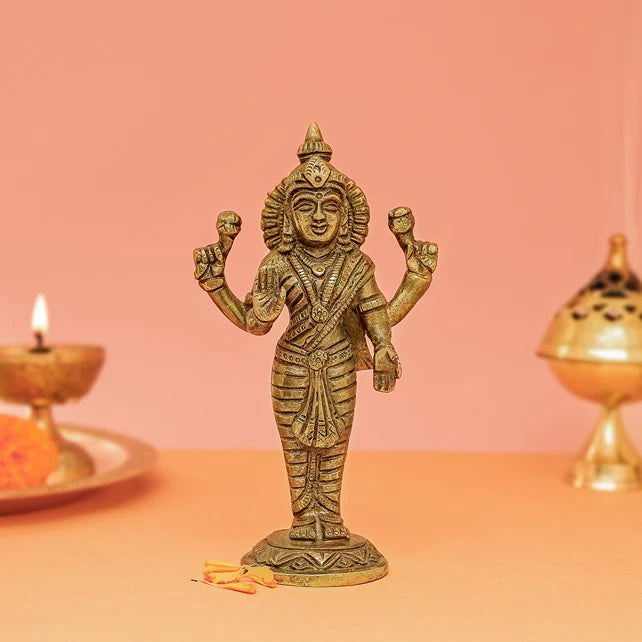
A brass image of Lakshmi is traditionally placed on the puja seat for the Kojagara Lakshmi puja on Sharad Purnima night and kept through the Diwali fortnight that follows; if your mandir does not have one, the Goddess Lakshmi brass idol is the kind most households keep for this night and for Lakshmi Puja on Diwali. Browse the wider Lakshmi idol collection, diyas and lamps and pooja thalis online, or visit Divine Hindu Store, Jayanagar 3rd Block East, Bengaluru 560011.
This guide is for educational and devotional purposes and reflects traditional practice, which varies by region, community and family. Tithi-to-date mapping shifts with sunrise and location, so please confirm the Sharad Purnima 2026 date and the moonrise time with a current panchang for your city before you observe. The properties attributed to the moonlight and the kheer are matters of traditional belief and personal faith, not medical claims; nothing here is medical advice.


